Reference · 331 terms
The AI Search Glossary
Working definitions for the metrics, platforms, surfaces, crawlers, and tactics shaping discovery across ChatGPT, Claude, Gemini, Perplexity, Copilot, Grok, DeepSeek, Meta AI, Google AI Overviews, and AI Mode in 2026.
331 terms
- A/B testingAnalytics & MeasurementAlso: split testing, A/B test, AB testing
- A/B testing is a controlled experiment that shows two or more versions of a page, email or feature to randomly split groups of users and compares how each performs against a chosen goal. It isolates the effect of a single change so improvement can be attributed rather than assumed. It is also called split testing.
- Agentic browserConsumer BehaviourAlso: AI browser
- A browser (or browsing layer) that uses an LLM agent to interpret pages, summarise content, and take actions on behalf of the user. Arc Search, Perplexity Comet, Browser Company's Dia, Dia browser, and similar.
- Agentic commerceConsumer BehaviourAlso: agent-led commerce, AI agent shopping, agentic checkout
- Agentic commerce is buying and selling in which an AI agent completes part or all of the purchase on a person's behalf, from finding products to placing the order. Instead of browsing a site, the shopper states an intent and the agent searches, compares, fills the cart and sometimes pays. It shifts the point of decision away from the merchant's own interface and towards the assistant.
- Agentic marketingMarketing StrategyAlso: agent-led marketing, agentic marketing operations
- Agentic marketing is the use of AI agents that can plan multi-step work and take actions across marketing tools, rather than only generating text on request. It also covers designing marketing for a world where buyers delegate research and purchasing to their own agents. In practice it is a mix of workflow automation, tool permissions and human review.
- Agentic researchSearch TacticAlso: deep research, AI deep research, agentic deep research
- Agentic research is the use of an AI system that plans and carries out a multi-step research task on its own, running many searches, opening and reading sources, then writing a synthesised answer or report with citations. It differs from a single search query because the model decides what to look up next based on what it has already found. Vendors often market this capability as deep research.
- Agents APIAI Model & ProductAlso: OpenAI Agents API
- An Agents API is a programming interface for building applications where a model plans, calls tools and completes multi-step tasks rather than returning a single reply. The term is most often used for OpenAI's agent building interfaces, though other vendors offer equivalents. Teams use it to connect models to search, internal data and actions such as booking, updating records or generating reports.
- Ahrefs Brand RadarTooling
- Ahrefs' AI-visibility module tracking brand mentions and impressions inside AI answers. Surfaces shifts in how brands appear across ChatGPT, Gemini, and other LLM surfaces.
- AI agentsEnterprise AIAlso: agentic AI, autonomous agents
- AI agents are software systems that use a language model to plan and carry out multi-step tasks, rather than simply returning a block of text. They can call tools, query APIs, browse websites and write to other systems in pursuit of a goal, with varying degrees of human oversight. The term covers everything from a scripted assistant that books a meeting to a research agent that gathers sources and drafts a report.
- AI assistantAI Model & ProductAlso: digital assistant, virtual assistant
- An AI assistant is a software product that uses a language model to hold a conversation, answer questions and carry out tasks on a user's behalf. It sits on top of one or more underlying models and adds an interface, memory, tools and safety controls. Examples include ChatGPT, Google Gemini, Microsoft Copilot, Claude and voice assistants such as Siri and Alexa.
- AI chipsEnterprise AIAlso: AI accelerators, AI semiconductors, GPUs for AI
- AI chips are processors designed or optimised to run machine learning workloads, especially the large matrix operations behind training and inference. The category covers GPUs, tensor and neural processing units, and custom ASICs, usually paired with high-bandwidth memory and fast interconnects. They are also called AI accelerators or AI semiconductors.
- AI complianceRegulation & PolicyAlso: AI regulatory compliance
- AI compliance is the work of making sure AI systems meet the laws, regulations, standards and internal policies that apply to them. It spans data protection, transparency, risk classification, documentation, human oversight and record keeping across the life of a system. In practice it combines legal interpretation, engineering controls and ongoing evidence gathering.
- AI content detectionToolingAlso: AI detector, AI content detector, AI text detection
- AI content detection is the use of software to estimate whether a piece of text, image, audio or video was generated by an AI model. Detectors return a probability or classification rather than proof, and accuracy varies with length, language, editing and model used. Because of that uncertainty, results are treated as a signal for review, not a verdict.
- AI cost managementEnterprise AIAlso: AI FinOps, LLM cost management, AI spend management, AI cost optimisation
- AI cost management is the practice of tracking, forecasting and controlling what an organisation spends on AI systems, including model API calls, inference compute, vector storage and the tooling around them. It applies familiar financial discipline to usage that is variable, token based and easy to scale without noticing. The goal is predictable spend at an acceptable level of quality and latency, rather than the lowest possible bill.
- AI cost per taskAnalytics & MeasurementAlso: cost per task, per-task AI cost, AI unit cost
- AI cost per task is the total cost of completing one unit of useful work with an AI system, divided by the number of tasks completed to an acceptable standard. It includes model tokens, tool and retrieval calls, retries, and any human review needed before the output can be used. It is the unit economics measure behind an AI workflow.
- AI drug discoveryEnterprise AIAlso: drug discovery, AI-driven drug discovery, computational drug discovery
- AI drug discovery is the use of machine learning and computational models to support the early stages of finding and refining new medicines. Models are applied to tasks such as predicting protein structures, identifying candidate molecules, prioritising targets and estimating properties like toxicity or binding affinity. The aim is to narrow a very large search space before expensive laboratory and clinical work begins.
- AI governanceRegulation & PolicyAlso: AI oversight, responsible AI governance
- AI governance is the set of policies, roles, controls and review processes an organisation uses to manage how AI systems are built, bought and used. It covers risk assessment, documentation, human oversight, data handling and accountability. It applies both to AI a company develops and to third-party AI tools used by staff.
- AI infrastructureEnterprise AIAlso: AI compute infrastructure, AI data centre infrastructure
- AI infrastructure is the stack of hardware, networking, storage and software needed to train, fine-tune and serve AI models at scale. It spans accelerators such as GPUs, the data centres and power that house them, and the orchestration and serving layers that turn raw compute into working model endpoints. For most marketing teams it is a cost and capacity constraint they consume through APIs rather than something they build.
- AI ModeGoogle Surface
- Google's standalone AI-first search experience inside Search itself, a conversational, multi-step interface for complex queries. Different ranking and citation logic from classical SERP.
- AI OverviewsGoogle SurfaceAlso: AIO, SGE
- Google's generative answer shown at the top of the SERP for eligible queries. Sourced from the open web, cites multiple pages, and increasingly replaces the traditional snippet for informational intent. Successor to the SGE experiment.
- AI privacyRegulation & PolicyAlso: privacy in AI, AI data privacy
- AI privacy is the set of practices, rights and obligations that govern how personal data is collected, used, stored and exposed when building or using AI systems. It covers training data, prompts and outputs, retention by AI vendors, and the transparency and control offered to the people whose data is involved. For marketing teams it shapes what customer data can safely be put into AI tools and what must be disclosed.
- AI procurementEnterprise AIAlso: buying AI tools
- AI procurement is the process of evaluating, buying and contracting artificial intelligence tools and services, from assistants and content platforms to models accessed through an application programming interface. It covers commercial terms alongside security, data protection, accuracy and integration questions that do not arise with ordinary software. Most organisations run it as a structured review with pilots, stakeholder sign off and defined exit conditions.
- AI safetyRegulation & PolicyAlso: model safety
- AI safety is the practice of designing, testing and operating AI systems so they cause less harm, behave predictably and resist misuse. It covers alignment with intended behaviour, evaluation and red teaming, content guardrails, and monitoring once a system is live. For marketers it shapes what models will say, how assistants handle brands, and what compliance teams expect before AI tools go into production.
- AI searchMarketing StrategyAlso: AI-powered search, generative search
- AI search is the use of large language models to answer a query directly, usually with a written summary rather than a list of links. It covers AI overviews inside traditional search engines and assistants such as ChatGPT, Perplexity, Copilot and Gemini. The visible outcome for a brand is being described and cited inside an answer rather than ranked on a results page.
- AI securityEnterprise AIAlso: securing AI systems
- AI security is the practice of protecting AI systems, their data and the applications built on them from misuse, manipulation and leakage. It covers threats such as prompt injection, data exfiltration through model outputs, unsafe tool use by agents and compromised supply chains. It also covers the controls that keep AI features safe once they are live.
- AI skills gapEnterprise AIAlso: AI talent gap, AI skills shortage
- The AI skills gap is the distance between the AI capabilities an organisation needs to deliver its plans and the capabilities its people currently have. It covers both technical skills such as model integration, evaluation and data engineering, and applied skills such as prompt and context design, output review and knowing when not to use AI. The gap is usually what slows AI adoption down, more than tooling or budget.
- AI transcriptionAI Model & ProductAlso: automatic speech recognition, ASR, AI speech-to-text
- AI transcription is the automatic conversion of spoken audio into written text using speech recognition models. Modern systems often add speaker labels, punctuation, timestamps and language detection, and can feed the output into summarisation or search. It is also called automatic speech recognition or ASR.
- AI transparencyRegulation & PolicyAlso: model transparency, AI disclosure
- AI transparency is the practice of making clear how an AI system works, what sits behind it, and when content or an interaction involves AI. It covers regulatory disclosure duties as well as voluntary explanations such as model cards, labels on synthetic media and citations in AI generated answers. For publishers and marketers it sets expectations about when AI involvement should be declared and how clearly.
- AI triageEnterprise AIAlso: AI-assisted triage, clinical AI triage
- AI triage is the use of machine learning or language models to sort, prioritise and route incoming cases so that the most urgent or most suitable ones reach the right person first. It is used in clinical settings for symptom assessment and in service operations for tickets, leads and enquiries. The system classifies and ranks, while a human usually makes the final decision.
- AI visibilityAI Search MetricAlso: AI Search visibility, visibility in AI answers
- AI visibility is how often and how prominently a brand, product or website appears in answers generated by AI assistants and AI search features. It is measured by mentions, citations and the quality of the description, not by keyword rankings. It is the AI search equivalent of share of voice on a results page.
- AI watermarkingToolingAlso: watermarking, generative watermarking, invisible watermark
- AI watermarking is the practice of embedding a signal into AI generated text, images, audio or video so the output can later be identified as machine produced. The signal is usually designed to be imperceptible to people but detectable by software that holds the matching key or detector. It is one of several provenance approaches used alongside metadata standards and content credentials.
- AI-generated contentMarketing StrategyAlso: AI content, generative content, synthetic content
- AI-generated content is text, images, audio, video or code produced wholly or mainly by a generative model rather than written or made by a person. It ranges from fully automated output to drafts that a human edits and approves. Its value in marketing depends on editorial control, accuracy and whether it adds anything a reader cannot get elsewhere.
- AI-generated creativeAdvertising & Paid MediaAlso: AI creative, generative ad creative
- AI-generated creative is ad and marketing creative produced or adapted using generative models, including images, video, voiceover, headlines and body copy. Teams use it to produce more variants, localise faster and test concepts that would be too costly to shoot. It still needs human direction, brand review and legal checks before it runs.
- AI-referred trafficAI Search MetricAlso: AI traffic, LLM traffic
- Sessions referred from ChatGPT, Claude, Gemini, Perplexity, Copilot, and other LLM surfaces. Often under-counted in standard analytics because referrers are stripped or labelled as direct.
- AIOpsEnterprise AIAlso: AI Ops, AI operations, artificial intelligence for IT operations
- AIOps is the use of machine learning and analytics on IT operations data, such as logs, metrics, traces and alerts, to detect problems, group related signals and speed up diagnosis. It aims to cut alert noise, surface likely causes and trigger automated responses instead of relying on manual triage. The term covers both dedicated platforms and AI features built into existing monitoring tools.
- Amazon BedrockLLM PlatformAlso: Bedrock, AWS Bedrock
- Amazon Bedrock is a managed AWS service that gives developers API access to foundation models from several providers, including Anthropic, Meta, Mistral, Cohere, AI21 Labs, Stability AI and Amazon's own models. It handles hosting, scaling and access control, so teams can call models without running their own inference infrastructure. It also bundles supporting features such as retrieval over your own documents, agents, guardrails and model evaluation.
- Amazon Web ServicesAI CompanyAlso: AWS, Amazon AWS
- Amazon Web Services is Amazon's cloud computing division, providing compute, storage, databases, networking and machine learning services on a pay as you go basis. It is one of the main cloud platforms used to host websites, data pipelines and AI applications. For AI work it offers services such as Amazon Bedrock, SageMaker, OpenSearch and various vector and database options.
- AndroidGoogle SurfaceAlso: Google Android, Android OS
- Android is Google's mobile operating system, used on phones, tablets, televisions and other devices from many manufacturers. For marketers it is a discovery surface as well as a platform, because it ships with Chrome, the Google app, Google Play and Google's assistant features. Being visible on Android means being findable through those entry points, not only through a browser.
- Answer attribution rateAI Search Metric
- The proportion of AI answers that explicitly link back to source pages versus those that summarise without attribution. Attribution rate varies materially by platform and query type.
- Answer engineLLM PlatformAlso: answer machine
- An answer engine is a search product that responds to a question with a direct, synthesised answer rather than a ranked list of links. It reads and summarises sources, usually citing some of them, and supports follow-up questions in the same session. ChatGPT search, Perplexity, Google AI Mode and AI Overviews all behave as answer engines.
- Answer Engine OptimisationSearch TacticAlso: AEO
- The practice of structuring content so it can be lifted directly into AI answers. Close cousin of GEO; emphasises clean, parseable facts and unambiguous attribution.
- AnthropicAI Company
- Anthropic is an AI company that builds the Claude family of large language models and positions safety research at the centre of its work. Its products include the Claude apps, a developer API and Claude integrations used inside other tools. For marketers, Anthropic matters because Claude is one of the assistants where buyers now ask questions that used to start in a search engine.
- App discoveryConsumer BehaviourAlso: mobile app discovery, how users find apps
- App discovery is the set of ways people find and decide to install mobile apps, including store search and browse, editorial placements, web search, social feeds, advertising, AI assistants and word of mouth. It covers the whole path from first awareness to tapping install. Growth teams study it to work out which surfaces create demand and which only capture it.
- Ask AdvisorEnterprise AIAlso: Ask Advisor assistant
- Ask Advisor is a common name for an embedded conversational assistant that answers questions in an advisory tone using a defined body of approved content, such as guidance, policies, product documentation or research. Users type a question in natural language and receive a summarised answer, usually with links or citations back to the underlying sources. The label is used by a range of software vendors and professional services firms rather than referring to a single product.
- Asset groupsAdvertising & Paid MediaAlso: Performance Max asset groups
- An asset group is the creative container inside a Google Performance Max or Demand Gen campaign, holding headlines, descriptions, images, logos, videos and audience signals. Google assembles ads from these assets and serves them across Search, Shopping, YouTube, Display, Discover, Gmail and Maps. Retail campaigns can tie an asset group to a specific set of products through listing groups.
- AttributionAnalytics & MeasurementAlso: marketing attribution, attribution modelling
- Attribution is the practice of assigning credit for a conversion to the marketing touchpoints that preceded it. It covers the models, rules and data joins used to decide which channels, campaigns or content get counted. In AI search, attribution is harder because many assistant-led journeys leave little or no referral data.
- Audience intelligenceMarketing StrategyAlso: audience insights, audience analytics
- Audience intelligence is the practice of gathering and analysing data about who your audience is, what they care about, and how they search and buy, then turning that into decisions. It combines first party behavioural data with research, search data, social listening, and customer conversations. The output is usually segments, messaging guidance, and content priorities rather than a single report.
- Auditable AIEnterprise AIAlso: AI auditability, auditable AI systems
- Auditable AI means building AI systems so that their inputs, decisions and outputs can be reconstructed and reviewed after the fact. It covers logging prompts and responses, recording model versions and data sources, and keeping evidence of testing and human review. The goal is that someone outside the team can check what happened and why.
- B2B marketingMarketing StrategyAlso: business-to-business marketing
- B2B marketing is the practice of promoting products and services to other organisations rather than to individual consumers. It typically involves longer sales cycles, multiple decision makers, higher contract values and a heavier reliance on content, sales enablement and relationships. Success is usually measured through pipeline and revenue contribution rather than immediate transactions.
- BingAI Model & ProductAlso: Microsoft Bing, bing.com
- Bing is Microsooft's web search engine, available at bing.com and integrated into Microsoft Copilot and other Microsoft products. It maintains its own crawler, Bingbot, and its own index, and provides Bing Webmaster Tools for site owners. Its index and APIs have also supplied results to third-party search products and AI assistants.
- Bot detectionToolingAlso: bot management, automated traffic detection
- Bot detection is the practice of identifying automated traffic to a website or API and separating it from human visitors. It distinguishes wanted automation, such as search engine and AI crawlers, from unwanted activity like scraping, credential stuffing and click fraud. Detection results feed decisions about what to allow, challenge, rate limit or block.
- Bounce-back rate (AI surface)AI Search Metric
- The rate at which users return to the SERP or refine the prompt after seeing an AI Overview. Google's internal signal that an Overview failed, high bounce-back is associated with Overviews being silently removed for that query cluster.
- Brand demandConsumer Behaviour
- Search volume for branded terms. In an AI-search world, brand demand is the single strongest moat, generic queries are absorbed by AI Overviews and ChatGPT, while branded queries route users directly to brand properties.
- Brand discoveryConsumer Behaviour
- Brand discovery is the process by which someone encounters a brand for the first time, or becomes newly aware it can solve their problem. It happens across search results, AI assistants, social feeds, communities, creators, reviews, marketplaces and word of mouth. Marketers study it to work out which surfaces introduce them to future customers.
- Brand mention rateAI Search Metric
- The frequency at which an LLM mentions a brand by name in answers across a prompt set, with or without citation. Brand mentions without citation are an early indicator of model-internalised brand awareness.
- Brand safetyAdvertising & Paid MediaAlso: brand suitability
- Brand safety is the practice of preventing advertising and brand content from appearing next to material that could damage reputation, such as violent, illegal or misleading content. Brand suitability is the related, narrower idea of matching placements to a specific brand's tolerance and values rather than a universal baseline. Both rely on exclusion lists, content classification and verification reporting.
- Brand voiceMarketing StrategyAlso: tone of voice, brand tone of voice
- Brand voice is the consistent personality and language a brand uses across every channel, covering vocabulary, tone, sentence rhythm and the things it will and will not say. It is documented in guidelines so different writers, agencies and AI tools produce work that sounds like the same organisation. Voice stays stable while tone flexes with context.
- Brave BrowserToolingAlso: Brave
- Brave is a Chromium based web browser from Brave Software that blocks third party trackers and most ads by default. It bundles privacy controls, Brave Search as the default engine, and an AI assistant called Leo. Because it strips tracking scripts, visits from Brave users are often harder to attribute in analytics.
- Brave SearchToolingAlso: search.brave.com, Brave Search API
- Brave Search is a search engine from Brave Software that serves results from its own web index rather than reselling another engine's results. It is the default engine in the Brave browser, offers AI generated answer summaries, and is sold to developers as the Brave Search API. That API makes it a grounding source for other search and AI products.
- BroadcomAI CompanyAlso: Broadcom Inc, AVGO
- Broadcom is a US semiconductor and infrastructure software company, listed as AVGO, that supplies networking, storage, wireless and custom silicon alongside a large enterprise software portfolio. In AI it is known for data centre networking components and for co-designing custom accelerators with large cloud operators. Its software side expanded significantly with the acquisition of VMware.
- CerebrasAI CompanyAlso: Cerebras Systems
- Cerebras Systems is a US computing company that builds very large wafer-scale processors and systems for training and running AI models. It sells hardware and also offers a hosted inference service that runs open models at high token generation speeds. It matters to search and marketing teams mainly as one of the infrastructure options behind fast AI assistants and agents.
- ChatGPTLLM PlatformAlso: GPT-4o, GPT-5, GPT-5.5, OpenAI ChatGPT
- OpenAI's consumer assistant, the largest LLM surface by user count. Citation patterns shift materially with major model releases (e.g. GPT-5.5 in May 2026), and persistent memory now carries brand affinity across sessions.
- ChatGPT AdsAdvertising & Paid MediaAlso: ads in ChatGPT, OpenAI advertising, ChatGPT advertising
- ChatGPT Ads refers to advertising placements inside OpenAI's ChatGPT. OpenAI has publicly signalled that advertising is part of its commercial plans and has been testing and building out ad capabilities, so the format details continue to change. For marketers it represents a possible new paid surface alongside organic visibility in AI assistants.
- ChatGPT Sponsored AgentsAdvertising & Paid MediaAlso: Sponsored Agents, OpenAI Sponsored Agents, sponsored agents in ChatGPT
- ChatGPT Sponsored Agents is the name given to a paid placement format in which a brand's agent or assistant can be surfaced inside a ChatGPT conversation to help complete a task, such as booking, quoting or buying. It sits alongside other advertising formats OpenAI has discussed for ChatGPT, where commercial results are marked as sponsored rather than blended invisibly into answers. Availability, naming and mechanics are still moving, so treat any specification as provisional and check current OpenAI documentation before planning spend.
- ChatGPT VoiceAI Model & ProductAlso: ChatGPT voice mode, Advanced Voice Mode
- ChatGPT Voice is the spoken conversation mode in OpenAI's ChatGPT apps, which lets you talk to the assistant and hear its replies read aloud. Advanced Voice Mode processes speech directly, so exchanges feel closer to a phone call and you can interrupt mid-answer. People use it hands free on mobile, and it is also available on desktop.
- ChatGPT WorkEnterprise AIAlso: ChatGPT for Work, ChatGPT Business
- ChatGPT Work is the umbrella term for OpenAI's workplace plans, sold to organisations rather than individuals, and covering ChatGPT Business (previously Team) and ChatGPT Enterprise. These plans add a shared workspace, admin controls and administrative tools on top of the consumer product. OpenAI states that business workspace content is not used to train its models by default.
- Circle to SearchGoogle SurfaceAlso: Android Circle to Search
- Circle to Search is an Android feature that lets people search whatever is on their screen by circling, highlighting or tapping it, without leaving the app they are in. It sends the selected content, image or text, to Google as a query and shows results in an overlay. It was introduced on selected Android devices in 2024.
- Citation depthAI Search MetricAlso: citation position
- How early in an AI-generated answer a source is cited. Earlier citations correlate with higher click-through from AI surfaces and stronger user trust signals.
- Citation diversity indexAI Search Metric
- The number of distinct domains an LLM cites across a prompt set, normalised by prompt count. Falling diversity in a category signals consolidation, and a closing window for new entrants.
- Citation shareAI Search MetricAlso: SOV in AI, answer share, share of citations
- The proportion of times a domain or page is cited inside AI-generated answers (ChatGPT, Claude, Gemini, Perplexity, AI Overviews) across a tracked prompt set. The AI-era equivalent of share-of-voice and the metric most predictive of branded discovery in 2026.
- Citation-worthy contentSearch Tactic
- Content with the qualities LLMs select for when synthesising an answer: a single, defensible claim per paragraph; named entities; first-hand evidence; and a clear authority signal.
- ClaudeLLM PlatformAlso: Anthropic Claude, Claude Opus, Claude Sonnet
- Anthropic's assistant. Strong on long-context analysis, tool use, and structured citation. Increasingly cited inside enterprise workflows where source attribution and reasoning quality matter.
- Claude CodeAI Model & ProductAlso: Anthropic Claude Code
- Claude Code is Anthropic's agentic coding tool that works directly with a codebase, reading files, proposing and making edits, and running commands with permission. It runs in the terminal and in supported development environments, driven by natural language instructions rather than manual file by file editing. Marketing and growth teams use it for technical SEO, structured data and data tasks that would otherwise wait for engineering.
- Claude CoworkAI Model & ProductAlso: Cowork, Anthropic Claude Cowork
- Claude Cowork is an agentic working environment from Anthropic aimed at non-developers, extending the delegated, multi-step approach of Claude Code to general knowledge work. It is designed so a user can hand over a task involving files, folders and connected tools and let the agent work through it. It was introduced as a limited preview product rather than a general release.
- Claude Fable 5.1AI Model & ProductAlso: Anthropic Claude Fable 5.1, Fable 5.1
- Claude Fable 5.1 is a model name with no public record in Anthropic's documented Claude line-up, which uses the Haiku, Sonnet and Opus family names. Treat it as unverified until it appears in Anthropic's own model documentation or release notes. The term is most often encountered as a hallucinated or mistaken model reference rather than a product you can call.
- Claude for GovernmentAI Model & ProductAlso: Anthropic Claude for Government, Claude Gov, Claude for Gov
- Claude for Government refers to Anthropic's packaging of its Claude models and tools for public sector use, delivered through government cloud environments and accredited partners. It covers the same underlying model family as commercial Claude, wrapped in the contracting, deployment and security arrangements agencies require. Anthropic has also described a Claude Gov model set built for national security customers operating in classified environments.
- Claude Frontier AcademyAI Model & ProductAlso: Anthropic Claude Frontier Academy, Frontier Academy
- Claude Frontier Academy is the name given to an Anthropic-branded training and enablement programme built around Claude, aimed at helping people and teams learn to build with and work alongside frontier AI models. Programmes of this type typically cover prompt and context design, agent and tool use, safety practice and applied build projects rather than general AI theory. Because Anthropic's education and enablement offerings are renamed and restructured over time, always check Anthropic's own pages for the current scope, eligibility and format before planning around it.
- Claude Mythos 5.1AI Model & ProductAlso: Anthropic Claude Mythos 5.1, Mythos 5.1
- Claude Mythos 5.1 is a model name that does not appear in Anthropic's published Claude range, which is organised around the Haiku, Sonnet and Opus families. There is no verifiable information about its capabilities, availability or pricing. In practice the term usually surfaces as an invented or misremembered model reference that needs checking against primary sources.
- Claude ScienceAI Model & ProductAlso: Anthropic Claude Science
- Claude Science is the shorthand people use for Anthropic's science-focused work with its Claude models, including research-oriented features, connectors to scientific tools and literature, and programmes that give researchers access to the API. It covers using Claude for tasks such as literature synthesis, protocol drafting, data analysis and code for research pipelines. For marketers, it matters mainly as a surface where technical and scientific content gets read, summarised and cited.
- ClaudeBotAI Crawler
- Anthropic's web crawler. Powers Claude's retrieval and training. Honour robots.txt; access controls are increasingly material to citation share.
- Click-through rateAnalytics & MeasurementAlso: CTR, clickthrough rate
- Click-through rate is the proportion of people who saw something and then clicked it, expressed as clicks divided by impressions. It is used to judge search listings, ads, emails and internal links. A higher rate usually means the message matched what the audience was looking for.
- Clicks per searchAI Search MetricAlso: CPS
- Clicks per search is the average number of outbound clicks a search generates, calculated as total clicks divided by total searches. Unlike click-through rate, which is measured against impressions for a single result, it describes how much onward traffic a whole search produces. It is used to discuss whether answer-led interfaces send more or fewer visits per query than a traditional results page.
- Cloud infrastructureEnterprise AIAlso: cloud computing infrastructure
- Cloud infrastructure is the compute, storage, networking and supporting services that a provider runs and rents out on demand, rather than an organisation buying and housing its own servers. It covers virtual machines, containers, object storage, databases, content delivery and the identity and monitoring layers around them. Teams use it to scale capacity up and down without long procurement cycles or fixed hardware costs.
- CodexAI Model & ProductAlso: OpenAI Codex
- Codex is an OpenAI product line for turning natural language instructions into working code. The original Codex model was trained on code and natural language and powered early code completion tools, and OpenAI later reused the name for its software engineering agent that can read a repository, write changes and run tasks. Teams use it to automate coding and maintenance work described in plain language.
- Coding agentToolingAlso: AI coding agent, software engineering agent, agentic coding
- A coding agent is an AI system that can carry out multi-step software tasks with limited supervision, reading a codebase, editing files, running commands and tests, and proposing changes for review. It differs from simple code completion because it plans, acts and checks its own work across several steps. Marketing and SEO teams increasingly use coding agents to ship technical fixes that would otherwise wait in an engineering backlog.
- Competition and Markets AuthorityRegulation & PolicyAlso: CMA, UK Competition and Markets Authority
- The Competition and Markets Authority (CMA) is the United Kingdom's competition and consumer protection regulator. It investigates mergers, anti-competitive conduct and market practices, and it holds specific powers over large digital firms under the Digital Markets, Competition and Consumers Act 2024. Its decisions shape how search engines, app stores and AI assistants operate in the UK market.
- Consent ModeAnalytics & MeasurementAlso: Google Consent Mode, Consent Mode v2
- Consent Mode is a Google framework that lets tags adjust their behaviour based on the consent choices a visitor has made. Instead of tags being blocked outright, they receive signals about whether analytics and advertising storage are allowed, and act accordingly. Version 2 added parameters covering the use of personal data for ads and for ad personalisation.
- Consumer behaviour signalConsumer Behaviour
- Observable patterns in how users phrase queries, refine searches, and choose answers, used by both ranking systems and generative models to infer intent and quality.
- Content auditSearch TacticAlso: content inventory audit
- A content audit is a structured review of every page or asset in a content set, scored against performance, quality, accuracy and search intent. The output is a decision for each item: keep, improve, consolidate, redirect or remove. It turns a large and uneven content library into a prioritised action plan.
- Content automationMarketing StrategyAlso: AI content pipelines, AI content automation, automated content production
- Content automation is the use of software, templates, data feeds and AI models to produce, update or distribute content with less manual effort at each step. It ranges from automatically refreshing prices and stock levels on a page to generating full drafts for human editing. The aim is consistency and scale, not the removal of editorial judgement.
- Content governanceMarketing StrategyAlso: content governance framework, editorial governance
- Content governance is the set of rules, roles and routines that decide who can create, approve, publish, update and retire content, and to what standard. It covers ownership, review cycles, style and accuracy requirements, and the systems used to enforce them. Teams use it to keep a growing content estate accurate, consistent and accountable as more people and tools contribute.
- Content licensingRegulation & PolicyAlso: AI content licensing, publisher licensing deals
- Content licensing is the practice of granting an AI company or platform permission to use your published material, usually for model training, retrieval or display inside an assistant, in return for payment or other terms. Deals set out what content is covered, how it can be used, how it is attributed and for how long. It is the commercial alternative to relying only on crawler blocking or copyright enforcement.
- Content operationsMarketing StrategyAlso: ContentOps, content ops
- Content operations is the system of people, processes, tools and governance that turns content strategy into published, maintained assets. It covers briefing, production, review, publishing, updating and retiring content at a predictable pace and quality. Often shortened to ContentOps or content ops.
- Content provenanceStructured DataAlso: C2PA, content credentials, provenance metadata
- Content provenance is verifiable information about where a piece of content came from, who created it and how it has been changed, carried with the file or published alongside it. The main open standard is C2PA, shown to people as Content Credentials, which uses cryptographic signing to record capture, edits and any AI involvement. It helps platforms, search systems and readers judge whether an image, video or audio clip is what it claims to be.
- Content strategyMarketing Strategy
- Content strategy is the plan that governs what content an organisation creates, for whom, why, and how it is maintained over time. It covers audience and topic decisions, formats and channels, editorial standards, ownership and the review cycle that keeps published work accurate. It sits above individual campaigns and briefs, and is what stops content production turning into an unmanaged backlog.
- Context windowAI Model & ProductAlso: context length, token window, context limit
- A context window is the maximum amount of text, measured in tokens, that a large language model can take into account in a single request. It covers everything the model sees at once: system instructions, the conversation so far, any retrieved or pasted documents, and the response being generated. Once the limit is reached, older or less relevant content has to be dropped, summarised or split across requests.
- Conversational advertisingAdvertising & Paid MediaAlso: chat advertising, ads in chat assistants, conversational ads
- Conversational advertising is paid placement inside a dialogue, whether that is an AI assistant, a chatbot, a messaging app or a voice interface. Instead of a static creative next to content, the ad appears as a response, suggestion or handover at the point where the user has expressed intent. The defining features are turn-by-turn context, a disclosure label, and the option for the user to keep talking rather than click away.
- Conversational AIEnterprise AIAlso: conversational artificial intelligence, chat AI
- Conversational AI is software that understands and generates natural language so people can interact with a system by talking or typing rather than clicking through menus. It covers assistants, chatbots, voice agents and support copilots, and is now commonly built on large language models. The defining feature is a back and forth exchange that keeps track of context across turns.
- Conversational commerceMarketing StrategyAlso: chat commerce, conversational shopping
- Conversational commerce is selling and supporting customers through messaging and chat interfaces rather than a traditional browse and checkout journey. It spans live chat, WhatsApp and other messaging apps, SMS, social DMs and AI shopping assistants. The transaction, or the step that leads to it, happens inside the conversation.
- Conversational searchConsumer BehaviourAlso: conversational query, multi-turn search, chat-based search
- Conversational search is the pattern of finding information through a back and forth dialogue rather than a single keyword query, with each follow-up interpreted in the context of what came before. Users ask broad questions, then narrow with refinements such as cheaper, nearby or without the subscription. It shifts discovery from ranked link lists towards answers that must survive several rounds of questioning.
- Conversion rate optimisationMarketing StrategyAlso: CRO, conversion optimisation
- Conversion rate optimisation is the practice of improving the share of visitors who complete a valuable action, such as a purchase, enquiry or signup. It combines research into user behaviour with structured changes to pages, forms and journeys, usually validated by testing. The aim is more outcomes from the same traffic rather than more traffic.
- Conversion trackingAnalytics & Measurement
- Conversion tracking is the practice of recording the actions you care about, such as purchases, form submissions or calls, and connecting them back to the channel, campaign or session that led to them. It gives advertising platforms and analytics tools the outcome data they need to report performance and optimise bidding. Accuracy depends on correct tag implementation, consent handling and clear conversion definitions.
- Conversion windowAdvertising & Paid MediaAlso: attribution window, lookback window
- A conversion window is the period of time after someone clicks, views or otherwise interacts with an ad during which a resulting conversion will be credited to that ad. If the conversion happens after the window closes, the platform does not attribute it to the interaction. Windows are set per conversion action or per campaign, and different platforms use different defaults, so the same sale can be counted by one channel and ignored by another.
- CopilotLLM PlatformAlso: Microsoft Copilot, Bing Chat
- Microsoft's assistant, integrated across Bing, Windows, Office, and Edge. Pulls from the open web with Bing's index; visibility in Copilot is correlated with Bing ranking signals more tightly than other LLMs.
- Core updateAlgorithm
- A broad Google algorithm update affecting search rankings sitewide rather than a single feature. Recent core updates (e.g. May 2026) have increasingly favoured intent-aligned content over keyword-optimised content.
- Crawler policySearch TacticAlso: AI crawler policy, robots.txt policy, bot access policy
- A crawler policy is the set of rules a site publishes and enforces to decide which automated agents may access its content, how often, and for what purpose. It typically combines robots.txt directives, server side rules and terms of use, and increasingly distinguishes search crawlers from AI training and assistant crawlers. The policy defines both what is allowed and what happens when a bot ignores it.
- Cross-channel reportingAnalytics & MeasurementAlso: multi-channel reporting
- Cross-channel reporting is the practice of bringing performance data from search, social, email, paid media, AI assistants and other channels into a single view. It standardises metrics and time periods so channels can be compared fairly rather than judged in isolated platform dashboards. The aim is to show how channels work together to produce enquiries, sales and revenue.
- CursorToolingAlso: Cursor AI, Cursor editor
- Cursor is a code editor built around AI assistance, developed by Anysphere. It is based on the Visual Studio Code codebase and adds inline completion, chat about your repository and an agent mode that can plan and apply multi-file changes. Developers and technical marketers use it to read, write and refactor code with a model that has context on the whole project.
- Custom siliconEnterprise AIAlso: custom chips, in-house silicon, ASICs
- Custom silicon is computer hardware designed by a company for its own specific workloads rather than bought as a general purpose part. In AI, it usually means accelerator chips built to train or run models efficiently, often as application specific integrated circuits (ASICs). Large cloud and model providers use it to cut cost per unit of compute and reduce dependence on third party suppliers.
- Customer data platformToolingAlso: CDP
- A customer data platform (CDP) is software that collects customer data from websites, apps, and back office systems, joins it into a persistent profile for each person, and makes those profiles available to other tools. Unlike a warehouse alone, a CDP is built for marketing and product teams to define audiences and activate them. It sits between data collection and the channels where campaigns and experiences run.
- Customer lifetime valueAnalytics & MeasurementAlso: CLV, LTV, lifetime value
- Customer lifetime value (CLV or LTV) is the total profit or revenue a business expects to earn from a customer relationship over its lifetime. It combines purchase value, purchase frequency, margin, and retention into a single forward looking figure. Teams use it to decide how much they can afford to spend acquiring and keeping customers.
- Customer relationship managementToolingAlso: CRM, CRM system, customer relationship management platform
- Customer relationship management, usually shortened to CRM, is the practice and the software used to record and manage an organisation's interactions with prospects and customers. A CRM system stores contacts, accounts, deals, activities and communication history in one place so sales, marketing and service teams work from the same record. It is the system most businesses use to connect marketing activity to revenue.
- Data governanceEnterprise AIAlso: data stewardship
- Data governance is the set of policies, roles and controls that decide how an organisation collects, stores, describes and uses its data. It covers ownership, quality standards, access rights, retention and compliance with privacy law. In AI work, it also governs which data may be used for training, retrieval or prompting.
- Data Protection OfficerRegulation & PolicyAlso: DPO, data protection officer role
- A Data Protection Officer is a designated role responsible for advising an organisation on data protection law, monitoring its compliance and acting as a contact point for regulators and individuals. Under UK and EU GDPR, appointing one is mandatory for public authorities and for organisations carrying out large scale monitoring or processing of special category data. Other organisations may appoint one voluntarily.
- Data retentionRegulation & PolicyAlso: data retention policy, retention period
- Data retention is the policy and practice of deciding how long records and personal data are kept before they are deleted or anonymised. Under UK GDPR, personal data must not be held for longer than necessary for the purpose it was collected for, and organisations are expected to document their retention periods. In marketing it governs how long CRM records, analytics data, form submissions and AI tool logs can be retained.
- DaybreakAI Model & ProductAlso: Daybreak model
- Daybreak is a model name that has circulated as a codename ahead of, or alongside, a public model release. Codenames like this typically appear in evaluation arenas, testing channels or reporting before a vendor confirms the official product name. Treat any specific capability, pricing or availability claim as unverified until the provider documents it.
- DeepfakeRegulation & PolicyAlso: synthetic media, AI face swap
- A deepfake is synthetic audio, image or video created with AI to make a real person appear to say or do something they did not. It is the most deceptive end of synthetic media, distinguished by its intent to pass as authentic footage. For brands it creates risks around impersonation, fraudulent endorsements and reputational attack.
- DeepSeekAI CompanyAlso: DeepSeek AI, DeepSeek-R1, DeepSeek-V3
- DeepSeek is a Chinese AI research company that develops large language models, including the DeepSeek-V3 general purpose family and the DeepSeek-R1 reasoning models. It is known for releasing open weight models that others can download, host and fine tune, alongside its own chat assistant and API. It became widely discussed for delivering competitive reasoning performance at low stated training and usage costs.
- Demand forecastingAnalytics & MeasurementAlso: demand forecast, search demand forecasting
- Demand forecasting is the practice of estimating future interest in a product, service or topic, often using search volumes, historic sales and seasonality. In marketing it usually means projecting how many searches, sessions or leads a channel should produce in a coming period. The output guides budget, content planning, stock and headcount decisions.
- Demand Gen campaignsAdvertising & Paid MediaAlso: Demand Gen, Google Demand Gen, Demand Generation campaigns
- Demand Gen is a Google Ads campaign type built for visually led prospecting across YouTube, Discover, Gmail and other Google feeds. Advertisers supply image, video and text assets plus audience signals, and Google's systems assemble and place ads to create interest before someone actively searches. It replaced Discovery campaigns and sits between upper funnel video and lower funnel search or shopping activity.
- Digital discoverySearch Tactic
- The full set of channels through which people find brands, products, and answers, search engines, AI assistants, social platforms, marketplaces, and agentic browsers. Replaces the narrower frame of just “SEO”.
- Digital Markets ActRegulation & PolicyAlso: DMA, EU Digital Markets Act
- The Digital Markets Act (DMA) is an EU regulation that sets conduct rules for very large online platforms designated as gatekeepers, such as major search engines, app stores, marketplaces, browsers and social networks. It bans practices like self preferencing in ranking and restricts how gatekeepers combine personal data across their services without consent. For marketers it changes how results, choice screens and tracking work for EU users.
- Digital Services ActRegulation & PolicyAlso: DSA, EU Digital Services Act
- The Digital Services Act is an EU regulation setting obligations for online intermediaries, from hosting providers and marketplaces to social platforms and search engines. It covers notice and action on illegal content, complaint handling, advertising transparency and periodic reporting, with additional duties for the largest services. It has applied in full across the EU since February 2024.
- Digital sovereigntyRegulation & PolicyAlso: technological sovereignty, data sovereignty
- Digital sovereignty is the principle that a country, region or organisation should retain control over the data, software and infrastructure it depends on. It covers where data is stored, which laws apply to it, and who can compel access to it. In practice it shapes procurement rules, cloud choices and AI vendor selection.
- Digital transformationEnterprise AIAlso: digital transformation programme
- Digital transformation is the coordinated change of an organisation's processes, data, technology and skills so that digital channels become the default way it operates and serves customers. It goes beyond buying software to include how work is organised and how decisions are made. Programmes typically run across several years and multiple functions.
- DiscoverGoogle SurfaceAlso: Google Discover
- Google's personalised feed in the Google app and on Android. Algorithmically curated, no query needed, driven by topical interest signals and freshness. Material traffic source for publishers.
- Ecommerce SEOSearch TacticAlso: e-commerce SEO, online store SEO
- Ecommerce SEO is the practice of making an online store's category, product, brand and editorial pages discoverable in organic search. It combines technical work on crawling, indexing and site structure with commercial decisions about which queries each page should serve. The goal is qualified non-paid traffic that converts into orders.
- EEATAlgorithmAlso: E-E-A-T, Experience Expertise Authoritativeness Trustworthiness
- Google's quality framework: Experience, Expertise, Authoritativeness, Trustworthiness. EEAT signals are increasingly weighted in both classical ranking and AI Overview source selection.
- Enterprise AIEnterprise AIAlso: enterprise artificial intelligence
- Enterprise AI is the application of artificial intelligence inside large organisations, with the governance, security, integration and support requirements that this implies. It covers assistants, search over internal knowledge, forecasting, automation and content operations. The distinguishing features are scale, data control and accountability rather than the underlying models.
- Enterprise resource planningEnterprise AIAlso: ERP, ERP system
- Enterprise resource planning, or ERP, is software that runs core business processes such as finance, procurement, inventory, manufacturing, supply chain and often HR on a shared data model. Instead of separate systems for each function, an ERP keeps one record of customers, products, orders and transactions. It is usually the system of record that other tools, including marketing and commerce platforms, read from.
- Entity salienceAlgorithmAlso: salience score, entity prominence
- Entity salience is a measure of how central an entity is to a piece of content, as opposed to merely being mentioned in it. Natural language processing systems assign a salience score based on signals such as position, frequency, grammatical role and surrounding context. It helps a system decide what a document is actually about.
- EU AI ActRegulation & PolicyAlso: AI Act, European AI Act
- The EU AI Act is European Union legislation that regulates artificial intelligence systems according to the risk they pose. It bans a small set of practices outright, places strict obligations on high risk uses, sets transparency duties for some systems and adds specific rules for general purpose AI models. Obligations apply in phases rather than all at once.
- European CommissionRegulation & PolicyAlso: EC, EU Commission
- The European Commission is the executive body of the European Union. It proposes EU legislation, enforces competition law and supervises large online platforms under digital rules such as the Digital Services Act and the Digital Markets Act. Its investigations and decisions regularly change how search engines, marketplaces and AI services behave in European markets.
- European Economic AreaRegulation & PolicyAlso: EEA
- The European Economic Area is the group of countries covering the EU member states plus Iceland, Liechtenstein and Norway, which together take part in the EU single market. It is the territory most commonly referenced in privacy, advertising and data transfer rules. Marketers encounter it as a geographic scope setting in consent, ads and analytics tools.
- Facebook MarketplaceToolingAlso: Meta Marketplace
- Facebook Marketplace is Meta's classifieds section inside Facebook, where people and businesses list items for sale to buyers nearby or further afield. Listings are browsed by category, location and search, and buyers usually contact sellers through Messenger. It is used heavily for second-hand goods, vehicles, property rentals and local services.
- Facebook SearchConsumer BehaviourAlso: Facebook search engine, search on Facebook
- Facebook Search is the search function inside Facebook that lets people find posts, people, Pages, Groups, events, videos and Marketplace listings. It is a platform search experience rather than a general web search engine, so results are shaped by what is published on Facebook and by the searcher's connections and activity. For businesses it affects whether a Page, Group or listing is found by people already inside the app.
- FedRAMPRegulation & PolicyAlso: Federal Risk and Authorization Management Program, FedRAMP authorisation, FedRAMP High
- FedRAMP, the Federal Risk and Authorization Management Program, is the US government programme that standardises how cloud services are security assessed, authorised and monitored for use by federal agencies. It is built on NIST security controls and issues authorisations at Low, Moderate and High impact levels. Authorised services are listed on the public FedRAMP Marketplace, which agencies use when choosing cloud tools.
- Feed freshnessStructured DataAlso: product feed freshness, feed recency
- Feed freshness is how recently a product or data feed has been updated, and how closely the values in it match what is live on your site. A fresh feed reflects current prices, stock levels and product details within minutes or hours rather than days. Stale feeds cause disapprovals, mismatched listings and lost sales.
- First-party dataAnalytics & MeasurementAlso: 1P data
- First-party data is information a business collects directly from its own audiences and customers, such as site behaviour, purchases, CRM records, email engagement and account activity. It is gathered on owned channels with consent rather than bought from or shared by third parties. It underpins personalisation, measurement and audience building as third-party cookies and cross site signals decline.
- Frontier modelAI Model & ProductAlso: frontier AI, frontier AI model
- A frontier model is one of the most capable general-purpose AI models available at a given time, trained at very large scale and able to handle open-ended reasoning, long documents and multiple formats such as text, images and code. The label marks the leading edge of capability rather than a fixed technical threshold, so which models count changes as new versions ship. Frontier models power most mainstream AI assistants and AI search experiences.
- GDPRRegulation & PolicyAlso: General Data Protection Regulation
- GDPR, the General Data Protection Regulation, is the European Union law that governs how organisations collect, store and use personal data about people in the EU. It came into force on 25 May 2018 and sets out lawful bases for processing, rights for individuals and obligations for controllers and processors. A parallel version, UK GDPR, applies in the United Kingdom alongside the Data Protection Act 2018.
- GeminiLLM PlatformAlso: Google Gemini, Gemini Advanced, Bard
- Google's flagship assistant, integrated across Workspace, Android, and Search (AI Overviews and AI Mode use Gemini-family models). Brands optimising for Gemini reach are simultaneously optimising for AI Overviews.
- Gemini EnterpriseEnterprise AIAlso: Google Gemini Enterprise
- Gemini Enterprise is Google's platform for bringing Gemini models, AI agents and company data together in a single workplace interface. It lets staff search internal systems, ask questions in natural language and run agents that carry out multi-step tasks, with admin controls over access and governance. It is aimed at organisations that want assistants grounded in their own documents, tickets and records rather than general web knowledge.
- Generative AI features reportAnalytics & MeasurementAlso: AI Mode performance report, Search Console generative AI features report, AI features report
- A generative AI features report is any reporting view that shows how a site performs inside AI-generated search experiences such as AI Overviews and AI Mode, rather than only in the classic blue link results. In Google Search Console, this data is currently folded into the standard Performance report totals for the Web search type rather than presented as a fully separate, filterable channel. The term is used loosely by practitioners to describe both the official platform data and the custom dashboards they build to approximate it.
- Generative Engine OptimisationSearch TacticAlso: GEO
- The discipline of optimising content to be cited inside generative answers across ChatGPT, Claude, Gemini, Perplexity, and AI Overviews. Overlapping but distinct from classical SEO, favours specificity, citation-worthy claims, and structured attribution.
- Geo incrementalityAnalytics & MeasurementAlso: geo incrementality testing, geo lift, geo experiments
- Geo incrementality is the practice of measuring the causal effect of media by changing activity in some geographic areas and comparing outcomes with matched areas where nothing changed. Because regions rather than people are randomised, it works with aggregate data and needs no user-level tracking. The output is an incremental lift, often expressed as incremental revenue, conversions or cost per incremental acquisition.
- Go-to-market strategyMarketing StrategyAlso: GTM, go-to-market, GTM strategy
- A go-to-market strategy is the plan for how a company brings a product or service to a defined set of buyers, covering who it is for, what is being offered, how it is priced and packaged, and which channels will carry the message. It connects positioning and messaging to the sales, marketing and partner motions that create demand and close revenue. Most teams write one for a new product, a new segment or a new market, then revise it as evidence comes in.
- GoogleAI CompanyAlso: Alphabet, Google LLC
- Google is the search engine and technology company owned by Alphabet, and the operator of Search, YouTube, Chrome, Android, Google Ads and Google Cloud. It develops the Gemini family of AI models and surfaces generated answers in products such as AI Overviews. For most businesses it remains the largest single source of organic and paid search demand.
- Google AdsAdvertising & Paid MediaAlso: AdWords, Google AdWords
- Google Ads is Google's advertising platform, where businesses bid in an auction to show ads on Google Search, YouTube, Gmail, Google Maps and partner sites. Advertisers usually pay per click or per conversion, and ad placement depends on bid, expected click-through rate, ad relevance and landing page experience rather than bid alone. It was called Google AdWords until it was renamed in 2018.
- Google AI EdgeAI Model & ProductAlso: AI Edge, Google on-device AI
- Google AI Edge is Google's collection of tools and runtimes for running AI models directly on devices such as phones, browsers and embedded hardware rather than in the cloud. It includes components like LiteRT for on-device inference, MediaPipe tasks for common vision, audio and text jobs, conversion tooling for models built in other frameworks, and APIs for on-device generative models. Developers use it to build features that work offline, respond quickly and keep data local.
- Google AI Edge EloquentAI Model & ProductAlso: AI Edge Eloquent, Eloquent
- Google AI Edge Eloquent is a name associated with Google's AI Edge on-device AI work, referring to model and tooling efforts for running language capabilities locally on phones and other devices. Public documentation under this specific name is limited, so it is best treated as an evolving label within the wider Google AI Edge stack. Anyone building on it should confirm current scope and availability in Google's official AI Edge documentation.
- Google Analytics 4Analytics & MeasurementAlso: GA4, Google Analytics
- Google Analytics 4 is Google's event-based web and app analytics platform, which replaced Universal Analytics. It records user interactions as events rather than pageviews and sessions alone, and reports across web and app properties in one place. Marketers use it to measure traffic sources, engagement and conversions.
- Google Analytics Data APIAnalytics & MeasurementAlso: Data API, GA4 Data API, Analytics Data API, runReport
- The Google Analytics Data API is the programmatic interface for pulling report data out of Google Analytics 4 properties. It lets you request dimensions, metrics, date ranges and filters through methods such as runReport and runRealtimeReport, returning structured data for dashboards and analysis. It replaces the older Reporting API used with Universal Analytics.
- Google Business ProfileGoogle SurfaceAlso: GBP, Google My Business, GMB
- Google Business Profile is the free Google tool that lets a business manage how it appears in Google Search, Google Maps and local results. It holds core details such as name, address, phone number, opening hours, categories, photos, products, services and reviews. Formerly called Google My Business, it is the main control panel for a business's local presence on Google.
- Google DeepMindAI CompanyAlso: DeepMind
- Google DeepMind is Google's artificial intelligence research and development unit, formed by combining DeepMind with the Google Brain team in 2023. DeepMind was founded in London in 2010 and acquired by Google in 2014. The unit develops Google's Gemini models alongside longer-running research projects such as AlphaFold.
- Google LensGoogle SurfaceAlso: Lens, Google Lens search
- Google Lens is Google's visual search tool, which lets people search using their phone camera, a photo from their gallery or an image on screen. It identifies objects, text, places and products, and returns matching or related results. It is built into the Google app, Google Photos, Chrome and parts of Android.
- Google Merchant CenterGoogle SurfaceAlso: Merchant Center, Merchant Center Next
- Google Merchant Center is the platform where retailers upload and manage product data for use across Google's shopping surfaces. It holds product feeds, business details, shipping and tax settings, and reports on how products are approved and performing. Merchant Center Next is Google's rebuilt version of the interface, designed to be simpler and more automated.
- Google MeridianAnalytics & MeasurementAlso: Meridian, Meridian MMM
- Google Meridian is an open-source marketing mix modelling framework that estimates how much each media channel contributes to sales or another business outcome using Bayesian methods. It works on aggregated data, models results at geographic level and can be calibrated with the findings of incrementality experiments. Teams use it to produce channel ROI estimates, response curves and budget scenarios without relying on user-level tracking.
- Google PlayGoogle SurfaceAlso: Google Play Store, Play Store, Android app store
- Google Play is Google's official app store for Android devices, used to distribute, update and monetise apps and games. It is also a discovery surface in its own right, with search, browse and editorial placements that decide which apps users see. Developers manage listings, releases and reporting through Google Play Console.
- Google SearchGoogle SurfaceAlso: Google web search, google.com search
- Google Search is Google's web search engine, reached mainly through google.com and the Chrome and Android search bars. It crawls and indexes web pages, then ranks results for a query using automated ranking systems. It now blends traditional blue links with features such as AI Overviews, AI Mode, featured snippets, knowledge panels and local packs.
- Google Search algorithmAlgorithmAlso: Google algorithm, Google ranking algorithm
- The Google Search algorithm is the collection of ranking and retrieval systems Google uses to find, order and present results for a query. It is not a single formula but many interacting systems that assess content, links, query intent, context and user signals. Google updates these systems continuously, with larger changes announced as core updates.
- Google Search CentralGoogle SurfaceAlso: Search Central, Google Webmaster Central, Search Central documentation
- Google Search Central is Google's official documentation and communication hub for site owners, SEOs and developers, published at developers.google.com/search. It hosts Google Search Essentials, spam policies, structured data reference documentation, crawling and indexing guidance, plus a blog, YouTube channel and community forum. It was previously known as Google Webmaster Central.
- Google Search ConsoleToolingAlso: GSC, Search Console
- Google Search Console is Google's free tool for site owners, showing how a verified site performs in Google Search and how Google crawls and indexes it. It reports clicks, impressions, average click-through rate and average position by query, page, country and device. It is the only first-party source of Google query data for your own site.
- Google Search Partner NetworkAdvertising & Paid MediaAlso: Partner Network, Search Partners, Google Partner Network
- The Google Search Partner Network is a group of non-Google websites, apps and search boxes that can show Google search and shopping ads alongside or instead of results on Google itself. Advertisers opt in or out of it at campaign level in Search and Shopping campaigns. Performance usually differs from Google Search, so it is normally reported and judged separately.
- Google Search Status DashboardGoogle SurfaceAlso: Search Status Dashboard, Google Search Status page, Search ranking updates dashboard
- The Google Search Status Dashboard is a public page run by Google that reports current and past incidents affecting Google Search systems, covering crawling, indexing and serving. When a widespread problem occurs, Google posts the affected system, a status such as service disruption or outage, timestamped updates and a resolution note. Practitioners check it to tell the difference between a Google-side fault and a problem on their own site.
- Google SheetsToolingAlso: Sheets, Google Spreadsheets
- Google Sheets is the cloud spreadsheet in Google Workspace, used for storing, calculating and sharing tabular data in a browser. It supports real time collaboration, formulas, pivot tables, charts, add-ons and scripting. Search and content teams use it as the default workspace for keyword research, crawl data, reporting and tracking.
- Google ShoppingGoogle SurfaceAlso: Shopping tab, Google Shopping ads
- Google Shopping is the set of Google surfaces where products are shown as visual listings with images, prices and merchant names. It includes the Shopping tab, product grids and units on Search, and product detail pages that aggregate offers from multiple retailers. Listings can be paid, through Shopping ads, or free, drawn from Merchant Center product data.
- Google Spam UpdateAlgorithmAlso: spam update, spam policy update
- A Google Spam Update is a rollout of changes to the systems Google uses to detect and demote content that breaks its spam policies. These updates target things like scaled content abuse, cloaking, hacked pages, link schemes and site reputation abuse rather than general content quality. Sites hit by a spam update usually need to remove the offending practices before they can recover.
- Google TrendsGoogle SurfaceAlso: trends.google.com, Google Trends Explore
- Google Trends is a free Google tool that shows the relative popularity of search terms over time, by location and by related query. It reports interest on a normalised 0 to 100 scale rather than absolute search volumes. Marketers use it to spot seasonality, compare terms and check whether a topic is rising or fading.
- Google WorkspaceToolingAlso: Workspace, G Suite, Google Apps
- Google Workspace is Google's cloud suite of productivity and collaboration tools, including Gmail, Drive, Docs, Sheets, Slides, Calendar, Meet and Forms. It was previously sold as G Suite and, before that, Google Apps. Marketing teams use it as the shared layer where briefs, data, reporting and approvals live.
- Google-ExtendedAI Crawler
- Google's opt-out signal for using your content in Bard, Gemini, and AI-powered Search features without affecting classical Search ranking. A separate lever from Googlebot.
- GPT-5.5-CyberAI Model & ProductAlso: OpenAI GPT-5.5-Cyber
- GPT-5.5-Cyber is the name used for a cybersecurity-focused variant in OpenAI's GPT-5.5 line. Domain-specialised security models of this type are positioned for work such as vulnerability analysis, code review, threat intelligence and incident triage, usually with tighter access controls than general purpose models. Check the provider's own documentation for current availability, access terms and supported uses before planning around it.
- GPT-5.6 SolAI Model & ProductAlso: Sol, GPT-5.6, OpenAI GPT-5.6 Sol
- GPT-5.6 Sol is a named model release in OpenAI's GPT-5 line, following the pattern of point releases and codenames that sit on top of a major version. As with any recent model name, the exact capabilities, context limits, pricing and availability should be read from OpenAI's own model documentation rather than assumed from the version number. For marketers, the practical question is not the name but which model powers the assistant answers your audience actually sees.
- GPT-6 LunaAI Model & ProductAlso: Luna, OpenAI GPT-6 Luna
- GPT-6 Luna is a name that circulates in rumour, speculation and scraped content about a possible future OpenAI model. There is no confirmed OpenAI product released under this name, and no verified details about its capabilities, pricing or availability. Treat it as an unverified label rather than a shipped model.
- GPT-6.1 SolAI Model & ProductAlso: GPT-6.1, OpenAI GPT-6.1 Sol, Sol 6.1
- GPT-6.1 Sol is the name given to a point release in OpenAI's GPT model line, positioned as a refinement of an existing generation rather than a wholly new one. Named releases like this usually change default behaviour inside ChatGPT and the API, which in turn changes how answers are written and which sources get cited. Specific capabilities, pricing, context limits and availability should be checked against OpenAI's own model documentation, because the detail differs from release to release.
- GPT-LiveAI Model & ProductAlso: GPT-Live-1
- GPT-Live, sometimes written GPT-Live-1, is a name used for a live or real-time mode of a GPT style model, built for streaming interaction such as continuous voice, screen or camera input with low latency replies. Naming in this area changes quickly and varies between vendors, so treat the label as a category of behaviour rather than a fixed product. Verify current capabilities and availability against the provider's own documentation before planning work around it.
- GPTBotAI Crawler
- OpenAI's web crawler. Used to gather training data and to power ChatGPT browsing. Can be allowed or disallowed in robots.txt; blocking may reduce ChatGPT citation eligibility.
- GrokLLM PlatformAlso: xAI Grok, Grok-2, Grok-3
- xAI's assistant, surfaced primarily inside X (formerly Twitter) and via the standalone Grok app. Distinctive for real-time access to the X firehose, which makes it the fastest LLM surface for current-events and live-trend queries, a different discovery shape from retrieval-grounded competitors.
- Grok BuildAI Model & ProductAlso: xAI Grok Build
- Grok Build is a mode within xAI's Grok that turns a natural language prompt into a working app, game or interactive page. The user describes what they want, Grok generates and runs the code, and the result can be refined through further prompts. It is xAI's take on prompt-to-app building, sitting alongside Grok's chat and image features.
- Grok Voice 3.0AI Model & ProductAlso: Grok Voice, xAI Grok Voice 3.0, Grok voice mode
- Grok Voice 3.0 is a named release of the spoken conversation mode in xAI's Grok assistant, which lets people talk to the model and hear replies rather than typing and reading. It combines speech recognition, the underlying Grok language model and speech synthesis into a single back and forth interaction. For marketers it matters because answers are spoken aloud, usually one at a time, with far fewer visible links than a search results page.
- GrokbotAI CrawlerAlso: grok bot, xAI crawler
- Grokbot is the web crawler associated with xAI, the company behind the Grok assistant. It requests pages from public websites so that content can be used in xAI's products and model training. Site owners see it in server logs and can allow or restrict it through robots.txt and edge rules.
- HealthBenchAI Model & ProductAlso: OpenAI HealthBench
- HealthBench is an open benchmark published by OpenAI for evaluating how large language models behave in realistic health conversations. It scores model responses against rubrics written by practising physicians rather than relying on multiple choice medical exam questions. It is used to compare models on safety, completeness and appropriate caution in health contexts.
- Helpful Content UpdateAlgorithmAlso: HCU
- Google's quality-focused update class targeting low-value, AI-generated, or thin content. Successive HCUs have favoured first-hand experience and named expertise over comprehensive but shallow coverage.
- HR techEnterprise AIAlso: HR technology, human resources technology, people tech
- HR tech is the category of software used to hire, pay, manage and develop people, covering areas such as applicant tracking, payroll, performance management and learning. Buyers are usually HR, talent or operations leaders, often supported by IT and finance. The market is crowded, so comparison and review content plays a large part in how buyers shortlist.
- HubSpotToolingAlso: HubSpot CRM, HubSpot Marketing Hub
- HubSpot is a customer platform that combines CRM, marketing automation, sales tools, service desk and a content management system in one account. Marketing teams use it to publish pages and blogs, capture leads through forms, run email and workflows, and report on pipeline against source. For AI search work it matters mainly as the place where content is published, structured and attributed.
- IncrementalityAnalytics & MeasurementAlso: incrementality testing, incremental lift, incrementality measurement
- Incrementality is the measure of how much additional business outcome a marketing activity causes that would not have happened without it. It separates genuine lift from conversions that would have occurred anyway through organic demand, brand recall or other channels. Practitioners test it by comparing exposed and unexposed groups rather than relying on last click attribution.
- Instagram SEOSearch TacticAlso: Instagram search optimisation
- Instagram SEO is the practice of optimising Instagram accounts and content so they rank in Instagram's own search results for keywords, and appear in relevant suggestions and Explore. It uses the name field, username, bio, captions, alt text, on screen text and hashtags as matching signals. The goal is to be discoverable to people searching inside the app.
- Intent resolutionSearch Tactic
- How completely a page answers the underlying job the searcher was trying to do, not whether it matches the keywords used. The dominant ranking factor post-Google May 2026 core update.
- JalapeñoAI Model & Product
- Jalapeño is a codename that has appeared in public model testing and community discussion as a label for an unannounced or in-testing AI model. Codenames like this are used so a model can be evaluated blind, without its vendor or final product name influencing testers. Any attribution of a codename to a specific company or release should be treated as unconfirmed until the vendor says so.
- Job-to-be-done (search)Consumer BehaviourAlso: JTBD
- The functional outcome a searcher is trying to achieve when they issue a query. Distinct from the literal query text. The unit of analysis for intent-aligned content strategy.
- JSON-LDStructured Data
- The recommended syntax for embedding Schema.org structured data on a page. Lightweight, decoupled from page HTML, and increasingly the format LLMs prefer when retrieving structured facts.
- Keyword researchSearch TacticAlso: query research, keyword discovery
- Keyword research is the process of finding and prioritising the queries people use when looking for information, products or services in your market. It combines volume, intent, difficulty and business value to decide which topics deserve pages and budget. The output is usually a mapped list of queries, clusters and target URLs.
- Knowledge graph entityStructured Data
- A node in Google's Knowledge Graph representing a real-world thing (person, place, organisation, work). Strong entity signals are prerequisite for Search Profile eligibility and consistent AI Overview attribution.
- Knowledge managementEnterprise AIAlso: KM, enterprise knowledge management
- Knowledge management is the practice of capturing, organising, maintaining and making available the information an organisation relies on to do its work. It covers documentation, policies, product facts, support answers and the tacit knowledge held by staff. In an AI context it also covers how that material is structured so machines, not just people, can retrieve and reuse it accurately.
- Knowledge PanelGoogle Surface
- The right-rail entity summary on a Google SERP. Driven by the Knowledge Graph and structured data; foundational entity surface that increasingly feeds Search Profile and AI Overview content.
- Landing page optimisationMarketing StrategyAlso: LPO
- Landing page optimisation is the practice of improving a single page that receives traffic from a campaign, search result or referral so that more visitors complete the intended action. It covers the message, layout, proof, forms and page speed rather than the whole site. The goal is a better match between what the visitor expected and what the page delivers.
- Large language modelAI Model & ProductAlso: LLM
- A large language model is a neural network trained on very large amounts of text to predict the next token in a sequence, which lets it generate fluent language, follow instructions and summarise or reason over supplied material. LLMs sit behind chat assistants, AI answers in search results and most AI writing and research tools. They produce plausible text from patterns rather than looking facts up, so grounding and citation matter.
- LatencyAI Search MetricAlso: response latency, time to first token, inference latency
- Latency is the delay between a request and the response it produces. In AI search it is usually split into time to first token, which is how long the user waits before words appear, and total completion time for the whole answer. High latency reduces the amount of retrieval and reasoning a system can afford, and it makes users abandon answers before they finish.
- LegaltechEnterprise AIAlso: legal tech, legal technology, AI for legal
- Legaltech is the category of software used to run legal work, covering contract management, e-discovery, case and matter management, research and document automation. AI has extended it into drafting, clause review and summarising large document sets. Buyers judge it on accuracy, confidentiality and whether output can be verified by a qualified lawyer.
- Link schemesSearch TacticAlso: link spam, paid link schemes
- Link schemes are attempts to manipulate a site's rankings by creating, buying or exchanging links that would not exist on merit. Google's spam policies name them explicitly, covering paid links that pass ranking signals, large scale link exchanges, automated link building and links embedded in syndicated articles at scale. Sites involved can be demoted algorithmically or hit with a manual action.
- LLM crawler shareAI Search Metric
- The proportion of crawler traffic to your site coming from AI bots (GPTBot, ClaudeBot, Google-Extended, PerplexityBot) vs. classical crawlers (Googlebot, Bingbot). A leading indicator of upcoming citation activity.
- LLM inferenceAI Model & ProductAlso: inference, model inference, large language model inference
- LLM inference is the process of running a trained large language model to produce output from a prompt, as opposed to training the model in the first place. Each request is turned into tokens, processed by the model, and returned as generated text one token at a time. It is the step that happens every time someone asks an AI assistant a question.
- LLM pricingEnterprise AIAlso: token pricing, model pricing
- LLM pricing is how providers charge for access to large language models, most commonly per token of input and output, with separate rates for each model. Subscription tiers, per-seat plans and discounts for cached or batched requests are also common. Understanding it lets teams estimate the running cost of an AI feature before they ship it.
- LLM-friendly contentSearch Tactic
- Content structured to be parseable and citation-worthy by language models: clear claims, specific facts, named sources, structured data, and unambiguous attribution.
- Local searchConsumer BehaviourAlso: near me search, local intent search
- Local search is the behaviour of looking for products, services or places near a specific location. It includes explicit queries such as "barber near me" or "plumber Bristol" and implicit ones where the search engine infers location from the device. These searches usually sit close to action, with the searcher intending to call, visit or book soon.
- Local SEOSearch TacticAlso: local search optimisation, local search engine optimisation
- Local SEO is the practice of improving how a business appears in search results that carry a geographic or proximity signal. It combines listing management, on site location content, reviews and local links to win visibility in map results, local packs and place based AI answers. The goal is usually a call, a visit, a booking or a quote request rather than a page view.
- Marketing analyticsAnalytics & MeasurementAlso: marketing measurement, marketing data analytics
- Marketing analytics is the collection, modelling and interpretation of data about marketing activity and its results, used to understand what is working and decide where to invest next. It joins channel data, site behaviour, pipeline and revenue into a view that supports decisions rather than just reporting. It covers descriptive reporting, attribution, experimentation and forecasting.
- Marketing automationMarketing StrategyAlso: marketing automation platform
- Marketing automation is the use of software to run repeatable marketing tasks and multi step journeys without manual sending, such as email sequences, lead scoring and list segmentation. A marketing automation platform stores contact data, triggers actions based on behaviour and reports on the results. It sits between the CRM and the channels where messages are delivered.
- Marketing Mix ModellingAnalytics & MeasurementAlso: MMM, media mix modelling, marketing mix model
- Marketing mix modelling is a statistical approach that relates aggregate marketing activity and external factors to a business outcome such as sales, in order to estimate what each channel contributed. It uses aggregated time series data rather than individual user journeys, so it covers offline and online media in one framework. Typical outputs are channel ROI, diminishing returns curves and budget scenarios.
- Marketing operationsMarketing StrategyAlso: marketing ops, MOps
- Marketing operations is the discipline that runs the systems, data, processes and reporting behind a marketing team. It covers the martech stack, campaign workflows, lead and account routing, governance and performance measurement. The aim is to make marketing repeatable, measurable and able to scale without adding friction.
- Marketing technologyToolingAlso: martech, martech stack
- Marketing technology, often shortened to martech, is the software a business uses to plan, deliver, measure and improve marketing. It covers categories such as content management systems, CRM, email and automation platforms, analytics, ad buying tools and data infrastructure. The particular set of tools a team runs together is usually called its martech stack.
- Meeting intelligenceEnterprise AIAlso: AI notetaker, meeting assistant, conversation intelligence
- Meeting intelligence is software that records, transcribes and analyses meetings to produce summaries, action items and searchable insight across conversations. It usually joins calls as a bot or runs inside the conferencing platform, then applies language models to the transcript. In sales settings it is often called conversation intelligence and is used to coach reps and track deal risk.
- Merchant APIToolingAlso: Google Merchant API, Content API for Shopping
- Merchant API is Google's programmatic interface for managing product and retail data in Merchant Center, including product listings, price and availability, promotions, business information and performance reporting. It is the successor to the Content API for Shopping and is structured as a set of modular sub-APIs. Retailers and their developers use it to keep large catalogues accurate without manual feed uploads.
- Meridian GeoXAnalytics & MeasurementAlso: GeoX
- Meridian GeoX is the term practitioners use for the geo experimentation side of working with Google Meridian: designing matched test and control regions, running a media holdout or spend change, and using the measured lift to calibrate the model. Geography rather than the individual user is the unit of randomisation, so it works with aggregate data. The aim is to anchor mix model estimates in experimental evidence.
- MetaAI CompanyAlso: Meta Platforms, Facebook Inc
- Meta is the US technology company behind Facebook, Instagram, WhatsApp, Messenger and the Quest headsets, formerly known as Facebook, Inc. It runs one of the largest digital advertising businesses in the world. It also develops the Llama family of open weight large language models and the Meta AI assistant built into its apps.
- Meta AILLM PlatformAlso: Llama, Meta Llama
- Meta's assistant, powered by Llama models and surfaced inside WhatsApp, Instagram, Messenger, and Facebook. Discovery channel reach grows with each new Llama release.
- Meta MuseAI Model & ProductAlso: Muse (Meta)
- Meta Muse, sometimes written simply as Muse, is a name used for generative AI work associated with Meta. The label is easily confused with similarly named models from other research labs, so the context in which it appears matters more than the name itself. For marketers, the practical question is not the model name but where Meta surfaces AI generated answers, recommendations and creative across its apps and ad products.
- Meta VerifiedMarketing StrategyAlso: Facebook Verified, Instagram Verified, verification badge subscription
- Meta Verified is a paid subscription from Meta that gives eligible Facebook and Instagram accounts a verified badge along with added protection and support features. Subscribers must confirm their identity and meet Meta's eligibility rules rather than being verified purely on public interest grounds. Meta offers versions for creators and for businesses.
- Microsoft AdvertisingAdvertising & Paid MediaAlso: Bing Ads, Microsoft Ads
- Microsoft Advertising is Microsoft's paid media platform, formerly known as Bing Ads. It serves search, shopping, display and native placements across Bing, Microsoft properties such as MSN, syndicated partners and Microsoft's AI experiences including Copilot. Advertisers commonly run it alongside Google Ads, often importing campaigns to reach an additional audience at different costs.
- Microsoft Agent 365Enterprise AIAlso: Agent 365, Microsoft Agent365
- Microsoft Agent 365 is a Microsoft control plane for managing AI agents across an organisation, announced at Microsoft Ignite in November 2025. It is designed to give IT teams a way to register, govern, secure and monitor agents in a similar way to how they manage user accounts. The aim is to bring agents built in Copilot Studio, Foundry and third party tools under one set of identity, security and compliance controls.
- MisalignmentAI Model & ProductAlso: model misalignment, AI misalignment, alignment failure
- Misalignment is the gap between what an AI system actually optimises for or does and what its developers or users intended. It shows up as behaviour that scores well on a proxy objective while failing the real goal, such as flattering a user instead of correcting them. Alignment work aims to detect, measure and reduce that gap.
- Model evaluationEnterprise AIAlso: evals, LLM evaluation, model evals
- Model evaluation is the practice of measuring how well a language model or AI system performs against defined criteria, using test cases, scoring rubrics and human or automated review. Practitioners often call the individual test suites "evals". It turns subjective impressions of AI output quality into repeatable measurements that can be tracked over time.
- Model routingAI Model & ProductAlso: LLM routing, model router, query routing, router model
- Model routing is the practice of sending each request to the most suitable model rather than using one model for everything. A router inspects the incoming query and directs it to a smaller, cheaper model or a larger, more capable one based on rules, classifiers or predicted difficulty. The aim is to hold quality steady while reducing cost and latency.
- mParticleToolingAlso: mParticle CDP
- mParticle is a commercial customer data platform used to collect customer events from web, mobile, and server sources, resolve them into unified profiles, and forward them to downstream marketing, analytics, and data tools. It is typically adopted by organisations with mobile apps and multiple channel systems that need consistent data plumbing. It sits alongside alternatives such as Segment and Tealium in the CDP category.
- Multimodal AIAI Model & ProductAlso: multimodal, multimodality, multimodal models
- Multimodal AI refers to models and systems that can work with more than one type of input or output, such as text, images, audio and video. A multimodal model can, for example, read a screenshot and answer questions about it, or transcribe speech and summarise it. This contrasts with text-only models that only accept and produce written language.
- Multimodal searchConsumer BehaviourAlso: multi-modal search, multimodal query
- Multimodal search is search that combines more than one type of input in a single query, such as an image plus text, or voice plus a screenshot. Instead of describing something in words alone, the user shows the system what they mean and adds a question or refinement. Search engines and assistants interpret the combined signals to return one set of results.
- MuseSparkAI Model & Product
- MuseSpark is a product-style name of the kind used by generative AI creative tools, combining a creativity word with an ideation word. It is not an established or widely documented AI model or platform, so any specific capability claims should be checked against the vendor's own site and documentation before use. In practice, marketers encounter names like this in briefs, vendor pitches and AI-generated answers, and need a way to verify them.
- Natural language queryingAnalytics & MeasurementAlso: NLQ, natural language query, ask-your-data
- Natural language querying, or NLQ, lets people ask questions of a dataset in plain language instead of writing SQL or building a report by hand. The system interprets the question, maps it to fields and filters in the underlying data model, and returns a figure, table or chart. It is the mechanism behind ask-your-data features in analytics and business intelligence tools.
- No-codeToolingAlso: no-code development, no-code platforms, low-code/no-code
- No-code describes tools that let people build software, workflows and websites through visual interfaces and configuration instead of writing code. Low-code sits alongside it, allowing optional scripting for cases the visual builder cannot handle. The category covers site builders, automation platforms, internal tool builders, form and database products, and increasingly AI agent builders.
- OAI-SearchBotAI Crawler
- OpenAI's user-agent for ChatGPT Search retrieval (distinct from GPTBot, which is for training). Allowing this is required for inclusion in ChatGPT Search results.
- Omnichannel marketingMarketing StrategyAlso: omnichannel, omnichannel retail
- Omnichannel marketing is the practice of coordinating every channel a customer can use, including search, social, email, apps, stores and support, so they behave as one connected experience. Customer data, pricing, stock and messaging are shared across channels rather than managed in separate silos. The aim is a continuous journey in which a shopper can start in one place and finish in another without repeating themselves.
- Open-weight modelAI Model & ProductAlso: open weights, open weight AI
- An open-weight model is an AI model whose trained parameters, the weights, are published for anyone to download and run. The licence may still restrict some commercial uses, and the training data and full training code are often not released, so open weights is not the same as fully open source. Practitioners use open-weight models to self-host, fine-tune and control how AI systems behave.
- OpenAIAI CompanyAlso: OpenAI Inc
- OpenAI is an American artificial intelligence research and deployment company, best known for ChatGPT and the GPT family of large language models. Its products and APIs are used both directly by consumers and as the underlying models inside many other tools. For marketers, OpenAI matters mainly because ChatGPT has become a common place where people ask questions that they once typed into a search engine.
- OpenAI AstraAI Model & ProductAlso: Astra
- OpenAI Astra is a product name that circulates in press reports and community discussion rather than a clearly documented OpenAI release, so treat any specific claims about it with caution. The name is frequently confused with Google DeepMind's Project Astra, a separate research effort on real time multimodal assistants. If you meet the term, check the primary source before building plans on it.
- OpenAI DotsAI Model & ProductAlso: dots, Dots by OpenAI
- OpenAI Dots is a product name associated with OpenAI that has circulated in industry coverage and community discussion rather than in long-established documentation. Because public detail is limited and subject to change, it is best treated as an emerging surface to verify rather than a settled part of the stack. Practitioners track it the same way they track any new OpenAI release: confirm scope against official sources before planning around it.
- OpenAI SignalsAI Model & ProductAlso: Signals (OpenAI)
- OpenAI Signals is a business insights offering from OpenAI that draws on aggregated, anonymised patterns in how people use ChatGPT. It is positioned as a way for organisations to see what consumers are asking about a category, rather than a tool for targeting individuals. Marketers treat it as a potential demand research input alongside search data and social listening.
- Organic reachAnalytics & MeasurementAlso: organic social reach, unpaid reach
- Organic reach is the number of unique accounts or people who see a piece of content without any paid promotion behind it. It is reported per post, per account and per period, and it differs from impressions, which count views rather than people. It is the standard measure of how far unpaid social and content distribution actually travels.
- Organic searchSearch TacticAlso: organic search traffic, organic channel
- Organic search is the traffic and visibility a site earns in search engine results without paying for placement. Rankings are determined by the engine's ranking systems rather than by bids, so position depends on relevance, quality and technical accessibility. It is usually reported as its own acquisition channel alongside paid search, direct, referral and social.
- Paid mediaAdvertising & Paid MediaAlso: paid advertising, paid channels, bought media
- Paid media is any exposure a brand buys rather than earns, including search ads, social ads, display, video, retail media and sponsorships. It sits alongside owned media (your site, email list, app) and earned media (coverage, mentions, word of mouth). Because it is bought, reach starts and stops with the budget.
- Patch the PlanetEnterprise AIAlso: OpenAI Patch the Planet
- Patch the Planet is the name of an OpenAI initiative applying AI security tooling to find and fix vulnerabilities in widely used open source software. The underlying idea is that automated security research agents can review far more code than human maintainers can, and submit candidate fixes back to projects. Confirm scope, eligibility and participation details with OpenAI's own announcements before relying on them.
- Pay-per-click advertisingAdvertising & Paid MediaAlso: PPC, paid search, cost-per-click advertising
- Pay-per-click advertising is a model in which advertisers pay only when someone clicks their ad rather than when it is shown. It underpins paid search on engines such as Google and Bing, and is also used across shopping, display and social placements. Position and cost are usually decided by an auction that weighs bid alongside ad quality and relevance.
- Performance marketingMarketing StrategyAlso: performance advertising, direct response marketing
- Performance marketing is advertising and marketing activity bought and optimised against measurable outcomes such as clicks, leads, installs or sales. Budget moves towards the channels, audiences and creative that hit an agreed cost per outcome. It contrasts with brand marketing, which is judged on awareness and long term effects rather than immediate response.
- Performance MaxAdvertising & Paid MediaAlso: PMax, Google Performance Max
- Performance Max is a goal based Google Ads campaign type that runs across Google's inventory, including Search, Shopping, YouTube, Display, Discover, Gmail and Maps, from a single campaign. Advertisers supply conversion goals, budget, assets and audience signals, and Google's automation handles targeting, bidding and creative assembly. Retailers commonly run it with a Merchant Center product feed.
- Performance Max themingAdvertising & Paid MediaAlso: PMax theming, campaign themes, PMax themes
- Performance Max theming is the practice of dividing a Performance Max campaign into coherent themes, usually one asset group per theme, so creative, products and landing pages align. Themes are commonly built around product category, margin, audience intent or brand versus non-brand. The aim is clearer reporting and more relevant ads inside a largely automated campaign.
- PerplexityLLM PlatformAlso: Perplexity AI, Perplexity Comet
- An answer engine that combines retrieval with LLM synthesis and shows inline citations by default. Higher attribution rate than most platforms, citations are part of the product, not an afterthought.
- PerplexityBotAI Crawler
- Perplexity's crawler. Allows real-time retrieval for Perplexity answers. Blocking reduces eligibility for Perplexity citation.
- PersonalisationMarketing StrategyAlso: personalised experiences
- Personalisation is the practice of adapting content, offers, recommendations or messaging to a specific person or segment based on data you hold about them. It ranges from simple rules, such as showing a country specific price, to model driven recommendations. The aim is to make the experience more relevant to the individual than a single default version would be.
- PlaudAI CompanyAlso: Plaud AI, Plaud Note, Plaud NotePin
- Plaud is a consumer AI hardware brand that makes voice recording devices, such as the card-shaped Plaud Note and the wearable Plaud NotePin, paired with an app that transcribes and summarises what was captured. The devices handle capture, while the companion software applies speech recognition and large language models to produce transcripts, summaries and structured notes. It is one of the better known examples of the AI wearable and AI notetaker category aimed at individuals rather than enterprise IT buyers.
- Preparedness FrameworkRegulation & PolicyAlso: OpenAI Preparedness Framework
- The Preparedness Framework is OpenAI's published approach to identifying, measuring and mitigating severe risks from its frontier models. It sets out tracked risk categories, capability thresholds that trigger safeguards, and the internal governance process for deciding whether a model can be developed or deployed. It is a voluntary company policy rather than a legal requirement.
- Price competitivenessAdvertising & Paid MediaAlso: price competitiveness report, Merchant Center price competitiveness
- Price competitiveness is a measure of how your product prices compare with the prices other retailers charge for the same items. In Google Merchant Center it appears as a report that sets your price for a product against a benchmark drawn from other retailers offering that product. Retailers use it to find items priced above the market and to decide where a price change, promotion or bid adjustment is worth making.
- Product discoveryConsumer BehaviourAlso: product research journey, shopping discovery
- Product discovery is how people find out that a product exists and decide it is worth considering, before they compare specific options or look for the best price. It happens across social feeds, marketplaces, search engines, AI assistants, reviews, retail shelves and word of mouth. Marketers map these moments to make sure their product turns up where interest first forms.
- Product feedStructured DataAlso: shopping feed, merchant feed
- A product feed is a structured file of product data, such as titles, descriptions, prices, availability, identifiers and image links, supplied to shopping channels and platforms. It gives retail surfaces a machine readable source of truth for what you sell. Feeds power Google Shopping listings, Meta catalogues, marketplaces and increasingly AI shopping answers.
- ProfoundTooling
- AI-visibility platform for marketers tracking brand mentions and citation share across LLM surfaces. Added Documents (June 2026) and a redesigned Sentiment tool to move beyond surface-level metrics.
- Project GlasswingTooling
- Anthropic's research initiative supporting organisations applying AI to high-stakes problems. Expanded in June 2026 to approximately 150 new organisations across 15 countries.
- Prompt cachingAI Model & ProductAlso: cached prompts, context caching, prompt cache
- Prompt caching is a technique where a model provider stores the processed form of a repeated section of a prompt so it does not have to be recomputed on every request. Later calls that begin with the same content reuse the cached work, which usually lowers cost and reduces time to first token. It applies to the stable parts of a prompt, such as system instructions, retrieved documents or long examples.
- Prompt engineeringSearch TacticAlso: prompting, prompt design, prompt writing
- Prompt engineering is the practice of writing and structuring instructions so a language model produces reliable, useful output. It covers wording, context, examples, output format and constraints, and usually involves testing variations against a fixed set of cases. It is a working method rather than a guarantee, since models differ and outputs vary.
- Prompt injectionEnterprise AIAlso: indirect prompt injection, prompt injection attack
- Prompt injection is an attack where instructions hidden in the content an AI system reads cause it to ignore its own rules or act against the user's interests. Indirect prompt injection happens when those instructions sit in a web page, document, email or product feed that a model or agent retrieves. It is a security and brand-safety concern for anyone deploying AI assistants or agents on untrusted content.
- Prompt visibilityAI Search MetricAlso: prompt coverage
- The percentage of monitored prompts in which a brand or domain appears at least once in the generated answer. The AI-search analogue of keyword ranking coverage.
- Prompt-shaping behaviourConsumer Behaviour
- How users refine the language of their prompts mid-conversation to get a better answer. Reveals a shift from keyword behaviour (typing fewer terms) to conversation behaviour (typing more, more naturally).
- Rank trackingAnalytics & MeasurementAlso: rank tracker, keyword rank tracking, position tracking
- Rank tracking is the practice of recording where a site's pages appear in search results for a chosen set of queries, then monitoring how those positions change over time. It is usually automated, with a tool querying search engines on a schedule and storing the results. Modern rank tracking increasingly extends beyond the classic blue links to features like AI answers, local packs and shopping units.
- Ranking signalsAlgorithmAlso: ranking factors, search ranking signals
- Ranking signals are the inputs a search system uses to decide which results to show and in what order. They include relevance signals from the page and query, quality and authority signals, and context such as location, device and language. Search engines do not publish the full list or the weightings, so practitioners work from documented signals, patents, testing and observed patterns.
- Real-time retrievalAlgorithmAlso: live retrieval, real-time web retrieval
- Real-time retrieval is when an AI system fetches information at the moment of the query rather than relying only on what the model learned during training. The assistant issues searches or direct fetches, reads the returned content and uses it to ground the answer and its citations. It is what allows AI answers to reflect current prices, news, availability and recently published pages.
- Reasoning modelAI Model & ProductAlso: AI reasoning, large reasoning model, LRM
- A reasoning model is a large language model trained and configured to work through a problem in explicit intermediate steps before producing a final answer. It spends more compute at inference time, generating internal chains of thought, checking options and revising its approach. The trade-off is slower, more expensive responses in exchange for better performance on multi-step tasks.
- RedditToolingAlso: reddit.com
- Reddit is a community discussion platform organised into subreddits, where members post links and text, comment, and vote content up or down. Its threads rank well in traditional search and are frequently used as source material by AI answer engines, which makes it a significant discovery surface. Brands use it for research, monitoring and careful participation rather than conventional advertising alone.
- ReelsAI Model & ProductAlso: Instagram Reels, Facebook Reels, Meta Reels
- Reels is Meta's short form vertical video format, available on Instagram and Facebook. Reels are published to a dedicated recommendation surface as well as to feeds and profiles, so they can reach people who do not follow the account. Marketers use them as the main organic video format on Meta platforms.
- Referral trafficAnalytics & MeasurementAlso: referrals, referral channel, referral sessions
- Referral traffic is the visits that arrive on your site from a link on another website, where the browser passes a referring domain to your analytics tool. It is reported separately from organic search, paid channels and direct traffic. Referral reports show which external pages, publications and tools are actually sending people to you.
- Retail mediaAdvertising & Paid MediaAlso: retail media networks, RMN
- Retail media is advertising sold by retailers across their own digital properties, apps, stores and offsite inventory, using their first party shopper and purchase data for targeting and measurement. It includes sponsored product placements in retailer search results, display and video on retailer sites, and campaigns run through the retailer's network on other channels. Retail media networks, often shortened to RMNs, are the ad businesses retailers build to package and sell this inventory.
- Retrieval-augmented generationStructured DataAlso: RAG
- A generation approach where an LLM pulls relevant documents at query time and uses them as the source for its answer. The pattern behind most enterprise AI search products and Perplexity-style answer engines.
- Return on ad spendAdvertising & Paid MediaAlso: ROAS, return on advertising spend, target ROAS
- Return on ad spend, or ROAS, is the revenue attributed to advertising divided by the cost of that advertising. It is usually expressed as a ratio, such as 4:1, or as a multiple or percentage. ROAS measures top line efficiency of media rather than profit, so it needs to be read alongside margin and other costs.
- Rich resultsGoogle SurfaceAlso: rich snippets
- Rich results are search listings that Google displays with extra features beyond the standard title, URL and snippet, such as review stars, prices, FAQs, images or event details. They are generated mainly from structured data on the page combined with Google's own eligibility rules. Being eligible does not guarantee the enhanced display will appear.
- RobloxToolingAlso: Roblox Corporation
- Roblox is an online platform where users play, create and publish interactive experiences built by other users, with reported daily active users in the tens of millions. Creators build experiences in Roblox Studio and monetise through the platform's Robux currency. Brands use it to build playable experiences and run in platform advertising, mainly for reach among younger audiences.
- SaaS bundlingMarketing StrategyAlso: software bundling, product bundling (SaaS), bundled SaaS pricing
- SaaS bundling is the practice of packaging two or more software products, modules or add-ons together and selling them as a single offer, usually at a price lower than buying each part separately. It can combine products from one vendor or from partner vendors. Bundles are typically expressed as tiers, suites or platform plans rather than as a list of standalone tools.
- Scaled content abuseAlgorithmAlso: scaled content abuse policy, mass-generated content spam
- Scaled content abuse is Google's spam policy term for producing many pages primarily to manipulate search rankings rather than to help people. It covers mass-produced content regardless of whether it is generated by automation, by people or by a combination of the two. Pages that add little original value and exist mainly to capture search traffic fall within scope.
- Schema.orgStructured Data
- The shared vocabulary for structured-data markup used by Google, Microsoft, and major search engines. As of June 2026, Schema.org publishes monthly aggregate adoption statistics by type.
- Scientific AIEnterprise AIAlso: AI for science, AI4Science, science AI
- Scientific AI, often written as AI for science or AI4Science, is the use of machine learning and language models to support research: reading literature, generating hypotheses, designing experiments, analysing data and modelling physical or biological systems. It spans specialised models trained on scientific data and general assistants used inside research workflows. The aim is to speed up discovery while keeping results reproducible and checkable.
- Search engine optimisationSearch TacticAlso: SEO
- Search engine optimisation is the practice of improving a website so it earns more relevant unpaid traffic from search engines. It combines technical health, content that matches what people search for, and signals of authority such as links and citations. Increasingly it also covers being retrievable and quotable by AI answer engines.
- Search indexAlgorithmAlso: search engine index, indexing
- A search index is the structured store of web content a search engine builds from crawling and processing pages, used to look up and rank results at query time. It typically maps words, entities and features back to the documents that contain them, along with signals about each document. If a page is not in the index, it cannot appear in results drawn from that index.
- Search intentConsumer BehaviourAlso: user intent, query intent, keyword intent
- Search intent is the goal behind a query: what the person actually wants when they type or speak it. It is usually grouped into broad types such as informational, navigational, commercial and transactional. Matching content to intent is the basic test of whether a page deserves to rank or be cited.
- Search monetisationAdvertising & Paid MediaAlso: monetising search
- Search monetisation is the practice of turning search demand into revenue, either by selling advertising against queries or by routing searchers towards transactions that pay out. It covers how search engines, marketplaces, publishers and AI assistants earn from the intent expressed in a query. For marketers it also describes how a site earns from its own internal search and search-driven traffic.
- Search ProfileGoogle SurfaceAlso: Google Search Profile
- A dedicated profile surface for publishers, creators, and brands inside Google Search (launched June 2026). Lets verified entities control bio, recent work, and links shown for branded and named-entity queries.
- Self-preferencingRegulation & PolicyAlso: self-preferencing rules
- Self-preferencing is when a dominant platform gives its own products or services more favourable treatment than rivals on the surfaces it controls, for example in rankings, layout or default placement. It is a competition law concern because the platform sets the rules for a market it also competes in. In the EU, the Digital Markets Act restricts self-preferencing by designated gatekeepers.
- SEO auditSearch TacticAlso: technical SEO audit, site audit
- An SEO audit is a structured review of a website to find the technical, content and authority issues holding back its visibility in search and AI answers. It produces a prioritised list of problems, their likely impact and the fixes needed. Audits are usually run as a baseline before a project and repeated periodically.
- SEO forecastingAnalytics & MeasurementAlso: organic traffic forecasting, search traffic forecasting
- SEO forecasting is the practice of estimating future organic search performance, such as clicks, sessions, conversions or revenue, using historical data and assumptions about rankings, demand and site changes. Forecasts are usually built as ranges or scenarios rather than single numbers. They are used to set targets, prioritise work and justify budget.
- SEO operationsMarketing StrategyAlso: SEO ops, search operations
- SEO operations is the systems and process side of search: the workflows, tooling, data pipelines, documentation and governance that let SEO work happen reliably at scale. It covers how briefs move through production, how technical checks are automated, and how reporting is built and maintained. The aim is to make good search outcomes repeatable rather than dependent on individual heroics.
- SERP volatilityAlgorithm
- The rate of change in search result rankings over a time window. High volatility usually signals a core update or major spam action in progress.
- SerpApiToolingAlso: SERP API
- SerpApi is a commercial API service that returns search engine results as structured JSON, so developers can query engines programmatically without building and maintaining their own scrapers. It handles the mechanics of fetching and parsing results, including proxies, location parameters and page rendering. Search teams use it to power rank trackers, SERP feature monitoring and AI answer tracking.
- ShopifyToolingAlso: Shopify Plus
- Shopify is a hosted ecommerce platform used by merchants to run online stores, with Shopify Plus as its enterprise tier. It provides the storefront, checkout, product catalogue, payments and an app ecosystem, and exposes product data through APIs and structured feeds. Those feeds and the structured data on product pages are what shopping tools and AI assistants read when describing a merchant's products.
- SISTRIXTooling
- SEO visibility platform widely used for post-core-update analysis. Source of the analysis that showed Google's May 2026 update favoured intent-aligned pages and the GPT-5.5 citation-pattern shift.
- Site reputation abuseAlgorithmAlso: parasite SEO, site reputation abuse policy
- Site reputation abuse is Google's spam policy term for publishing third-party content on an established site mainly to exploit that site's ranking signals. It is the practice long known in the industry as parasite SEO. The policy targets content hosted on a strong domain with little oversight or involvement from the host site.
- Social commerceMarketing StrategyAlso: social shopping, in-app social buying
- Social commerce is selling products directly within social platforms, so browsing, product details and often checkout happen without leaving the app. It includes shoppable posts and videos, in-app storefronts, live shopping and creator affiliate links. The aim is to shorten the path from discovery to purchase by removing the jump to a separate website.
- Social media algorithmAlgorithmAlso: social feed algorithm, social recommendation algorithm, feed ranking algorithm
- A social media algorithm is the ranking and recommendation system a platform uses to decide which posts each person sees, and in what order. It scores candidate content against signals such as predicted engagement, relevance to the viewer's interests and recency. Because every feed is assembled per user, two people following the same accounts rarely see the same thing.
- Social media marketingMarketing StrategyAlso: SMM
- Social media marketing is the practice of using social platforms such as Instagram, TikTok, LinkedIn, Facebook, Pinterest and YouTube to build audiences, earn attention and drive commercial outcomes. It covers organic content, community management, creator partnerships and paid social advertising. The work is judged on reach, engagement, demand created and revenue influenced rather than follower counts alone.
- Social searchConsumer BehaviourAlso: social media search, searching on social platforms
- Social search is the practice of using social platforms such as TikTok, Instagram, YouTube, Reddit or LinkedIn as search engines rather than as feeds. People type a query into the platform's search bar and browse posts, videos and comment threads for answers, recommendations and reviews. It sits alongside web search and AI assistants as a route to discovery, and often influences the final decision.
- Social SEOSearch TacticAlso: social media SEO, social platform SEO
- Social SEO is the practice of optimising social media profiles, posts and videos so they surface in the search functions inside those platforms, and in web search results that include social content. It treats captions, on screen text, audio, hashtags and profile fields as ranking and retrieval signals. The aim is to be found by people searching, not only by people scrolling.
- Software supply chain securityEnterprise AIAlso: software supply chain, SBOM security, supply chain security
- Software supply chain security is the practice of securing every component, tool and process used to build, package and deliver software, including open source dependencies, build systems and deployment pipelines. It treats third party code and build infrastructure as part of the attack surface, not as trusted background plumbing. Common controls include software bills of materials, dependency scanning, signed artefacts and hardened CI/CD.
- Source recencyAI Search Metric
- How recent the sources cited in an AI answer are. Recency-weighted models favour fresh content; signals when an LLM is treating a topic as time-sensitive.
- SpaceXAIAI CompanyAlso: SpaceX xAI, SpaceX xAI merger
- SpaceXAI is an informal shorthand used in press and investor commentary for the idea of combining Elon Musk's rocket company SpaceX with his artificial intelligence company xAI, the maker of the Grok assistant. It is a label for a discussed or rumoured corporate structure rather than a confirmed, separately trading company. Marketers mainly encounter it as a monitoring keyword when tracking consolidation across Musk-controlled businesses, including X, xAI and SpaceX.
- Spam penaltyAlgorithmAlso: manual action, Google penalty, search spam penalty
- A spam penalty is a loss of search visibility imposed on a site for breaching a search engine's spam policies. The term covers two distinct things: manual actions, applied by human reviewers and reported in Google Search Console, and algorithmic demotions applied automatically by spam detection systems. Manual actions can be appealed with a reconsideration request once the issue is fixed, while algorithmic demotions lift only when the systems reassess the site.
- Stripe LinkToolingAlso: Link by Stripe
- Stripe Link is Stripe's saved payment method that lets a shopper store card and contact details once and reuse them across businesses that accept Link. Returning shoppers are recognised by email or phone number, confirm with a one time code and check out without re entering details. It is switched on inside Stripe Checkout and the Payment Element rather than built separately.
- Structured dataStructured Data
- Markup (typically JSON-LD using Schema.org vocabulary) that tells search engines and LLMs what the entities and relationships on a page are. Increasingly important as both Google and generative systems converge on entity-level understanding.
- SuperintelligenceAI Model & ProductAlso: ASI, artificial superintelligence
- Superintelligence, or artificial superintelligence, is a hypothetical AI system that would greatly exceed human ability across effectively all cognitive tasks, not just narrow ones. It does not exist, and there is no agreed definition or test for it. The term mainly shapes research agendas, safety debates, policy discussion and investor narratives.
- Synthetic prompt panelAI Search MetricAlso: prompt set, evaluation set
- A curated set of representative prompts run against multiple LLMs on a schedule to track citation share, brand mentions, and visibility over time. The AI-search equivalent of a rank-tracker.
- SynthIDAI Model & ProductAlso: Google SynthID, SynthID watermarking
- SynthID is a watermarking technology from Google DeepMind that embeds an imperceptible signal into AI-generated images, audio, video and text so the content can later be identified as machine-made. The watermark is designed to survive common edits such as cropping, compression or light colour changes. Google applies it to output from its own generative models and provides tooling to detect it.
- System integratorEnterprise AIAlso: SI
- A system integrator, often shortened to SI, is a services firm that designs, connects and deploys technology across an organisation's existing systems so it works as a whole. In AI programmes, SIs handle data plumbing, model selection, security review, change management and ongoing support. They frequently decide which vendors make an enterprise shortlist.
- Technical SEOSearch TacticAlso: technical search engine optimisation
- Technical SEO is the practice of making a website easy for search engines and other automated agents to crawl, render, index and understand. It covers site architecture, URL and status code handling, page speed, mobile rendering, structured data and controls such as robots.txt, canonicals and sitemaps. It sets the conditions that allow content and links to earn visibility.
- TextGrainAI Model & ProductAlso: Text Grain
- TextGrain, also written as Text Grain, refers to the grain or granularity of text: the size and structure of the unit a system treats as a single piece of content, from a whole document down to a section, passage, sentence or token. In AI search and retrieval work, the chosen grain decides what gets embedded, indexed, retrieved and cited. The name is also used by various text analysis tools and products, so confirm which sense is meant before relying on it.
- TikTok SEOSearch TacticAlso: TikTok search optimisation
- TikTok SEO is the practice of making TikTok videos and profiles discoverable through TikTok's search function and search suggestions. It relies on spoken words, on screen text, captions, hashtags and engagement signals to match a video to a typed query. It treats TikTok as a place people research, not just a feed they scroll.
- Topical authorityAlgorithm
- The perceived depth and breadth of a domain's coverage of a topic. Post-HCU, depth + first-hand expertise are weighted more heavily than breadth.
- UK GDPRRegulation & PolicyAlso: UK General Data Protection Regulation, Data Protection Act 2018
- UK GDPR is the United Kingdom's data protection regime, based on the EU General Data Protection Regulation and retained in domestic law after the UK left the EU. It operates alongside the Data Protection Act 2018 and is enforced by the Information Commissioner's Office. It sets the rules for how organisations collect, use and store personal data about people in the UK.
- URL redirectionSearch TacticAlso: redirects, 301 redirect, URL redirects
- URL redirection sends a request for one URL to a different URL, usually with an HTTP status code such as 301 for a permanent move or 302 for a temporary one. It keeps users and crawlers from hitting dead pages when addresses change and passes ranking signals to the new location. Redirects are a core part of site migrations, restructures and consolidating duplicate pages.
- User acquisitionMarketing StrategyAlso: UA, UA marketing, app user acquisition
- User acquisition, usually shortened to UA, is the practice of attracting new users to an app or product through paid media, organic channels and partnerships. It covers campaign planning, creative production, bidding, measurement and post-install analysis. The goal is a sustainable cost per user relative to the value those users generate.
- UTM parametersAnalytics & MeasurementAlso: UTM tracking, UTM tags, UTM codes, Urchin Tracking Module
- UTM parameters are tags added to the end of a URL that tell analytics tools where a click came from and which campaign it belongs to. The five standard tags are utm_source, utm_medium, utm_campaign, utm_term and utm_content. They do not change the page a visitor sees, they simply travel with the link and get recorded in your analytics platform.
- Vendor risk managementEnterprise AIAlso: vendor risk, provider risk, third-party risk, AI vendor risk
- Vendor risk management is the process of assessing, approving and monitoring the third parties an organisation depends on, including AI model providers, SaaS platforms and agencies. In an AI context it covers how a supplier handles your data, how its models behave, and what happens if the service changes, degrades or disappears. It usually combines pre-contract due diligence with ongoing review.
- Vertex AILLM PlatformAlso: Google Vertex AI, Google Cloud Vertex AI
- Vertex AI is Google Cloud's managed platform for building, tuning and deploying machine learning and generative AI applications. It provides access to Gemini and other models, tooling for retrieval, grounding, evaluation and agents, and the infrastructure to run them in production. Teams use it when they need programmatic control and cloud governance rather than a consumer chat interface.
- Vertical AIEnterprise AIAlso: industry-specific AI, vertical AI applications
- Vertical AI is AI built for one industry or job function rather than general purpose use, for example tools for legal review, clinical documentation or construction estimating. These products combine a model with domain data, workflows, terminology and compliance requirements specific to the sector. Buyers choose them when generic assistants lack the context or auditability their work demands.
- Very Large Online Search EngineRegulation & PolicyAlso: VLOSE, VLOSE designation
- A Very Large Online Search Engine, or VLOSE, is a designation under the European Union's Digital Services Act for search engines that reach more than 45 million average monthly active users in the EU. Designated services face extra duties on risk assessment, transparency, auditing and researcher data access, and are supervised directly by the European Commission. Google Search and Microsoft Bing were among the first services designated.
- Video advertisingAdvertising & Paid MediaAlso: video ads, online video advertising
- Video advertising is paid media that uses moving image to reach audiences across platforms such as YouTube, connected TV, social feeds and publisher sites. Formats range from skippable and non-skippable in-stream ads to short in-feed clips and out-stream placements. It is bought on impressions, views or conversions depending on the objective.
- Visual searchConsumer BehaviourAlso: image search, camera search, search by image
- Visual search is the practice of searching with an image rather than typed words, using a camera, a photo or a screenshot as the query. Systems identify what is in the image and return matching products, information or visually similar results. It is offered by tools such as Google Lens, Pinterest Lens, Amazon and Bing Visual Search.
- Voice AIAI Model & ProductAlso: voice assistants, speech AI, conversational voice AI
- Voice AI covers systems that understand spoken input, generate spoken output, or both, including speech recognition, text to speech and speech to speech models. It powers phone agents, in-car assistants, smart speakers and voice modes inside AI chat apps. In discovery terms, it usually returns one spoken answer rather than a page of options.
- Voice searchConsumer BehaviourAlso: spoken search
- Voice search is the act of speaking a query to a device or assistant and receiving a spoken or on screen answer. It covers smart speakers, phone assistants, in car systems, TV remotes and voice input inside search and shopping apps. Spoken queries tend to be longer and more conversational than typed ones, and often return a single answer rather than a list.
- Vulnerability managementEnterprise AIAlso: vuln management, patch management
- Vulnerability management is the ongoing process of finding, assessing, prioritising and fixing security weaknesses across software, systems and infrastructure. It combines scanning and asset inventory with a risk based decision on what to patch first. Patch management is the remediation part of that wider cycle.
- Wearable AIAI Model & ProductAlso: AI wearables, AI wearable devices
- Wearable AI refers to devices worn on the body, such as pins, pendants, clips, earbuds or glasses, that capture audio, images or context and pass it to AI models for transcription, summarising or assistance. The device usually handles capture and connectivity while the heavy processing happens in a companion app or in the cloud. The category covers both general purpose assistants and narrow tools such as recorders and notetakers.
- Web crawlingAI CrawlerAlso: crawling, site crawling
- Web crawling is the automated process of fetching pages and following links to discover and download content across a site or the wider web. Search engines, AI companies, SEO tools and archives all run crawlers to build indexes and datasets. Crawling is the discovery and retrieval step that happens before content is parsed, indexed or used to train or ground a model.
- Web scrapingToolingAlso: scraping, data scraping
- Web scraping is the automated extraction of data from web pages, usually by fetching the HTML and parsing out specific elements into a structured format. It is used to gather information at a scale that manual collection cannot reach, such as prices, listings, reviews or search results. Legality and acceptable use depend on the site's terms, the data involved and local law.
- WhatsAppToolingAlso: WhatsApp Business, Meta WhatsApp
- WhatsApp is Meta's messaging app, used by people and businesses for one to one and group conversation across mobile and web. Businesses reach customers through the WhatsApp Business app for smaller teams or the WhatsApp Business Platform for programmatic messaging at scale. It functions as a support, transaction and retention channel rather than a public, indexable content surface.
- Workflow automationEnterprise AIAlso: business process automation, automated workflows
- Workflow automation is the use of software to run a sequence of tasks, approvals and data transfers without someone doing each step by hand. It covers simple rule-based triggers, such as moving a form submission into a CRM, as well as longer chains that involve multiple systems and people. In marketing teams it is often used to keep content, data and reporting moving between tools on a fixed set of rules.
- XAI CompanyAlso: Twitter, X.com, X Corp
- X, formerly Twitter, is a social platform where short public posts, replies and media are published in real time. It matters in AI search because its posts are a source of fresh commentary and because the Grok assistant is available inside the platform. Marketers treat it as both a distribution channel and a signal source for real-time topics.
- xAIAI Company
- xAI is an artificial intelligence company founded by Elon Musk in 2023 that develops the Grok family of models. Grok is available through the X platform, standalone apps and an API. The company positions itself as a frontier lab competing with OpenAI, Anthropic and Google DeepMind.
- Youth safetyRegulation & PolicyAlso: online youth safety, teen safety, child safety online, minor safety
- Youth safety is the set of policies, product controls and legal duties that govern how under-18s experience online services, including search, social platforms and AI assistants. It covers age assurance, default protections for minors, restrictions on harmful or age-inappropriate content, and limits on data collection and ad targeting. For brands, it shapes which content and ads can reach younger audiences and how assistants describe products to them.
- YouTube SEOSearch TacticAlso: YouTube search optimisation, video SEO on YouTube
- YouTube SEO is the practice of optimising video content, metadata and channel signals so videos surface in YouTube search, suggested video panels and Google results. It covers keyword research, titles, descriptions, thumbnails, chapters, captions and the engagement signals that follow a click. The goal is sustained discovery rather than a launch-day spike.
- Zero data retentionEnterprise AIAlso: ZDR, zero-retention
- Zero data retention is an arrangement in which an AI provider does not store your prompts or the model's outputs after the request has been answered. Data is held only transiently in memory to produce the response, then discarded rather than logged for abuse monitoring or model training. It is normally agreed contractually and enabled at the account or endpoint level for enterprise customers.
- Zero-click queryAI Search MetricAlso: zero-click search
- A query the user resolves on the SERP itself without clicking any result. Zero-click rates have risen sharply with the rollout of AI Overviews and persistent ChatGPT memory.
Primary research · August 2026
How ChatGPT Shortlists Software Brands
An audit across 10 categories and 60 buying questions. I recorded what ChatGPT reads, throws away and links to when a buyer asks it which software to buy, and what that decides.
- 60
- Questions asked
- 10
- Software markets
- 2,680
- Results read
- 367
- Links shown
Free35 pages · PDF · 536 KBDiscovery Digest every Friday
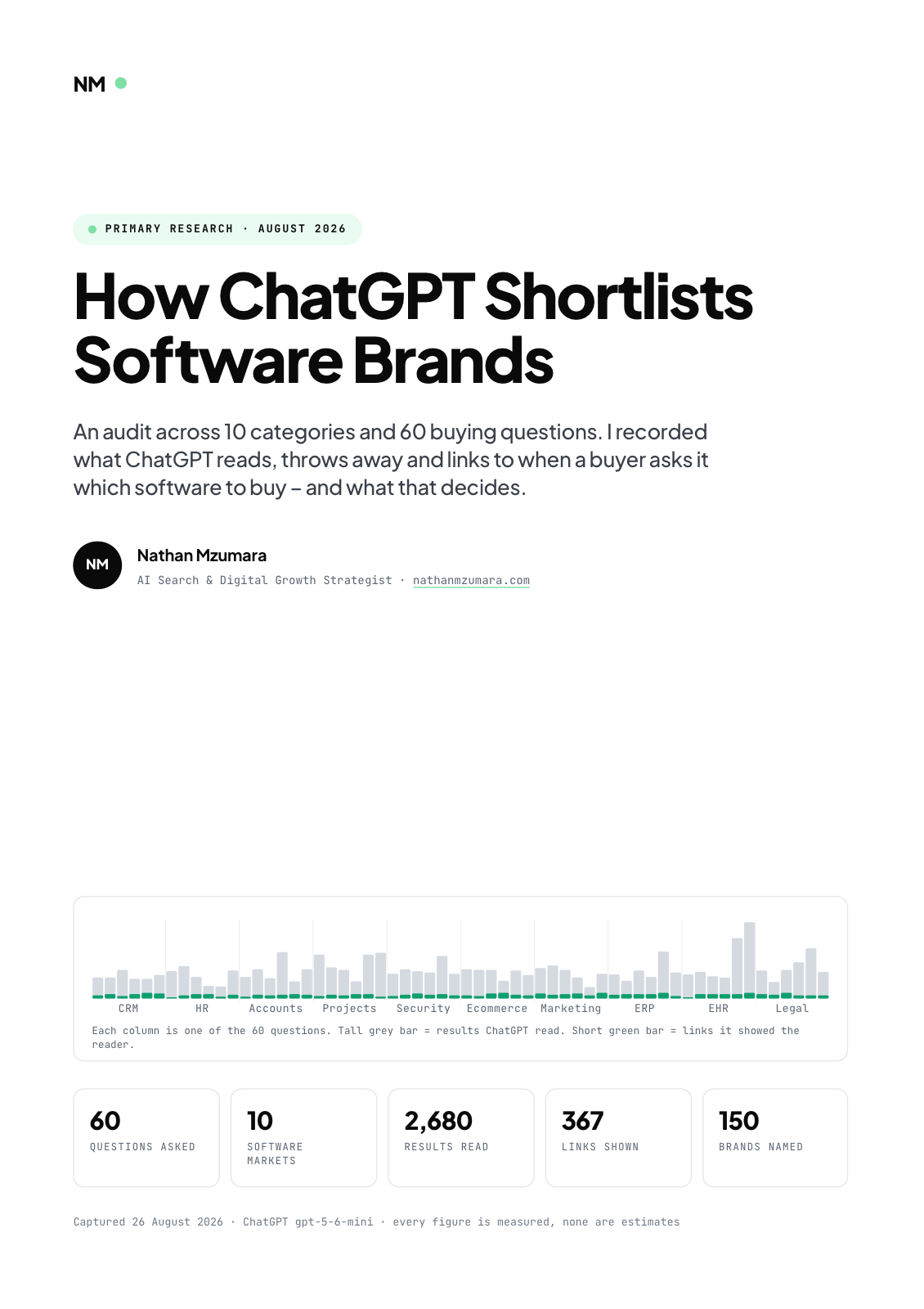
Free download
Get the full report
35 pages · PDF · 536 KB. Enter your details and it downloads straight away.