AI Search Metric
Source recency
How recent the sources cited in an AI answer are. Recency-weighted models favour fresh content; signals when an LLM is treating a topic as time-sensitive.
What it is
Source recency measures how recent the sources cited in an AI answer are, from publication or last-updated dates. It indicates whether a model is favouring fresh material for a given topic.
Why it matters
Recency-weighted models favour fresh content, so this metric signals when an LLM treats a topic as time-sensitive and rewards updates, which tells you where freshness drives visibility.
How it works
Practitioners record the age of cited sources across a prompt set and look for topics where recent dates dominate, then maintain a refresh cadence on content in those time-sensitive areas.
When it applies
Act on it for topics where answers consistently cite recent sources, signalling that freshness matters.
Examples
- A topic where cited sources are mostly weeks old rather than years
- A brand refreshing a guide and regaining citations on a fast-moving subject
- A team spotting that evergreen topics tolerate older sources while news-like ones do not
How it is measured
- Median age of cited sources per prompt
- Share of citations published within a recent window
- Recency distribution compared across topics
- Change in citations after a content refresh
Related terms in AI Search Metric
- AI visibilityAI visibility is how often and how prominently a brand, product or website appears in answers generated by AI assistants and AI search features. It is measured by mentions, citations and the quality of the description, not by keyword rankings. It is the AI search equivalent of share of voice on a results page.
- AI-referred trafficSessions referred from ChatGPT, Claude, Gemini, Perplexity, Copilot, and other LLM surfaces. Often under-counted in standard analytics because referrers are stripped or labelled as direct.
- Answer attribution rateThe proportion of AI answers that explicitly link back to source pages versus those that summarise without attribution. Attribution rate varies materially by platform and query type.
- Bounce-back rate (AI surface)The rate at which users return to the SERP or refine the prompt after seeing an AI Overview. Google's internal signal that an Overview failed, high bounce-back is associated with Overviews being silently removed for that query cluster.
- Brand mention rateThe frequency at which an LLM mentions a brand by name in answers across a prompt set, with or without citation. Brand mentions without citation are an early indicator of model-internalised brand awareness.
- Citation depthHow early in an AI-generated answer a source is cited. Earlier citations correlate with higher click-through from AI surfaces and stronger user trust signals.
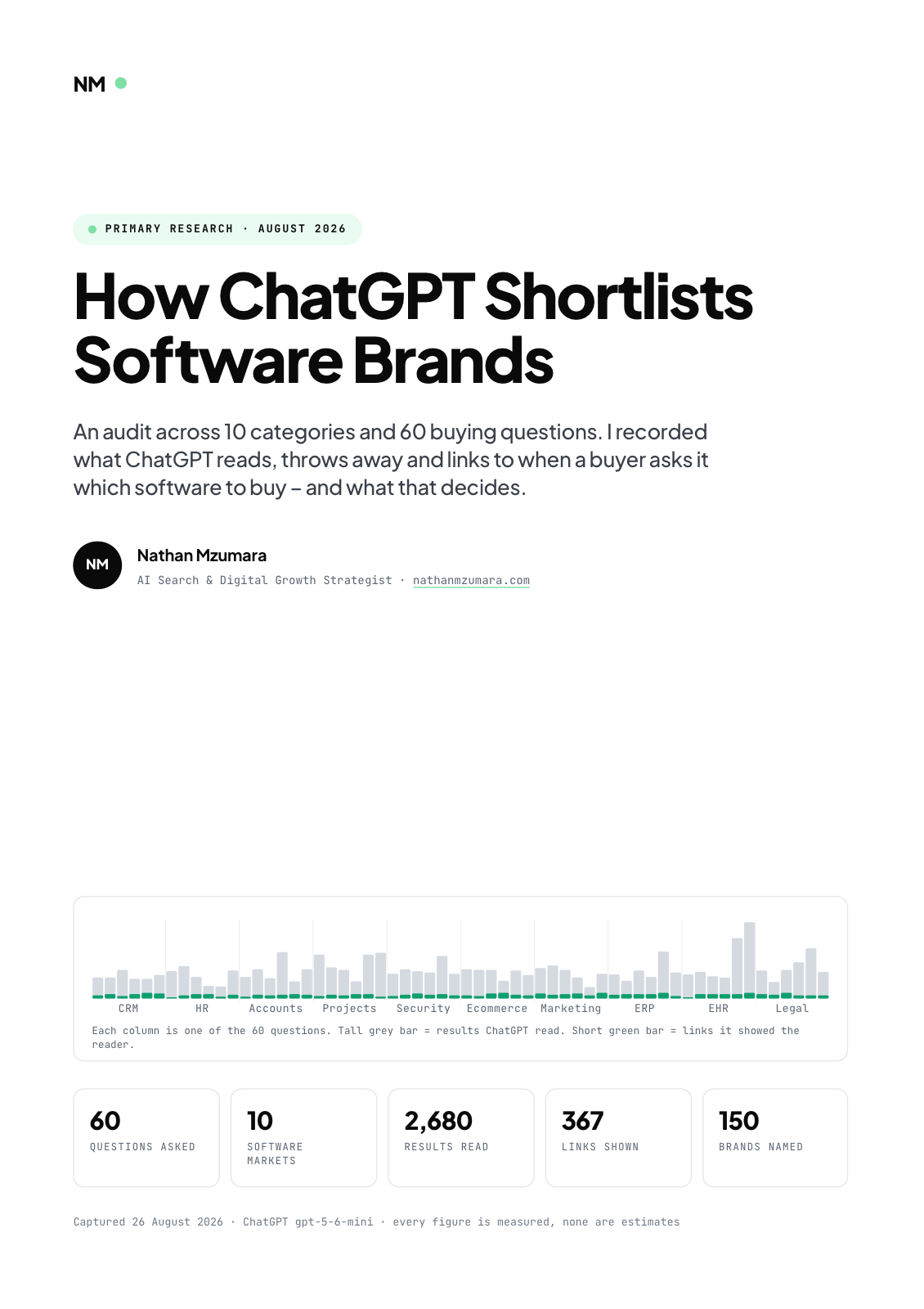
Primary research · August 2026
How ChatGPT Shortlists Software Brands
An audit across 10 categories and 60 buying questions. I recorded what ChatGPT reads, throws away and links to when a buyer asks it which software to buy, and what that decides.
- 60
- Questions asked
- 10
- Software markets
- 2,680
- Results read
- 367
- Links shown
Free download
Get the full report
35 pages · PDF · 536 KB. Enter your details and it downloads straight away.