AI Search Metric
Bounce-back rate (AI surface)
The rate at which users return to the SERP or refine the prompt after seeing an AI Overview. Google's internal signal that an Overview failed, high bounce-back is associated with Overviews being silently removed for that query cluster.
What it is
Bounce-back rate on an AI surface is the rate at which users return to the results page or refine their prompt after seeing an AI Overview, rather than acting on the answer. It reflects answer dissatisfaction at the surface level.
Why it matters
High bounce-back is associated with Overviews being silently removed for that query cluster, so it is an early signal that an AI surface may stop appearing for those queries, changing the visibility landscape.
How it works
Practitioners infer bounce-back from query refinement and return-to-results behaviour, then watch clusters with high rates as candidates for Overview removal or for content that better resolves intent.
When it applies
Watch it for query clusters where AI Overviews appear and you want to anticipate whether they will persist.
Examples
- Users re-querying immediately after an Overview that did not answer their question
- A query cluster where Overviews disappear after sustained high bounce-back
- A team flagging high bounce-back clusters as unstable for planning
How it is measured
- Share of sessions returning to results after an Overview
- Prompt refinement rate following an AI answer
- Bounce-back rate by query cluster
- Correlation between bounce-back and Overview disappearance
Related terms in AI Search Metric
- AI visibilityAI visibility is how often and how prominently a brand, product or website appears in answers generated by AI assistants and AI search features. It is measured by mentions, citations and the quality of the description, not by keyword rankings. It is the AI search equivalent of share of voice on a results page.
- AI-referred trafficSessions referred from ChatGPT, Claude, Gemini, Perplexity, Copilot, and other LLM surfaces. Often under-counted in standard analytics because referrers are stripped or labelled as direct.
- Answer attribution rateThe proportion of AI answers that explicitly link back to source pages versus those that summarise without attribution. Attribution rate varies materially by platform and query type.
- Brand mention rateThe frequency at which an LLM mentions a brand by name in answers across a prompt set, with or without citation. Brand mentions without citation are an early indicator of model-internalised brand awareness.
- Citation depthHow early in an AI-generated answer a source is cited. Earlier citations correlate with higher click-through from AI surfaces and stronger user trust signals.
- Citation diversity indexThe number of distinct domains an LLM cites across a prompt set, normalised by prompt count. Falling diversity in a category signals consolidation, and a closing window for new entrants.
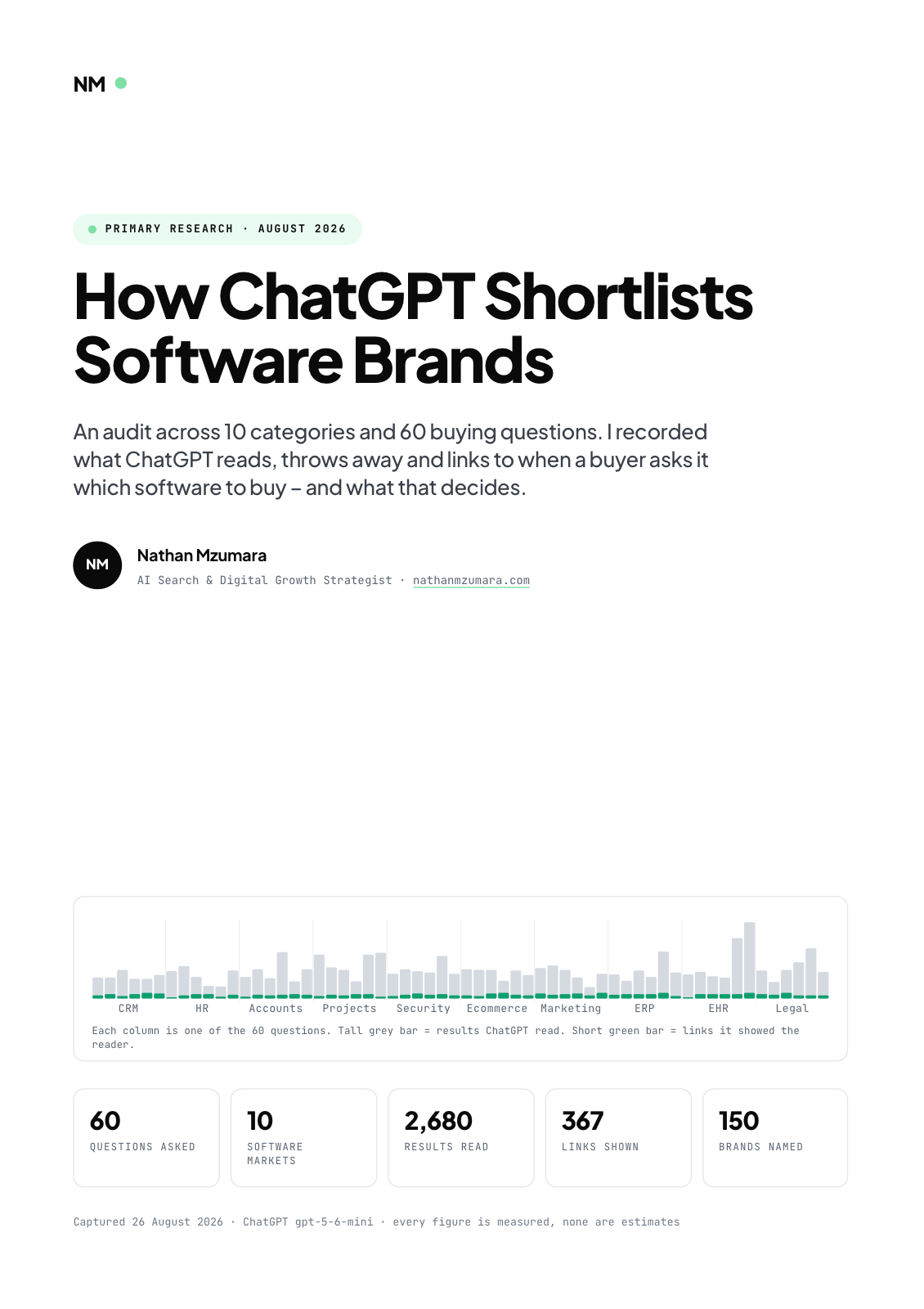
Primary research · August 2026
How ChatGPT Shortlists Software Brands
An audit across 10 categories and 60 buying questions. I recorded what ChatGPT reads, throws away and links to when a buyer asks it which software to buy, and what that decides.
- 60
- Questions asked
- 10
- Software markets
- 2,680
- Results read
- 367
- Links shown
Free download
Get the full report
35 pages · PDF · 536 KB. Enter your details and it downloads straight away.