Live · Every Friday
The Discovery Digest
Ten official platform updates each week from OpenAI (ChatGPT), Anthropic (Claude), Google (Gemini, AI Overviews, AI Mode), Microsoft (Copilot), Perplexity, xAI (Grok), Meta AI, and Profound. What changed, when it shipped, how it shifts discovery, the questions to ask, and where to read more.
31 issues · search & filter
 Issue 17·11 September 2026·10 updates
Issue 17. OpenAI ships the agent loop, a Wall Street ChatGPT, and voice at five cents a minute
**OpenAI spent one Thursday turning three research demos into products you can buy.** The Agents API puts the agent loop behind a managed service with no orchestration fee, ChatGPT for Financial Services bundles GPT-6 Astra with licensed market data, and GPT-Live-1 brings full-duplex voice to the API at five cents a minute. Underneath them sits a Data agent that lets anyone interrogate the company warehouse in plain English. The common thread is not capability. It is that the expensive, fiddly parts of deploying AI just got priced at or near zero, which is what turns a demo into deployed volume. Meanwhile Anthropic published its most detailed threat report yet, and one case in it should worry anyone whose defences rely on recognising known malware.
Inside: 1. OpenAI ships the Agents API, and charges nothing to run the loop · 2. ChatGPT for Financial Services bundles GPT-6 Astra with licensed market data · 3. GPT-Live-1 arrives in the API at $0.05 a minute with full-duplex voice
Read issue Issue 15·September 7, 2026·5 updates
Issue 15. The week GPT-6 arrived and data sovereignty became infrastructure
In three days starting 1 September, the AI frontier delivered more substantive releases than most months have managed. OpenAI launched GPT-6 Astra on 3 September, the most capable model the company has shipped, rated Critical for cybersecurity and gated behind the Daybreak programme before broader access followed. On 1 September, Anthropic released Claude Fable 5.1 with a 75 per cent reduction in cache-read costs and announced Enterprise Frontier Safeguards, a framework that stores activity logs in the customer's own cloud while Anthropic's detection layer still runs across them. Google published Gemini 3.8 Flash on 2 September, its third Flash model in six weeks, alongside a restricted cybersecurity variant for government and infrastructure operators. And Perplexity launched Hybrid Compute on Mac the same day, routing sensitive data to an on-device model while the cloud handles reasoning and planning. The week that opened September set the terms for the rest of the quarter.
Inside: OpenAI launches GPT-6 Astra, the first frontier model rated Critical for cybersecurity · Anthropic releases Fable 5.1 with a 75% cache-read cost cut and a restricted Mythos 5.1 variant · Anthropic launches Enterprise Frontier Safeguards, keeping customer logs in the customer's cloud
Read issue Issue 16·4 September 2026·10 updates
Issue 16. OpenAI hits the Critical cyber line, ChatGPT Ads clears $1bn, Google rewires the SERP
**This week the AI stack got riskier, pricier to ignore, and harder to scrape.** OpenAI's Astra is the first model to hit the Critical cybersecurity threshold, while ChatGPT Ads has quietly reached a $1bn run rate, turning the answer engine into a paid channel you now have to budget for. Meanwhile Google's new goto URL redirects are breaking third-party rank trackers, and a fresh open-source measurement tool from Google lands for post-cookie teams.
Inside: 1. OpenAI Astra becomes the first model to hit the 'Critical' cyber threshold · 2. ChatGPT Ads clears $1bn run rate as the auction opens · 3. Claude Fable 5.1 cuts costs 25% through cheaper caching
Read issue Issue 14·August 31, 2026·5 updates
Issue 14. The week enterprise defaults were set and compute moved to the edge
This week, enterprise AI stopped being optional infrastructure and started being built into the default systems organisations already run. Salesforce and Anthropic announced Claudeforce on 26 August, establishing Claude as the reasoning engine across the world's most-used enterprise CRM, while Google launched Ask Gemini inside Google Chat the same day, folding Gemini into the collaboration layer that hundreds of millions of Workspace users work inside daily. OpenAI published the first independently validated results from its Jalapeño chip at Hot Chips 2026, posting a 1.9x efficiency lead over Nvidia Blackwell and accelerating the timeline for frontier API pricing compression. Perplexity launched Portable Computer, the most aggressive attempt yet to move serious AI agent workloads off the cloud and onto local hardware, with a pricing model that charges nothing for work completed on-device. And Anthropic confirmed that Claude Sonnet 5's launch pricing is permanent, cancelling the 50 per cent increase that had been scheduled for 1 September.
Inside: Salesforce and Anthropic embed Claude as the default reasoning engine across the CRM stack · OpenAI's Jalapeño chip posts a 1.9x efficiency lead over Nvidia Blackwell at Hot Chips 2026 · Perplexity launches Portable Computer: a local-first AI agent that charges nothing for on-device work
Read issue Issue 15·28 August 2026·10 updates
Issue 15. the login wall fell and your site is now read by machines
Two labs shipped agentic browsing in the same fortnight: ChatGPT Work can now sign in to sites on its own, and Claude reads pages and fills forms inside Cowork. GA4 is rebuilding its reporting workspace around a '+ Create' button, rolling out to all accounts now. And fresh primary research on 2,680 ChatGPT search results shows the discipline is measuring the wrong thing: only 11% of URLs the model reads ever become a citation.
Inside: 1. ChatGPT Work can now sign in to your site on its own · 2. GA4 rebuilds reporting around a '+ Create' button · 3. Claude gets a built-in browser that reads pages and fills forms
Read issue- Issue 13·August 24, 2026·5 updates
Issue 13. The week AI went commercial in Europe and agents stopped being demos
This week, two transitions moved from announcement to execution. OpenAI launched ChatGPT Ads across 31 European markets from 24 August and a dedicated teen experience on 18 August, extending its commercial and demographic footprint simultaneously. Anthropic moved computer use, browser use, the Skills API, and the Files API to general availability on 19 August, closing the gap between agent capability and enterprise production readiness in a single release. Microsoft began retiring Copilot features and merging four AI products into one app from 18 August, signalling that the product experimentation phase is over and the platform consolidation phase has begun. And Google completed its third spam update of 2026 in under three days, maintaining an enforcement cadence that no longer resembles a scheduled event.
Inside: OpenAI expands ChatGPT Ads to 31 European markets with contextual-only targeting · OpenAI launches ChatGPT for Teens with parental controls, a study mode, and content protections · Microsoft begins merging four Copilot products into one app, retiring features from 18 August
Read issue - Issue 14·21 August 2026·9 updates
Issue 14. ChatGPT turns advertiser, Google turns up the spam heat, and latency becomes a ranking signal
OpenAI is turning ChatGPT into a paid discovery surface across 31 European markets while it hires an enterprise sales chief and ships answers 14x faster, all in one week. Google has confirmed the August 2026 spam update is live across every language and region, and quietly changed how its JSON-LD parser handles escaped entities. Add Claude watermarking its text by default and GA4 baking agentic AI into the homepage, and the discovery layer just shifted under your feet.
Inside: 1. ChatGPT Ads lands in 31 European markets · 2. Google's August 2026 spam update is live · 3. OpenAI's Ultrafast tier makes latency a discovery variable
Read issue - Issue 12·August 17, 2026·5 updates
Issue 12. The week agents got cloud computers and the model frontier split
This week, autonomous AI agents became enterprise infrastructure. xAI shipped Grok Bot on 11 August, giving always-on AI agents their own persistent cloud computers, user-credential sign-ins, and the ability to learn workflows by demonstration, then released Grok 4.6 the following day, a model matching GPT-5.6 Sol on the Artificial Analysis Intelligence Index at a fifth of the output cost. Google shipped Gemini 3.7 Flash, its latest Flash-tier release while Gemini 3.5 Pro remains without a delivery date, delivering the largest coding and agent benchmark gains the Flash tier has produced and making it the model powering all Google Search queries from the launch date. At the same time, the frontier split: OpenAI gated its first purpose-built cybersecurity model behind a legal attestation vetting programme that most organisations cannot enter, and Anthropic entered preliminary talks to acquire Decart AI for $6 billion, a move into real-time video generation and world simulation that signals where the AI interface layer is heading next.
Inside: Google releases Gemini 3.7 Flash with the biggest agent benchmark gains the Flash tier has produced · xAI launches Grok Bot: always-on AI agents with their own cloud computers and credential-level tool access · Grok 4.6 matches frontier-tier intelligence at one-fifth the output cost of GPT-5.6 Sol
Read issue

Primary research · August 2026
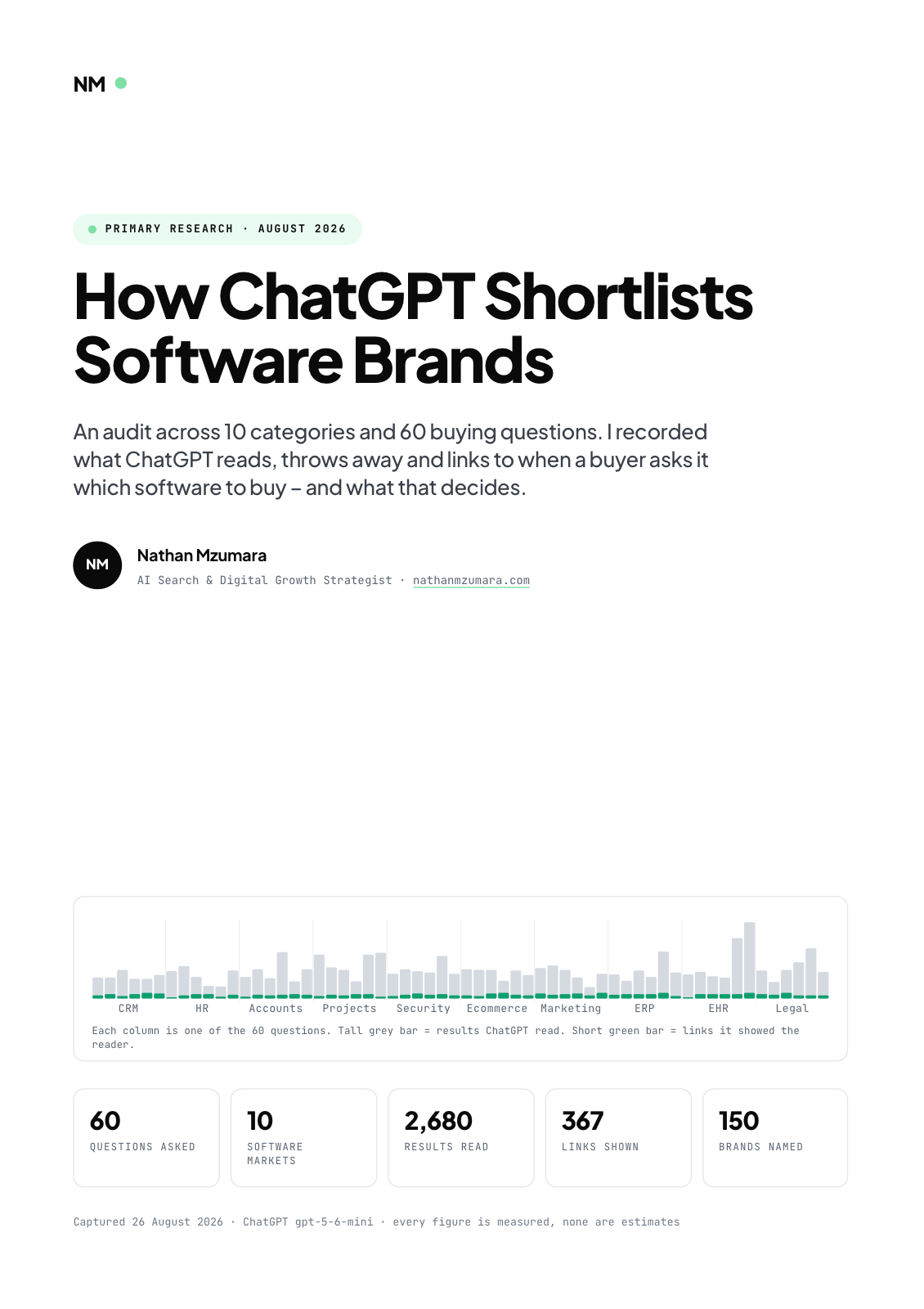
How ChatGPT Shortlists Software Brands
An audit across 10 categories and 60 buying questions. I recorded what ChatGPT reads, throws away and links to when a buyer asks it which software to buy, and what that decides.
- 60
- Questions asked
- 10
- Software markets
- 2,680
- Results read
- 367
- Links shown
Free download
Get the full report
35 pages · PDF · 536 KB. Enter your details and it downloads straight away.