Consumer Behaviour
Job-to-be-done (search)
Also known as: JTBD
The functional outcome a searcher is trying to achieve when they issue a query. Distinct from the literal query text. The unit of analysis for intent-aligned content strategy.
What it is
The job-to-be-done in search is the functional outcome a person wants to accomplish when they issue a query, which often differs from the literal words they type. It is the unit of analysis for intent-aligned content strategy rather than the keyword itself.
Why it matters
AI systems increasingly answer the underlying job directly, so content built around the outcome rather than the phrasing is more likely to be retrieved, synthesised, and cited across many query variations.
How it works
Strategists infer the job by clustering queries that share an outcome, reading the follow-up questions users ask, and mapping content to the decision or task the searcher is trying to complete.
When it applies
It applies during content planning and intent research, before deciding what to publish or how to structure an answer.
Examples
- A query for best CRM software maps to the job choose a tool my small team can adopt quickly.
- A how to fix a leaking tap search maps to the job stop the leak myself today without a plumber.
- Several differently worded queries about pricing all serve one job decide whether this fits my budget.
How it is measured
- Share of query variants mapped to a single defined outcome
- Coverage of follow-up questions answered within one piece of content
- Citation rate across the cluster of queries serving the job
- Conversion or task completion among visitors arriving on intent
Related terms in Consumer Behaviour
- Agentic browserA browser (or browsing layer) that uses an LLM agent to interpret pages, summarise content, and take actions on behalf of the user. Arc Search, Perplexity Comet, Browser Company's Dia, Dia browser, and similar.
- Agentic commerceAgentic commerce is buying and selling in which an AI agent completes part or all of the purchase on a person's behalf, from finding products to placing the order. Instead of browsing a site, the shopper states an intent and the agent searches, compares, fills the cart and sometimes pays. It shifts the point of decision away from the merchant's own interface and towards the assistant.
- App discoveryApp discovery is the set of ways people find and decide to install mobile apps, including store search and browse, editorial placements, web search, social feeds, advertising, AI assistants and word of mouth. It covers the whole path from first awareness to tapping install. Growth teams study it to work out which surfaces create demand and which only capture it.
- Brand demandSearch volume for branded terms. In an AI-search world, brand demand is the single strongest moat, generic queries are absorbed by AI Overviews and ChatGPT, while branded queries route users directly to brand properties.
- Brand discoveryBrand discovery is the process by which someone encounters a brand for the first time, or becomes newly aware it can solve their problem. It happens across search results, AI assistants, social feeds, communities, creators, reviews, marketplaces and word of mouth. Marketers study it to work out which surfaces introduce them to future customers.
- Consumer behaviour signalObservable patterns in how users phrase queries, refine searches, and choose answers, used by both ranking systems and generative models to infer intent and quality.
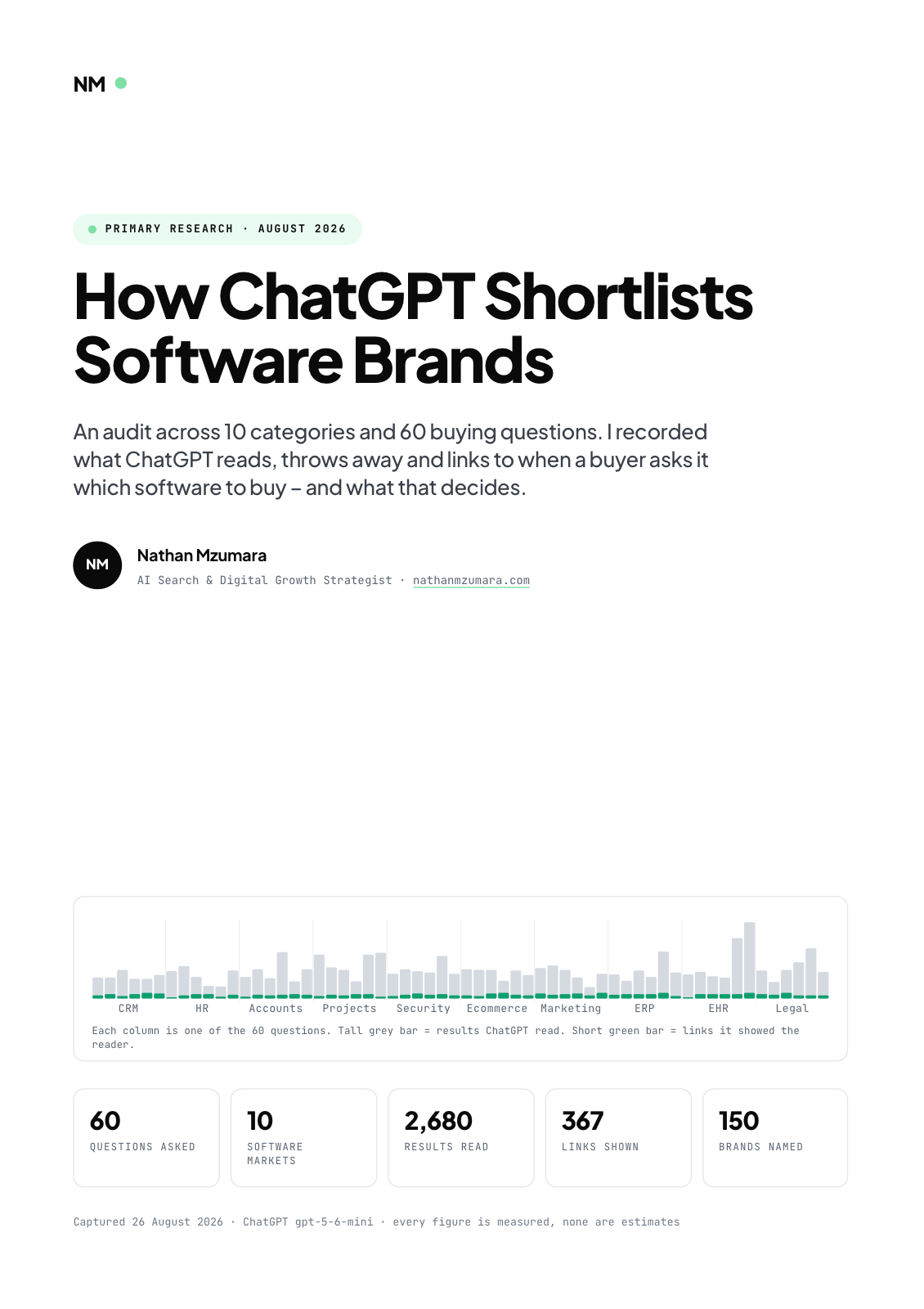
Primary research · August 2026
How ChatGPT Shortlists Software Brands
An audit across 10 categories and 60 buying questions. I recorded what ChatGPT reads, throws away and links to when a buyer asks it which software to buy, and what that decides.
- 60
- Questions asked
- 10
- Software markets
- 2,680
- Results read
- 367
- Links shown
Free download
Get the full report
35 pages · PDF · 536 KB. Enter your details and it downloads straight away.