Consumer Behaviour
Brand discovery
Brand discovery is the process by which someone encounters a brand for the first time, or becomes newly aware it can solve their problem. It happens across search results, AI assistants, social feeds, communities, creators, reviews, marketplaces and word of mouth. Marketers study it to work out which surfaces introduce them to future customers.
What it is
Brand discovery covers the earliest stage of the customer journey, before intent is strong enough to produce a branded search. It is usually indirect: a recommendation in a forum thread, a mention in an AI answer, a creator video, a listicle or a colleague's suggestion. The brand often has no direct control over the surface where discovery occurs.
Why it matters
Branded search, direct traffic and conversion rates all depend on awareness created earlier, so measuring only last click activity hides where demand comes from. AI assistants and social platforms increasingly compress discovery into a single answer or feed, which means being absent from the sources those systems draw on removes you from consideration. Brands that appear in comparison content, reviews and community discussion get recommended more often.
How it works
Practitioners map the surfaces where their category gets discussed, then work to be present and accurately described there through content, PR, creator partnerships, review coverage and consistent naming. They ask assistants and search engines category questions to see which brands get named, and interview new customers about how they first heard of them. Branded search volume and direct traffic are then tracked as downstream signals of discovery activity.
When it applies
It applies to any category where buyers do not already know the vendor set, including new markets, new products and crowded categories. It matters most when growth depends on creating demand rather than capturing it.
Examples
- A B2B software buyer finds a vendor named in an AI assistant answer to 'best tools for invoice approval', then searches the brand directly a week later.
- A skincare brand is mentioned in a Reddit thread comparing routines and sees a rise in branded search from that country.
- A first time customer survey shows that a third of new signups first heard of the brand through a YouTube review rather than search.
How it is measured
- Branded search volume and impressions over time
- Share of category prompts in AI assistants and search where the brand is named
- Self reported first touch source from post purchase or signup surveys
- New versus returning visitor mix and direct traffic trend
Related terms in Consumer Behaviour
- Agentic browserA browser (or browsing layer) that uses an LLM agent to interpret pages, summarise content, and take actions on behalf of the user. Arc Search, Perplexity Comet, Browser Company's Dia, Dia browser, and similar.
- Brand demandSearch volume for branded terms. In an AI-search world, brand demand is the single strongest moat, generic queries are absorbed by AI Overviews and ChatGPT, while branded queries route users directly to brand properties.
- Consumer behaviour signalObservable patterns in how users phrase queries, refine searches, and choose answers, used by both ranking systems and generative models to infer intent and quality.
- Conversational searchConversational search is the pattern of finding information through a back and forth dialogue rather than a single keyword query, with each follow-up interpreted in the context of what came before. Users ask broad questions, then narrow with refinements such as cheaper, nearby or without the subscription. It shifts discovery from ranked link lists towards answers that must survive several rounds of questioning.
- Facebook SearchFacebook Search is the search function inside Facebook that lets people find posts, people, Pages, Groups, events, videos and Marketplace listings. It is a platform search experience rather than a general web search engine, so results are shaped by what is published on Facebook and by the searcher's connections and activity. For businesses it affects whether a Page, Group or listing is found by people already inside the app.
- Job-to-be-done (search)The functional outcome a searcher is trying to achieve when they issue a query. Distinct from the literal query text. The unit of analysis for intent-aligned content strategy.
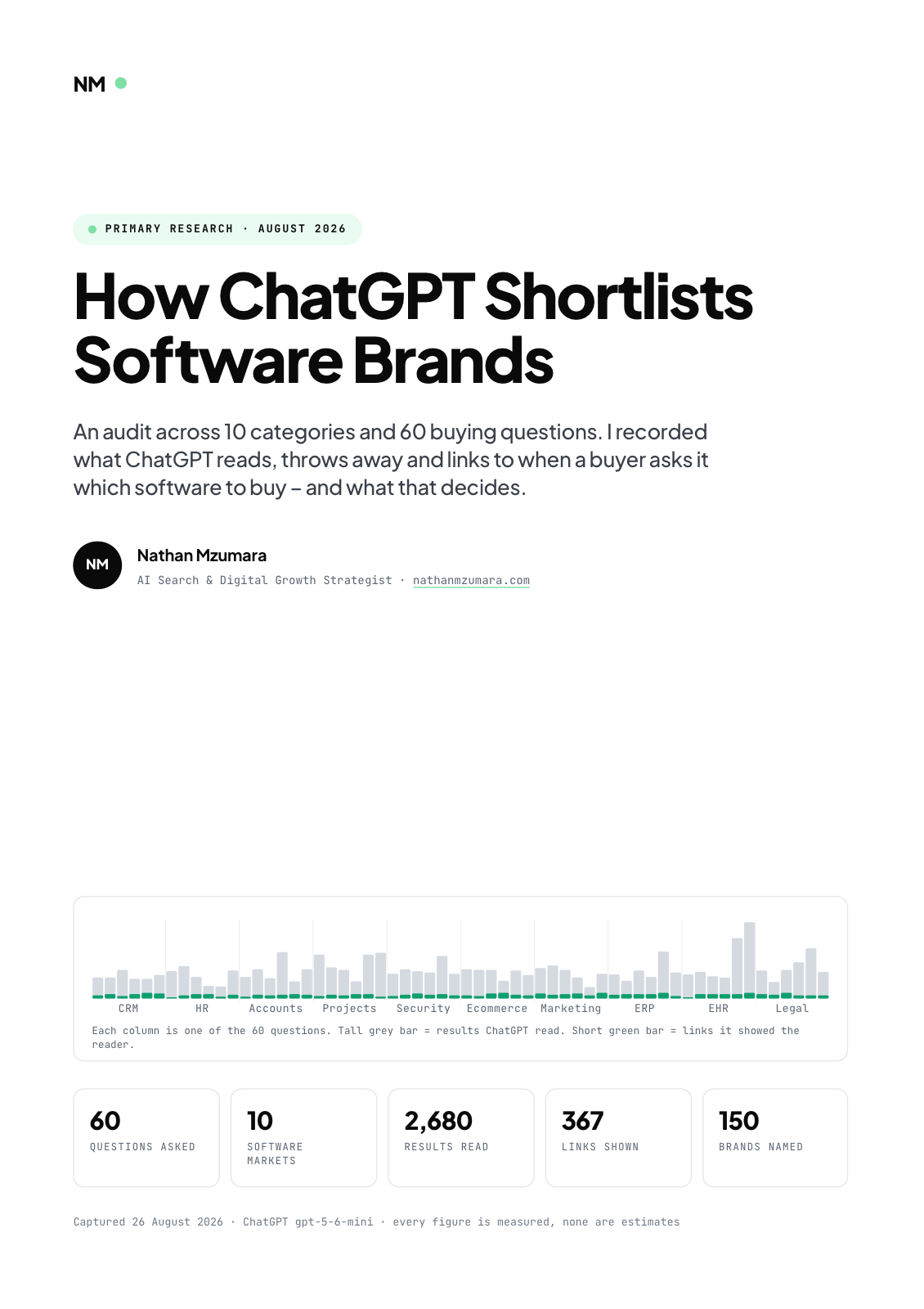
Primary research · August 2026
How ChatGPT Shortlists Software Brands
An audit across 10 categories and 60 buying questions. I recorded what ChatGPT reads, throws away and links to when a buyer asks it which software to buy, and what that decides.
- 60
- Questions asked
- 10
- Software markets
- 2,680
- Results read
- 367
- Links shown
Free download
Get the full report
35 pages · PDF · 536 KB. Enter your details and it downloads straight away.