ChatGPT Picks Winners Before It Searches. Here's the Proof.
Here is the finding that should reorder your AI visibility budget. When you ask ChatGPT for the best product in a category, it writes its own search query first, and that query already contains brand names you never typed. The shortlist exists before anything touches the web. If your brand is not on it, your website never gets looked at, however well built it is.
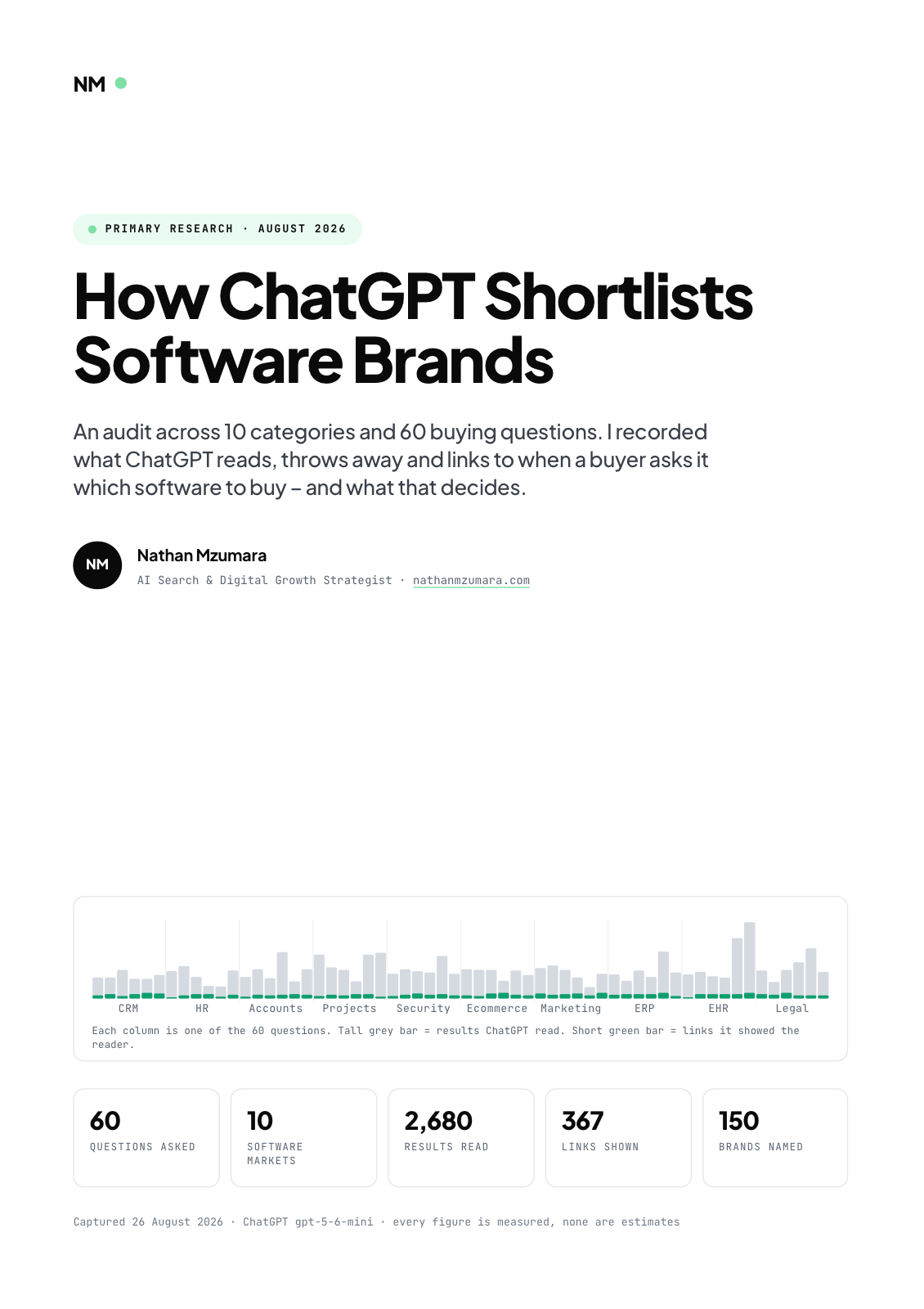
I went on to test the same mechanism from the other end and at larger scale. How ChatGPT Shortlists Software Brands, an audit of 60 buying questions across ten software categories, found 69.3% of the brands ChatGPT recommended carried no link to them anywhere in the answer. That is what a shortlist written before the search looks like from the outside.
This comes from Suganthan Mohanadasan, who spent two months reading the search queries ChatGPT generates behind its answers. In his write-up, ChatGPT Already Knows Who It'll Recommend Before It Searches, he documents a mechanism that changes what most of us have been telling clients to do. I think it is the most important structural insight into AI discovery I have read this year.
What actually happened
He asked ChatGPT for the best AI note taking app. Seven words, no brand names. Before fetching anything, the model wrote itself a search that ended: Granola Notion AI Otter Fireflies Fathom Mem Limitless. Seven products, none of them named by the user, and nothing had come back from the web yet. Those names came out of the model, not the results.
Then it ran nine more searches, one per name, each pointed straight at that company's own website with a site: probe. So the famous fan-out was never a hunt for candidates. It was ChatGPT working down a list it already held, one name at a time.
ChatGPT decides its shortlist from training memory before it searches the web. Image: Unsplash.
How the mechanism works
ChatGPT rewrites your question into its own search queries, runs them, reads the results, then writes an answer. Those queries sit in the JSON your browser downloads, under a key currently called search_queries. OpenAI renamed it from search_model_queries in early August 2026. This is not a leak. Your own browser needs that data to draw the page, and you can read it in DevTools on your own account in about two minutes.
To rule out timing, Mohanadasan took the first user message and the first search query in each conversation, ordered by timestamp. At that point nothing has been fetched, so there is no earlier result to have learned from. In 21 of 27 conversations, that first query contained brands the user never typed. Across thirteen unrelated categories, 11 of 13 did the same.
The robot vacuum row is the one that stood out. It did not just recall Roborock. It named Saros, Dreame X50 and Eufy S1 Pro. Current model numbers, unprompted, in the first query. This knowledge goes down to the product line.
Being named is worth around 33 times more
Here is the figure that matters. He sorted every brand into two groups: those named in a query ChatGPT wrote itself, and those merely fetched during the search without ever being named. Then he checked how often each made it into the final answer.
Brand's situationCountMentioned in the answerNamed in ChatGPT's own query11968.9%Fetched, never named in a query5152.1%
Source: Suganthan Mohanadasan, reading a few hundred ChatGPT search queries. Figures come from a single account, so treat them as direction, not measurement.
That is roughly a 33 times difference. He also found 86 cases where a brand was recommended and its website was never fetched at all. A mention does not need a crawl.
The myths this debunks
Myth one: GEO is retrieval work. Most of what is sold as generative engine optimisation right now sits in that 2.1% column. It optimises how well you are fetched. But the 68.9% column, whether you get named in the first place, is decided before any of that runs. In my opinion this is the single biggest misalignment between GEO spend and GEO outcomes today.
Myth two: a great website gets you cited. It does not, on its own. If you miss the shortlist, the site:yourdomain.com probe never fires and your server is never touched. The decision happens upstream of your site entirely.
Myth three: one answer tells you where you stand. When he re-ran categories, accounting collapsed from six vendors to a single QuickBooks probe, and web hosting dropped every vendor and switched to a review site. The truth is that settled categories carry stable shortlists while contested ones wobble between runs.
So what does this mean exactly?
From my observation, this reframes the whole exercise. The shortlist is a function of what the model absorbed in training and holds in memory, not of your on-page work. It also fires on complaints, not just shopping questions: someone grumbling that their meeting notes are a mess got turned into Granola official pricing before a single page was fetched. And displacement queries like "alternatives to Zendesk" pull in whoever the model already knows, which could be you or your rival, with no say on the day.
Here's a fun experiment you can try
Open ChatGPT and ask the "best [your category]" question your buyers actually ask.
Read the query it writes back. That one string tells you whether ChatGPT knows your brand exists.
Run it five times and write down every name that appears. Names that show up every run are your real competitive set. Names that come and go are contested ground where a push can move things.
If your brand never appears across five runs, you have your answer, and it is not a technical one.
This connects to a shift I have written about before. When ChatGPT moves from answering to acting, as I covered in how ChatGPT is shifting from asking to doing, the shortlist becomes the funnel. And once you know AI is sending traffic, you need to count it, which is where making AI referral traffic countable in GA4 earns its place.
The concrete action: stop measuring your AI visibility from the answer alone and start reading the query. If you are not in that first string, no amount of retrieval polish will save you. Brand presence in training memory is now the game, and it is won long before anyone types your category.
Tags