Search Tactic
Search engine optimisation
Also known as: SEO
Search engine optimisation is the practice of improving a website so it earns more relevant unpaid traffic from search engines. It combines technical health, content that matches what people search for, and signals of authority such as links and citations. Increasingly it also covers being retrievable and quotable by AI answer engines.
What it is
SEO is usually split into technical work, on-page content and off-page authority. Technical work makes pages crawlable, fast and correctly structured; on-page work aligns titles, headings and body copy with search intent; off-page work builds references from other credible sites. Local and international variants add location and language signals to the mix.
Why it matters
Organic search remains one of the largest sources of qualified, compounding traffic for most businesses, and it does not stop when a budget is paused. The same foundations now feed AI assistants, which crawl and cite web pages when generating answers, so SEO investment influences both blue links and AI summaries. Neglecting it means ceding both channels to competitors.
How it works
Teams audit crawling and indexing, fix site speed and structure, research the questions their audience actually asks, and publish pages that answer them clearly with schema markup where relevant. They then earn coverage and links, monitor rankings and clicks, and iterate on pages that underperform. For AI search, practitioners also run prompt tests, check whether pages are being cited, and structure content into clearly headed, self-contained sections that are easy to quote.
When it applies
It applies whenever people search for what you offer and you want durable visibility, and it is most valuable when the buying journey involves research rather than impulse.
Examples
- An e-commerce site fixes duplicate category URLs and canonical tags, and recovers lost product page indexing.
- A B2B firm rewrites a thin pricing page into a detailed comparison guide that starts ranking for 'X vs Y' queries.
- A local dental practice completes its Google Business Profile and earns consistent citations, appearing in the map pack for nearby searches.
How it is measured
- Non-brand organic clicks and impressions from Search Console
- Indexed page count and crawl error volume
- Rankings for a defined priority keyword set, tracked over time
- Organic conversions and assisted revenue, plus citation share in AI answers
Insights on Search engine optimisation
- Google Goto URL Redirects: What They Mean for SEO and Rank Tracking
- Anthropic Claude Computer Use Browser Control: What Changed
- ChatGPT Picks Winners Before It Searches. Here's the Proof.
- EU Fines Google €890M: Steering Rules Just Reopened
- The 2021 Paper That Still Explains Why Google Beats Bing
- Google's June 2026 Spam Update Is Live. Here's What 'Normal' Actually Means.
Related terms in Search Tactic
- Answer Engine OptimisationThe practice of structuring content so it can be lifted directly into AI answers. Close cousin of GEO; emphasises clean, parseable facts and unambiguous attribution.
- Citation-worthy contentContent with the qualities LLMs select for when synthesising an answer: a single, defensible claim per paragraph; named entities; first-hand evidence; and a clear authority signal.
- Content auditA content audit is a structured review of every page or asset in a content set, scored against performance, quality, accuracy and search intent. The output is a decision for each item: keep, improve, consolidate, redirect or remove. It turns a large and uneven content library into a prioritised action plan.
- Crawler policyA crawler policy is the set of rules a site publishes and enforces to decide which automated agents may access its content, how often, and for what purpose. It typically combines robots.txt directives, server side rules and terms of use, and increasingly distinguishes search crawlers from AI training and assistant crawlers. The policy defines both what is allowed and what happens when a bot ignores it.
- Digital discoveryThe full set of channels through which people find brands, products, and answers, search engines, AI assistants, social platforms, marketplaces, and agentic browsers. Replaces the narrower frame of just “SEO”.
- Ecommerce SEOEcommerce SEO is the practice of making an online store's category, product, brand and editorial pages discoverable in organic search. It combines technical work on crawling, indexing and site structure with commercial decisions about which queries each page should serve. The goal is qualified non-paid traffic that converts into orders.
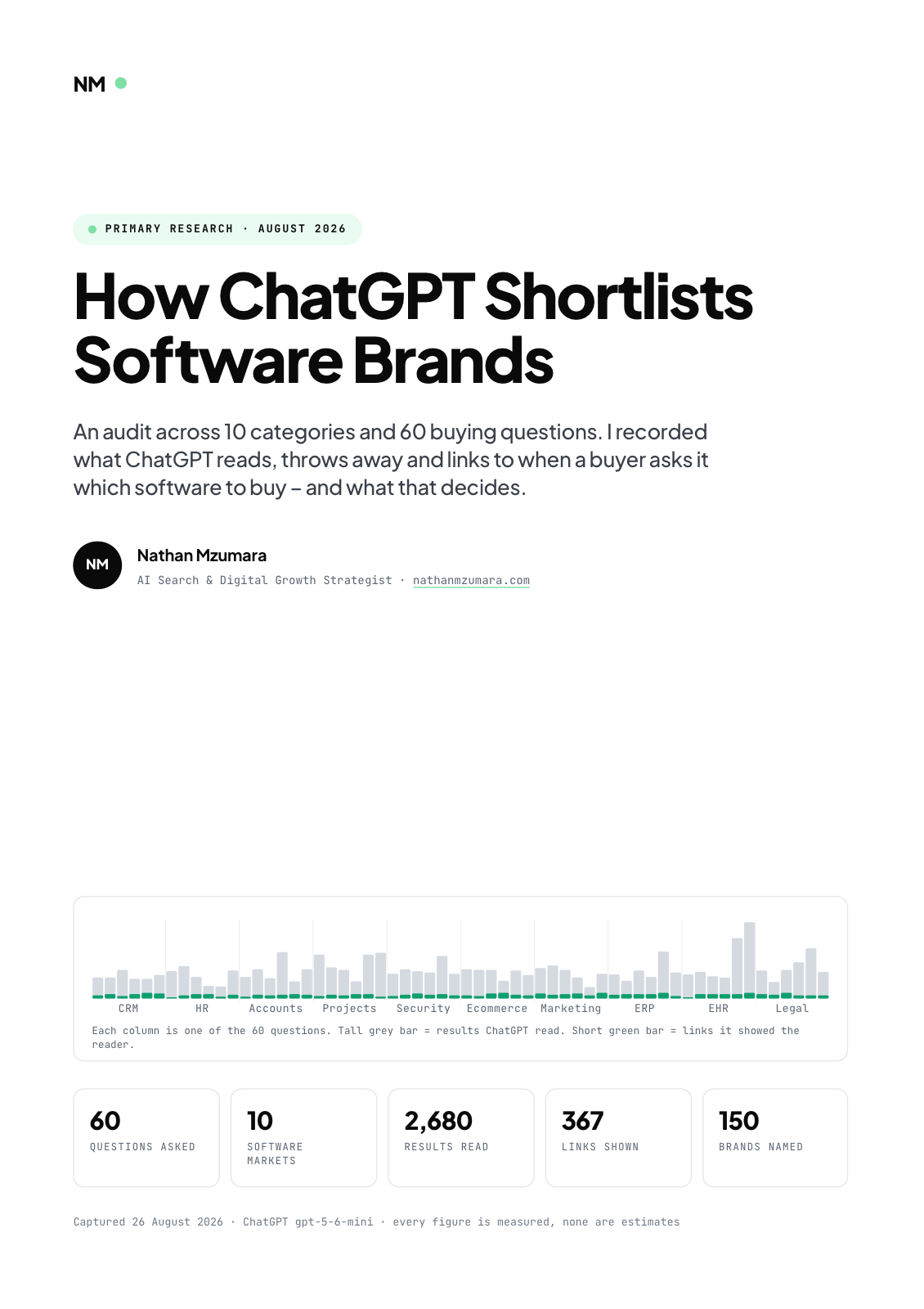
Primary research · August 2026
How ChatGPT Shortlists Software Brands
An audit across 10 categories and 60 buying questions. I recorded what ChatGPT reads, throws away and links to when a buyer asks it which software to buy, and what that decides.
- 60
- Questions asked
- 10
- Software markets
- 2,680
- Results read
- 367
- Links shown
Free download
Get the full report
35 pages · PDF · 536 KB. Enter your details and it downloads straight away.