Search Tactic
Digital discovery
The full set of channels through which people find brands, products, and answers, search engines, AI assistants, social platforms, marketplaces, and agentic browsers. Replaces the narrower frame of just “SEO”.
What it is
Digital discovery is the full set of channels through which people find brands, products, and answers, spanning search engines, AI assistants, social platforms, marketplaces, and agentic browsers. It replaces the narrower frame of treating search engine optimisation as the whole of findability.
Why it matters
Audiences now begin journeys in many places at once, so optimising only for traditional search leaves large parts of the discovery surface uncovered. Treating discovery holistically reveals where attention and intent actually originate.
How it works
Map every surface where your audience searches or stumbles on answers, then tailor content and structured data to each one while keeping a consistent entity and attribution layer across them. Measure presence per channel rather than ranking alone.
When it applies
It applies to any brand whose audience finds information across more than one platform, which is now nearly all of them.
Examples
- A retailer optimises product data for a marketplace, a social feed, and an AI shopping assistant alongside its own site.
- A creator tracks discovery from a video platform and an AI assistant, not just organic search.
- A B2B vendor ensures an agentic browser can complete a research task using its structured pages.
How it is measured
- Share of discovery attributed to each channel
- Presence and citation rate across AI assistants and answer engines
- Cross channel branded query and direct visit growth
- Consistency of entity and attribution data across surfaces
Insights on Digital discovery
- Grok Build Just Went Free. Your Micro-Tool Moat Is Gone.
- Claude Just Put a Designer in Your Terminal. What Now?
- ChatGPT Now Watches Everything You Do. Search Just Ended.
- Meta Is Crawling the Whole Web. A New Search Index Is Forming.
- ChatGPT Shifts From Asking to Doing. Intent Just Moved.
- OpenAI Flags Astra 'Critical'. Trust Just Became Rank Currency.
- GPT-Live Now Listens While It Speaks. Voice Search Just Got Real.
- OpenAI Just Cut Luna 80%. AI Agents Hit Front-of-Funnel.
Related terms in Search Tactic
- Agentic researchAgentic research is the use of an AI system that plans and carries out a multi-step research task on its own, running many searches, opening and reading sources, then writing a synthesised answer or report with citations. It differs from a single search query because the model decides what to look up next based on what it has already found. Vendors often market this capability as deep research.
- Answer Engine OptimisationThe practice of structuring content so it can be lifted directly into AI answers. Close cousin of GEO; emphasises clean, parseable facts and unambiguous attribution.
- Citation-worthy contentContent with the qualities LLMs select for when synthesising an answer: a single, defensible claim per paragraph; named entities; first-hand evidence; and a clear authority signal.
- Content auditA content audit is a structured review of every page or asset in a content set, scored against performance, quality, accuracy and search intent. The output is a decision for each item: keep, improve, consolidate, redirect or remove. It turns a large and uneven content library into a prioritised action plan.
- Crawler policyA crawler policy is the set of rules a site publishes and enforces to decide which automated agents may access its content, how often, and for what purpose. It typically combines robots.txt directives, server side rules and terms of use, and increasingly distinguishes search crawlers from AI training and assistant crawlers. The policy defines both what is allowed and what happens when a bot ignores it.
- Ecommerce SEOEcommerce SEO is the practice of making an online store's category, product, brand and editorial pages discoverable in organic search. It combines technical work on crawling, indexing and site structure with commercial decisions about which queries each page should serve. The goal is qualified non-paid traffic that converts into orders.
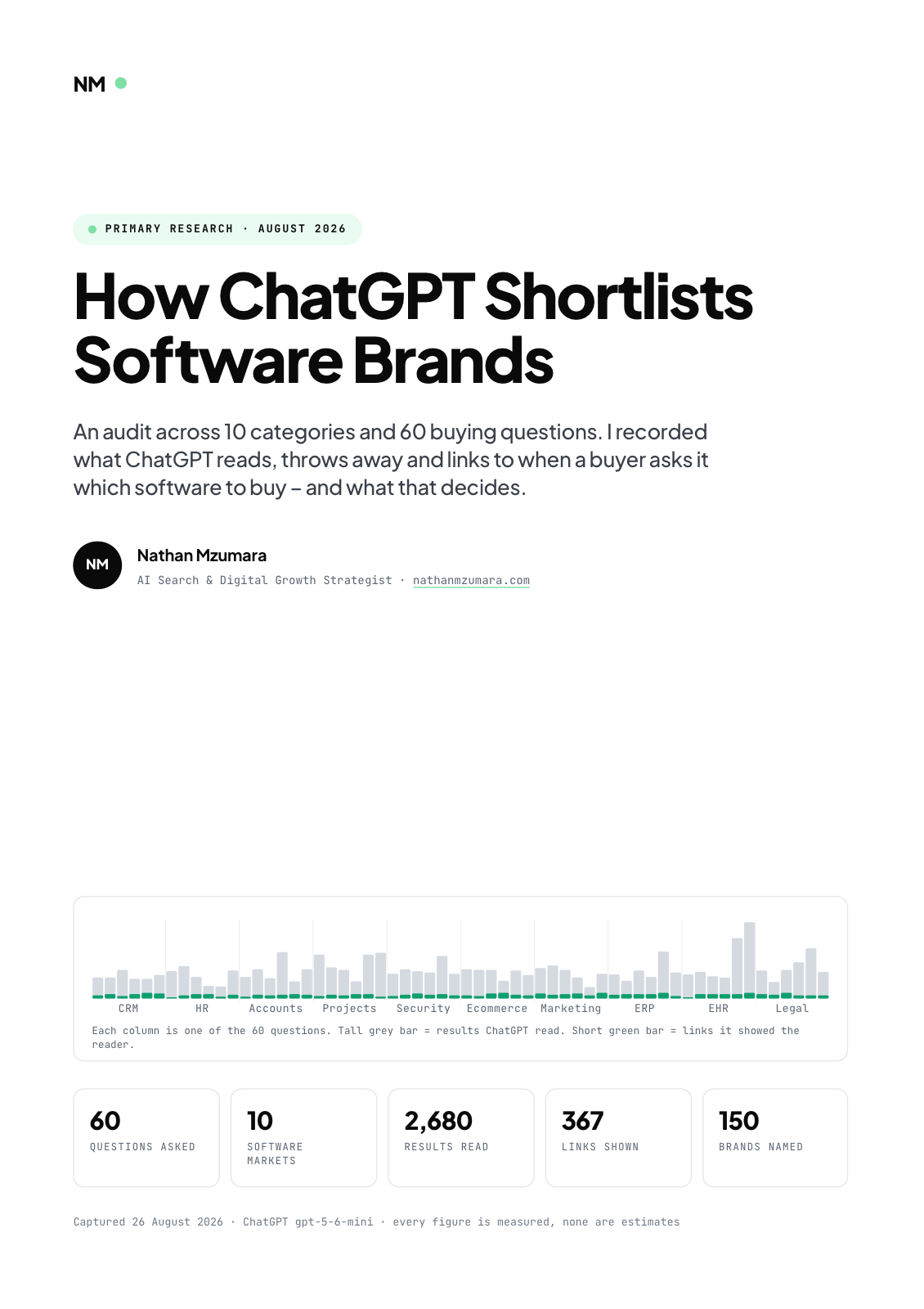
Primary research · August 2026
How ChatGPT Shortlists Software Brands
An audit across 10 categories and 60 buying questions. I recorded what ChatGPT reads, throws away and links to when a buyer asks it which software to buy, and what that decides.
- 60
- Questions asked
- 10
- Software markets
- 2,680
- Results read
- 367
- Links shown
Free download
Get the full report
35 pages · PDF · 536 KB. Enter your details and it downloads straight away.