Search Tactic
LLM-friendly content
Content structured to be parseable and citation-worthy by language models: clear claims, specific facts, named sources, structured data, and unambiguous attribution.
What it is
LLM friendly content is content deliberately structured to be easy for language models to parse and cite: clear claims, specific facts, named sources, structured data, and unambiguous attribution. It reduces the interpretive work a model must do before quoting it.
Why it matters
Models preferentially synthesise from sources they can read confidently, so parseable, well attributed content is more likely to be surfaced and correctly credited. It lowers the chance of being paraphrased without attribution or skipped entirely.
How it works
State claims plainly, attach sources and dates, add schema markup, use descriptive headings, and keep passages self contained so they make sense when extracted in isolation. Avoid vague pronouns and buried qualifiers that confuse extraction.
When it applies
It applies to any content you want quoted, summarised, or cited by AI systems rather than merely indexed.
Examples
- A research summary lists each finding with its source and date in a consistent pattern a model can map.
- A product page uses structured specifications so an assistant reports the correct dimensions.
- A glossary entry opens with a one sentence definition that reads cleanly out of context.
How it is measured
- Frequency of model citations or quotations of the content
- Accuracy of facts when reproduced by an assistant
- Share of passages extracted without distortion
- Coverage of pages with valid structured data
Related terms in Search Tactic
- Agentic researchAgentic research is the use of an AI system that plans and carries out a multi-step research task on its own, running many searches, opening and reading sources, then writing a synthesised answer or report with citations. It differs from a single search query because the model decides what to look up next based on what it has already found. Vendors often market this capability as deep research.
- Answer Engine OptimisationThe practice of structuring content so it can be lifted directly into AI answers. Close cousin of GEO; emphasises clean, parseable facts and unambiguous attribution.
- Citation-worthy contentContent with the qualities LLMs select for when synthesising an answer: a single, defensible claim per paragraph; named entities; first-hand evidence; and a clear authority signal.
- Content auditA content audit is a structured review of every page or asset in a content set, scored against performance, quality, accuracy and search intent. The output is a decision for each item: keep, improve, consolidate, redirect or remove. It turns a large and uneven content library into a prioritised action plan.
- Crawler policyA crawler policy is the set of rules a site publishes and enforces to decide which automated agents may access its content, how often, and for what purpose. It typically combines robots.txt directives, server side rules and terms of use, and increasingly distinguishes search crawlers from AI training and assistant crawlers. The policy defines both what is allowed and what happens when a bot ignores it.
- Digital discoveryThe full set of channels through which people find brands, products, and answers, search engines, AI assistants, social platforms, marketplaces, and agentic browsers. Replaces the narrower frame of just “SEO”.
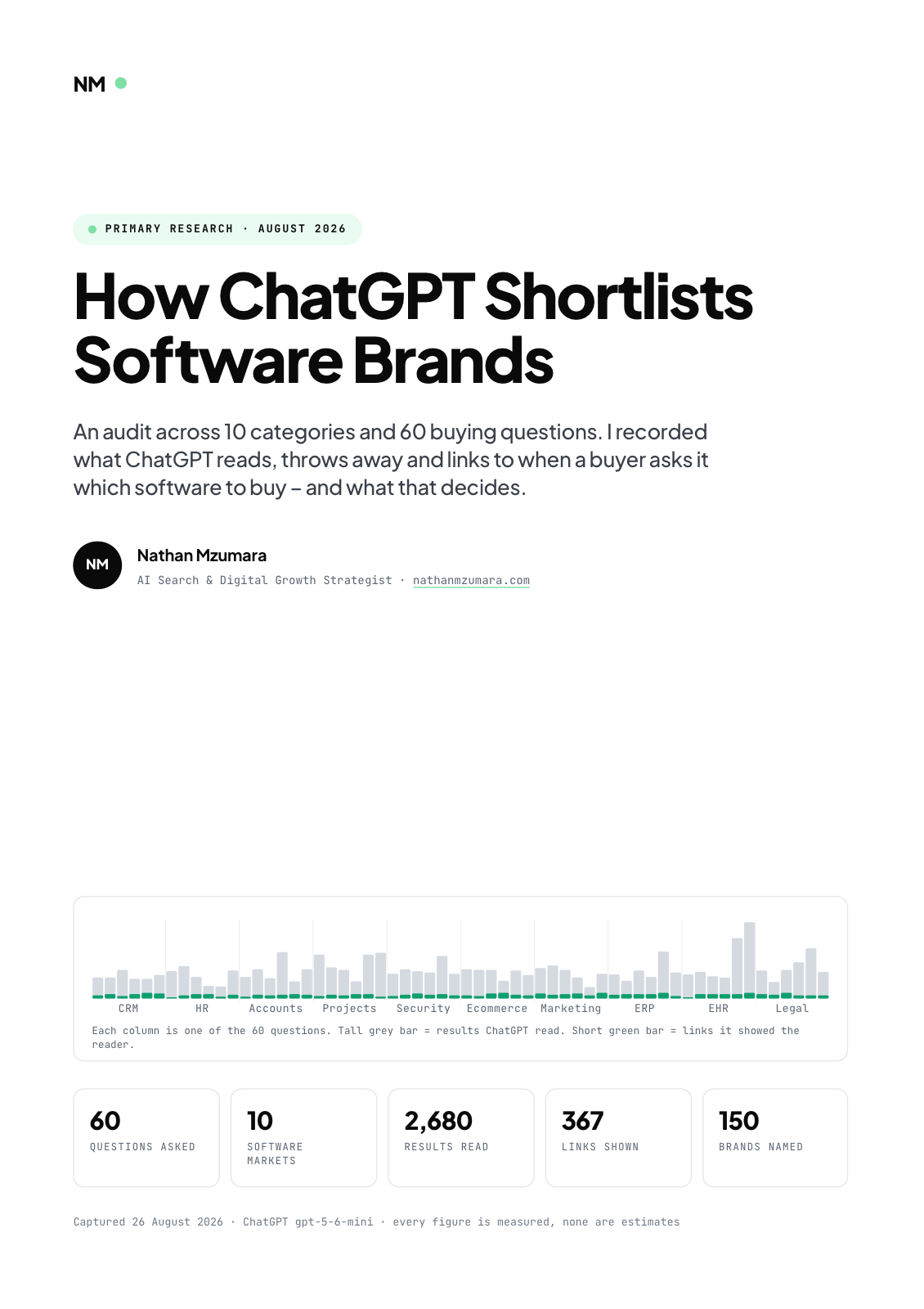
Primary research · August 2026
How ChatGPT Shortlists Software Brands
An audit across 10 categories and 60 buying questions. I recorded what ChatGPT reads, throws away and links to when a buyer asks it which software to buy, and what that decides.
- 60
- Questions asked
- 10
- Software markets
- 2,680
- Results read
- 367
- Links shown
Free download
Get the full report
35 pages · PDF · 536 KB. Enter your details and it downloads straight away.