Search Tactic
Intent resolution
How completely a page answers the underlying job the searcher was trying to do, not whether it matches the keywords used. The dominant ranking factor post-Google May 2026 core update.
What it is
Intent resolution measures how completely a page satisfies the underlying job the searcher was trying to accomplish, rather than how well it matches the words they typed. It treats the query as a proxy for a goal and judges the page on whether that goal is met.
Why it matters
It became the dominant ranking factor after the Google May 2026 core update, so pages that fully resolve intent outrank keyword matched pages that leave the user still searching. AI engines similarly prefer sources that close the loop in one place.
How it works
Map the full job behind a query, including the obvious next questions, then ensure the page answers all of them with evidence, examples, and a clear path to the next step. Test by asking whether a reader would need to run another search after reading.
When it applies
It applies to every query, but matters most for complex, multi step, or decision oriented searches.
Examples
- A guide on choosing a pension explains the options, the trade offs, and the steps to switch, so the reader does not search again.
- A comparison page resolves not just which tool is best but for whom and why, answering the unspoken follow up.
- A how to article anticipates the common failure point and addresses it inline rather than ending at the happy path.
How it is measured
- Reduction in follow up or refined searches after a visit
- Task completion or conversion rate for the page
- Dwell time and scroll depth indicating the answer was found
- Lower pogo sticking back to the results page
Related terms in Search Tactic
- Agentic researchAgentic research is the use of an AI system that plans and carries out a multi-step research task on its own, running many searches, opening and reading sources, then writing a synthesised answer or report with citations. It differs from a single search query because the model decides what to look up next based on what it has already found. Vendors often market this capability as deep research.
- Answer Engine OptimisationThe practice of structuring content so it can be lifted directly into AI answers. Close cousin of GEO; emphasises clean, parseable facts and unambiguous attribution.
- Citation-worthy contentContent with the qualities LLMs select for when synthesising an answer: a single, defensible claim per paragraph; named entities; first-hand evidence; and a clear authority signal.
- Content auditA content audit is a structured review of every page or asset in a content set, scored against performance, quality, accuracy and search intent. The output is a decision for each item: keep, improve, consolidate, redirect or remove. It turns a large and uneven content library into a prioritised action plan.
- Crawler policyA crawler policy is the set of rules a site publishes and enforces to decide which automated agents may access its content, how often, and for what purpose. It typically combines robots.txt directives, server side rules and terms of use, and increasingly distinguishes search crawlers from AI training and assistant crawlers. The policy defines both what is allowed and what happens when a bot ignores it.
- Digital discoveryThe full set of channels through which people find brands, products, and answers, search engines, AI assistants, social platforms, marketplaces, and agentic browsers. Replaces the narrower frame of just “SEO”.
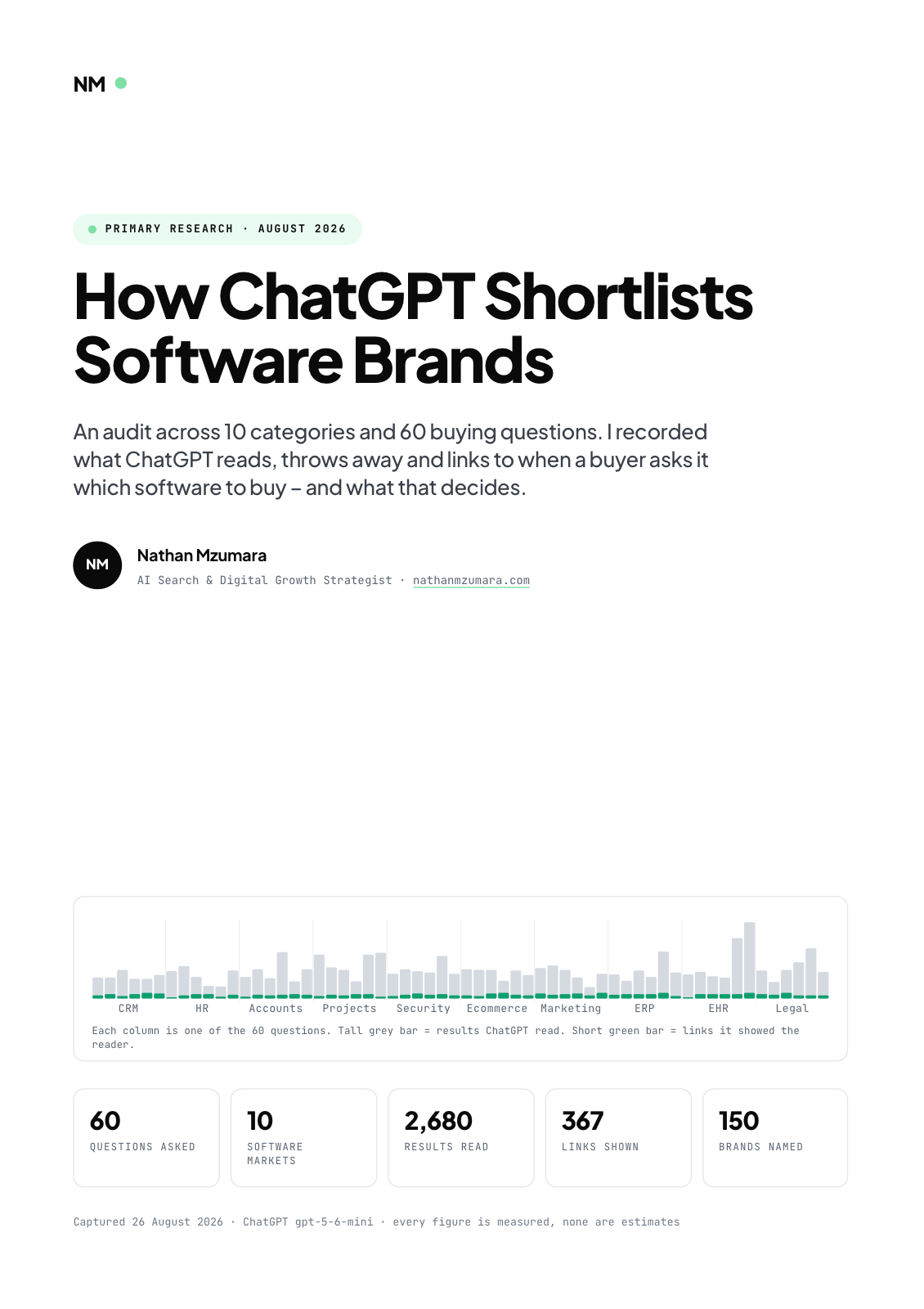
Primary research · August 2026
How ChatGPT Shortlists Software Brands
An audit across 10 categories and 60 buying questions. I recorded what ChatGPT reads, throws away and links to when a buyer asks it which software to buy, and what that decides.
- 60
- Questions asked
- 10
- Software markets
- 2,680
- Results read
- 367
- Links shown
Free download
Get the full report
35 pages · PDF · 536 KB. Enter your details and it downloads straight away.