Search Tactic
Content audit
Also known as: content inventory audit
A content audit is a structured review of every page or asset in a content set, scored against performance, quality, accuracy and search intent. The output is a decision for each item: keep, improve, consolidate, redirect or remove. It turns a large and uneven content library into a prioritised action plan.
What it is
A content audit starts with an inventory, usually a crawl joined to analytics, search performance and conversion data, then adds qualitative judgement about accuracy, depth, tone and whether the page still matches what searchers want. Audits can cover an entire site or a single cluster such as blog posts, product pages or help documentation. It is a diagnostic exercise first and an editing exercise second.
Why it matters
Most sites accumulate near-duplicate, outdated and thin pages that split internal links, confuse intent signals and waste crawl budget. Clearing that out concentrates authority on the pages you want to rank and reduces the chance that an AI assistant or search engine quotes something stale. Audits also surface the content gaps that should shape the next planning cycle.
How it works
Practitioners export a full URL list, join it to sessions, conversions, impressions, clicks, backlinks and last updated dates, then tag each page with a status and an action owner. Low-value duplicates are merged into a stronger canonical page with redirects, thin pages are either expanded or retired, and high-potential pages get a refresh brief. Work is sequenced by business value so that revenue pages are fixed before the long tail.
When it applies
Run a full audit before a redesign, migration, replatform or major strategy change, and lighter cluster level audits on a quarterly or annual cycle.
Examples
- A SaaS company audits 600 blog posts and consolidates 90 overlapping posts into 20 stronger guides with redirects.
- An ecommerce team removes 400 discontinued product pages and redirects them to the relevant category.
- A professional services firm reviews its service pages and finds outdated pricing and compliance wording on a third of them.
How it is measured
- Share of inventory audited and assigned an action, by cluster
- Pages by action type: keep, improve, consolidate, redirect, remove
- Organic sessions, conversions and revenue per page before and after the work
- Indexed page count and crawl requests to low-value URLs after clean-up
Insights on Content audit
Related terms in Search Tactic
- Answer Engine OptimisationThe practice of structuring content so it can be lifted directly into AI answers. Close cousin of GEO; emphasises clean, parseable facts and unambiguous attribution.
- Citation-worthy contentContent with the qualities LLMs select for when synthesising an answer: a single, defensible claim per paragraph; named entities; first-hand evidence; and a clear authority signal.
- Crawler policyA crawler policy is the set of rules a site publishes and enforces to decide which automated agents may access its content, how often, and for what purpose. It typically combines robots.txt directives, server side rules and terms of use, and increasingly distinguishes search crawlers from AI training and assistant crawlers. The policy defines both what is allowed and what happens when a bot ignores it.
- Digital discoveryThe full set of channels through which people find brands, products, and answers, search engines, AI assistants, social platforms, marketplaces, and agentic browsers. Replaces the narrower frame of just “SEO”.
- Ecommerce SEOEcommerce SEO is the practice of making an online store's category, product, brand and editorial pages discoverable in organic search. It combines technical work on crawling, indexing and site structure with commercial decisions about which queries each page should serve. The goal is qualified non-paid traffic that converts into orders.
- Generative Engine OptimisationThe discipline of optimising content to be cited inside generative answers across ChatGPT, Claude, Gemini, Perplexity, and AI Overviews. Overlapping but distinct from classical SEO, favours specificity, citation-worthy claims, and structured attribution.
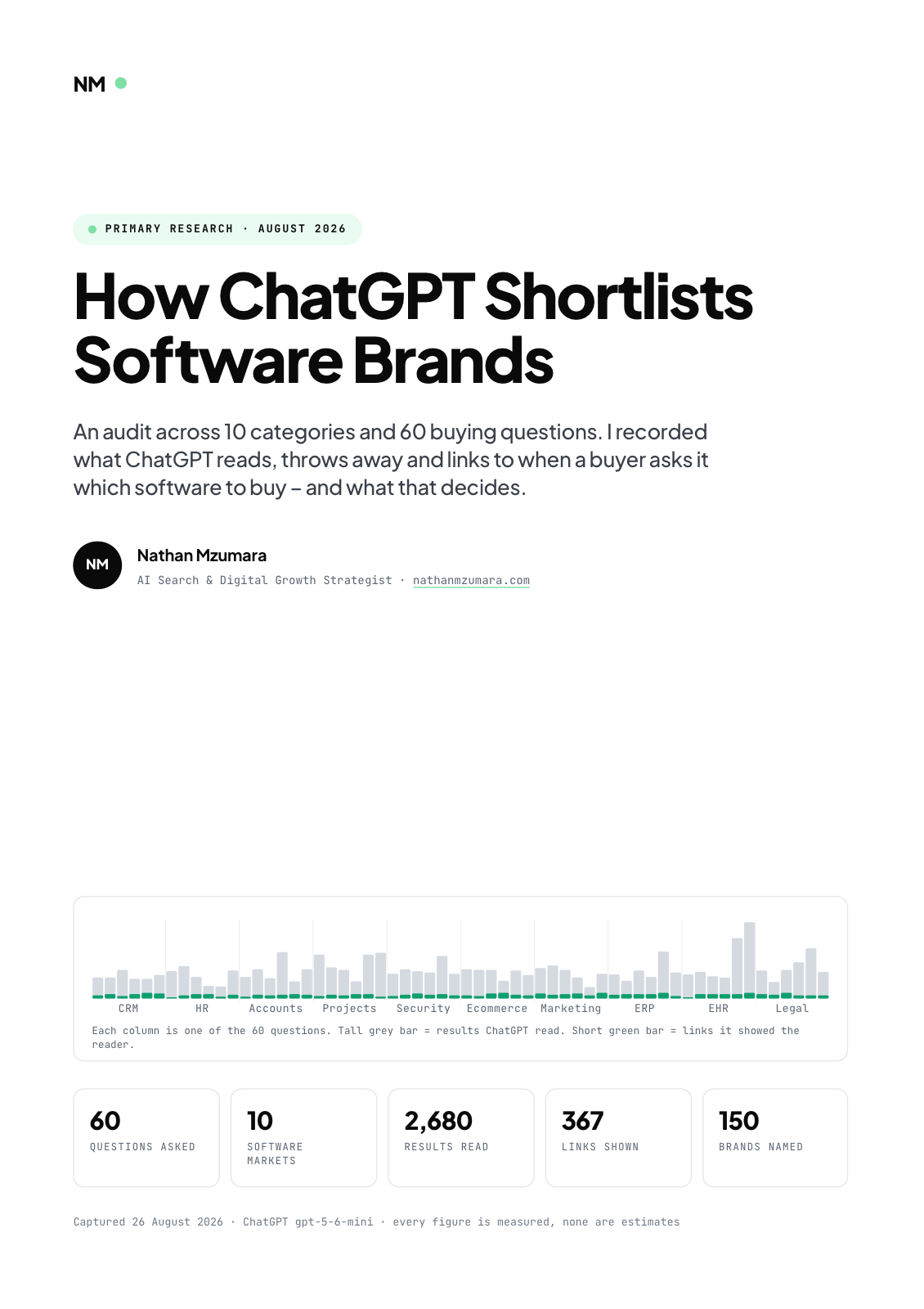
Primary research · August 2026
How ChatGPT Shortlists Software Brands
An audit across 10 categories and 60 buying questions. I recorded what ChatGPT reads, throws away and links to when a buyer asks it which software to buy, and what that decides.
- 60
- Questions asked
- 10
- Software markets
- 2,680
- Results read
- 367
- Links shown
Free download
Get the full report
35 pages · PDF · 536 KB. Enter your details and it downloads straight away.