Search Tactic
Ecommerce SEO
Also known as: e-commerce SEO, online store SEO
Ecommerce SEO is the practice of making an online store's category, product, brand and editorial pages discoverable in organic search. It combines technical work on crawling, indexing and site structure with commercial decisions about which queries each page should serve. The goal is qualified non-paid traffic that converts into orders.
What it is
Ecommerce SEO covers the specific problems that shops face: large catalogues, faceted navigation, duplicate and near-duplicate product pages, out-of-stock and discontinued items, and thin manufacturer descriptions. It spans information architecture, internal linking, structured data for products and reviews, page performance and content on category and product pages. It sits alongside paid shopping and marketplace listings rather than replacing them.
Why it matters
Category and product pages are where commercial intent is highest, so small ranking and click-through gains compound into revenue. Store platforms generate huge numbers of URL variations by default, which wastes crawl budget and splits ranking signals unless it is controlled. Product data that is clean and marked up also feeds shopping surfaces and AI assistants that cite or compare retailers.
How it works
Practitioners map keyword demand to a page hierarchy, decide which facets deserve indexable landing pages and which should be blocked or canonicalised, then fix duplication and internal linking so authority reaches money pages. They add product schema with price, availability and review data, write original copy on top of supplier feeds, and set rules for handling stock outs and retired lines with redirects or retained pages. Ongoing work is log file and crawl analysis, index monitoring and content refreshes on priority categories.
When it applies
It applies to any store that relies on organic demand, and becomes critical when a catalogue is large, seasonal or frequently changing, or when a platform migration or replatform is planned.
Examples
- A homeware store makes colour and material facets indexable but blocks price and sort parameters, cutting crawled URLs sharply while adding new landing pages for 'oak dining tables'.
- A retailer keeps discontinued product URLs live with clear alternatives instead of returning 404s, retaining links and organic entrances to those pages.
- A marketplace seller rewrites the top 200 product descriptions with original specification tables and FAQ content rather than using supplier boilerplate.
How it is measured
- Organic revenue and conversion rate split by category, product and editorial page types
- Share of catalogue URLs indexed versus submitted, and crawl requests wasted on parameter URLs
- Non-brand organic clicks and average position for category head and mid-tail queries
- Organic entrances to product pages and the assisted revenue from them
Insights on Ecommerce SEO
Related terms in Search Tactic
- Answer Engine OptimisationThe practice of structuring content so it can be lifted directly into AI answers. Close cousin of GEO; emphasises clean, parseable facts and unambiguous attribution.
- Citation-worthy contentContent with the qualities LLMs select for when synthesising an answer: a single, defensible claim per paragraph; named entities; first-hand evidence; and a clear authority signal.
- Content auditA content audit is a structured review of every page or asset in a content set, scored against performance, quality, accuracy and search intent. The output is a decision for each item: keep, improve, consolidate, redirect or remove. It turns a large and uneven content library into a prioritised action plan.
- Crawler policyA crawler policy is the set of rules a site publishes and enforces to decide which automated agents may access its content, how often, and for what purpose. It typically combines robots.txt directives, server side rules and terms of use, and increasingly distinguishes search crawlers from AI training and assistant crawlers. The policy defines both what is allowed and what happens when a bot ignores it.
- Digital discoveryThe full set of channels through which people find brands, products, and answers, search engines, AI assistants, social platforms, marketplaces, and agentic browsers. Replaces the narrower frame of just “SEO”.
- Generative Engine OptimisationThe discipline of optimising content to be cited inside generative answers across ChatGPT, Claude, Gemini, Perplexity, and AI Overviews. Overlapping but distinct from classical SEO, favours specificity, citation-worthy claims, and structured attribution.
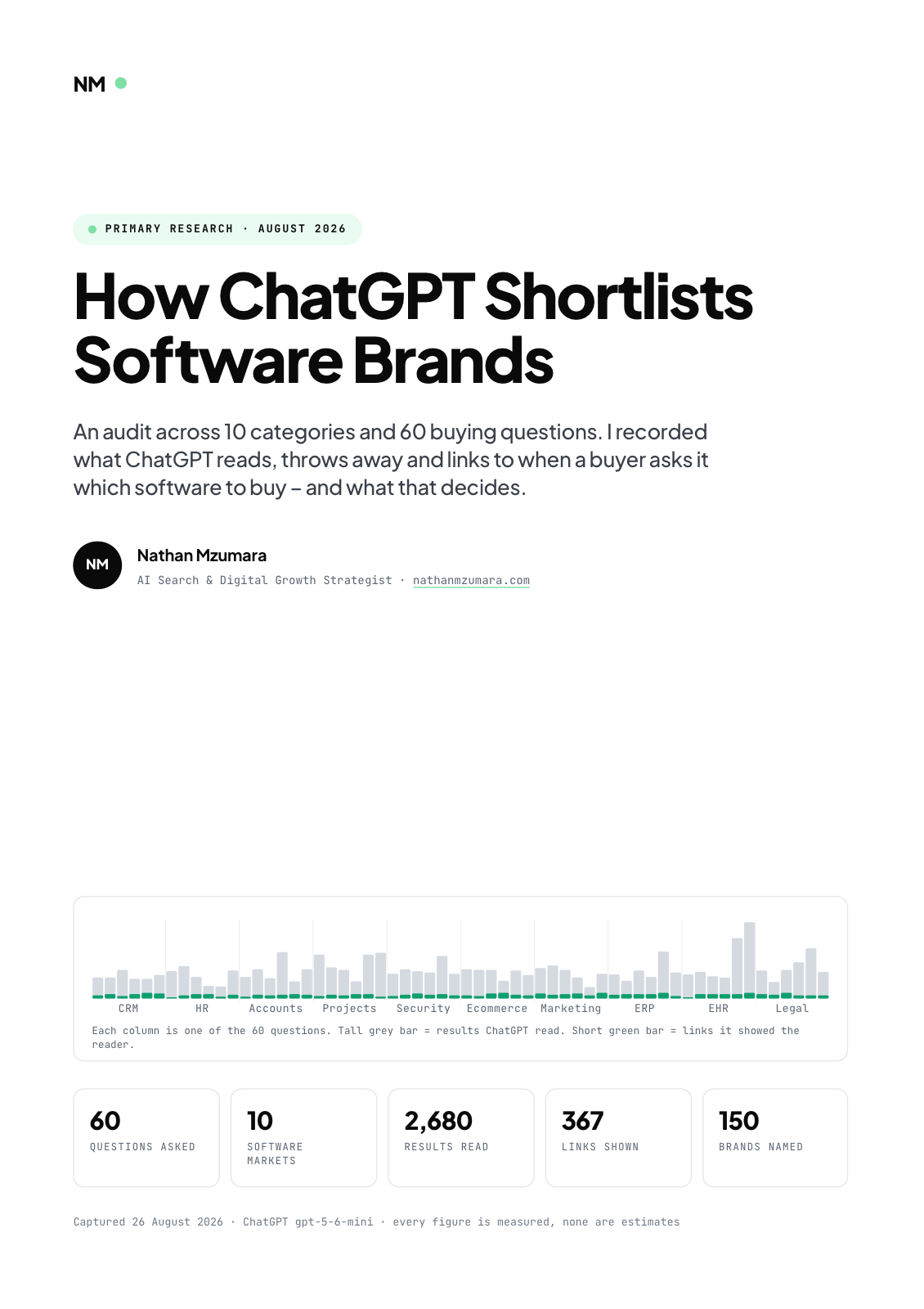
Primary research · August 2026
How ChatGPT Shortlists Software Brands
An audit across 10 categories and 60 buying questions. I recorded what ChatGPT reads, throws away and links to when a buyer asks it which software to buy, and what that decides.
- 60
- Questions asked
- 10
- Software markets
- 2,680
- Results read
- 367
- Links shown
Free download
Get the full report
35 pages · PDF · 536 KB. Enter your details and it downloads straight away.