Marketing Strategy
AI search
Also known as: AI-powered search, generative search
AI search is the use of large language models to answer a query directly, usually with a written summary rather than a list of links. It covers AI overviews inside traditional search engines and assistants such as ChatGPT, Perplexity, Copilot and Gemini. The visible outcome for a brand is being described and cited inside an answer rather than ranked on a results page.
What it is
AI search combines retrieval, where the system gathers candidate sources, with generation, where a model writes an answer from those sources and its own training. The interface is conversational, so people ask longer, more specific questions and follow up rather than re-typing keywords. Results vary between users and between runs, because generation is probabilistic and the retrieved set changes.
Why it matters
When an answer is written for the user, fewer people click through, so visibility has to be measured by mention and citation as well as by clicks. It also changes what content earns inclusion, favouring clear, specific, well evidenced pages that a model can quote accurately. Brands that ignore it risk being described by competitors' content and third party reviews instead of their own.
How it works
Teams build a set of real questions across the funnel, run them across the main assistants, and record mentions, citations, sentiment and factual accuracy. They then fix the gaps by publishing direct answers to those questions, tightening product and pricing pages, and earning presence on the third party sources that assistants tend to cite. Technical work covers crawl access for AI agents, clean structure and readable HTML.
When it applies
It applies to any category where buyers research before purchase, and it becomes urgent when organic clicks fall while impressions hold steady.
Examples
- A logistics firm finds that AI overviews answer its top how to queries, so it rewrites those pages to lead with a short direct answer.
- A DTC brand discovers Perplexity cites two review sites for its category and starts working with both.
- A SaaS company adds a detailed comparison page after seeing assistants answer 'X versus Y' questions using a competitor's page.
How it is measured
- Prompt coverage, the share of tracked questions where the brand appears
- Citation count and citing domains per assistant
- Referral traffic and assisted conversions from AI assistants
- Share of AI answers where brand facts are stated correctly
Insights on AI search
- ChatGPT DSA Designation: Now a Search Engine in the EU
- GPT-Live-1 Makes Voice Cheap. Nobody Can Measure It Yet
- ChatGPT Ads : OpenAI Hits $1bn as the Auction Opens
- OpenAI Status: What OpenAI Is, Who Owns It, and Where It Stands in 2026
- Anthropic Claude Computer Use Browser Control: What Changed
- Grok 4.6 Just Landed on Google's Cloud. Your GEO Playbook Changes.
- Google's August 2026 Spam Update Is Live. Read This First.
- OpenAI Just Hired a Sales Machine. ChatGPT Is Now a B2B Channel.
Related terms in Marketing Strategy
- Agentic marketingAgentic marketing is the use of AI agents that can plan multi-step work and take actions across marketing tools, rather than only generating text on request. It also covers designing marketing for a world where buyers delegate research and purchasing to their own agents. In practice it is a mix of workflow automation, tool permissions and human review.
- AI-generated contentAI-generated content is text, images, audio, video or code produced wholly or mainly by a generative model rather than written or made by a person. It ranges from fully automated output to drafts that a human edits and approves. Its value in marketing depends on editorial control, accuracy and whether it adds anything a reader cannot get elsewhere.
- Audience intelligenceAudience intelligence is the practice of gathering and analysing data about who your audience is, what they care about, and how they search and buy, then turning that into decisions. It combines first party behavioural data with research, search data, social listening, and customer conversations. The output is usually segments, messaging guidance, and content priorities rather than a single report.
- B2B marketingB2B marketing is the practice of promoting products and services to other organisations rather than to individual consumers. It typically involves longer sales cycles, multiple decision makers, higher contract values and a heavier reliance on content, sales enablement and relationships. Success is usually measured through pipeline and revenue contribution rather than immediate transactions.
- Brand voiceBrand voice is the consistent personality and language a brand uses across every channel, covering vocabulary, tone, sentence rhythm and the things it will and will not say. It is documented in guidelines so different writers, agencies and AI tools produce work that sounds like the same organisation. Voice stays stable while tone flexes with context.
- Content automationContent automation is the use of software, templates, data feeds and AI models to produce, update or distribute content with less manual effort at each step. It ranges from automatically refreshing prices and stock levels on a page to generating full drafts for human editing. The aim is consistency and scale, not the removal of editorial judgement.
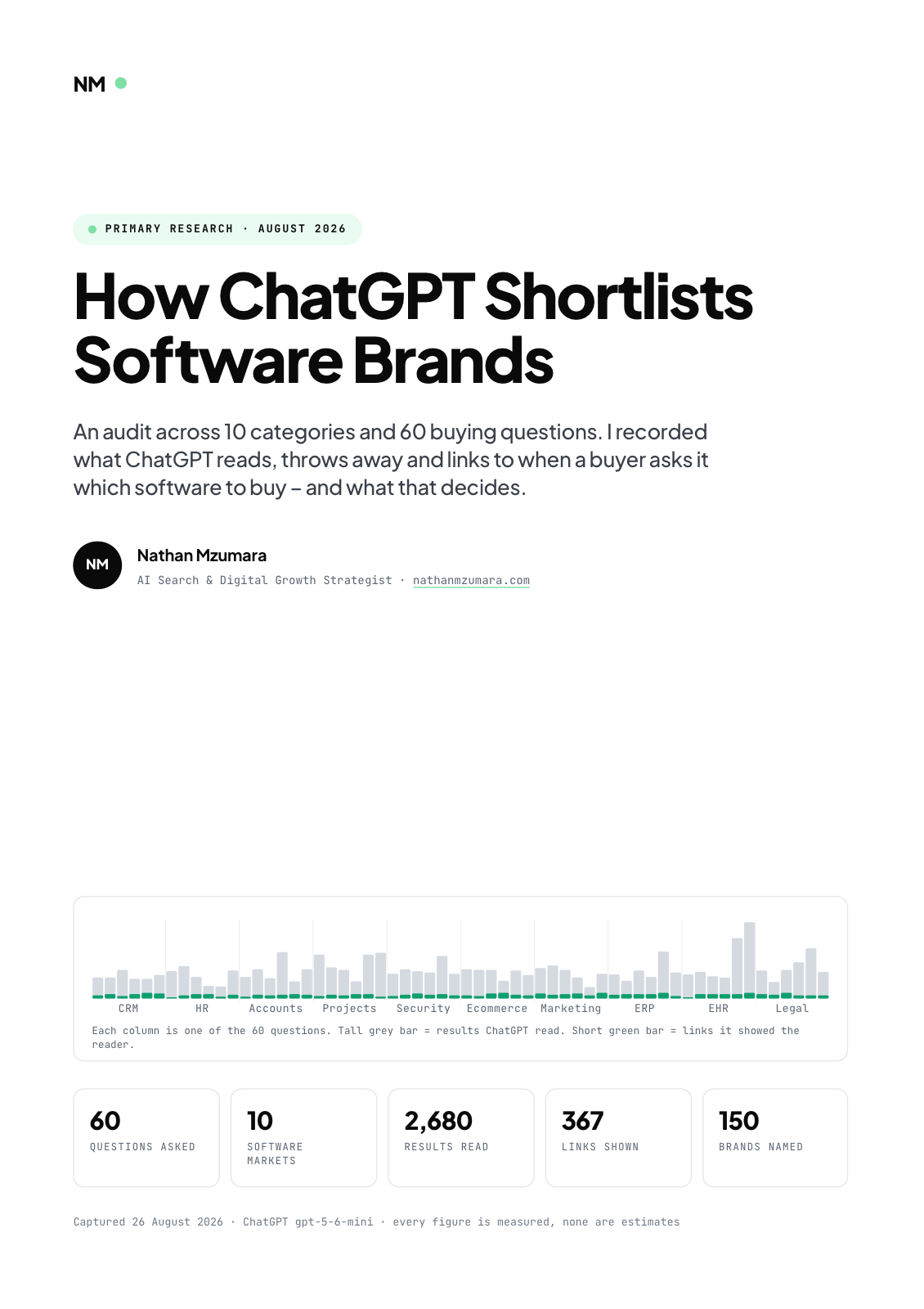
Primary research · August 2026
How ChatGPT Shortlists Software Brands
An audit across 10 categories and 60 buying questions. I recorded what ChatGPT reads, throws away and links to when a buyer asks it which software to buy, and what that decides.
- 60
- Questions asked
- 10
- Software markets
- 2,680
- Results read
- 367
- Links shown
Free download
Get the full report
35 pages · PDF · 536 KB. Enter your details and it downloads straight away.