ChatGPT Voice Can Now Use Your Email, Calendar and Slack

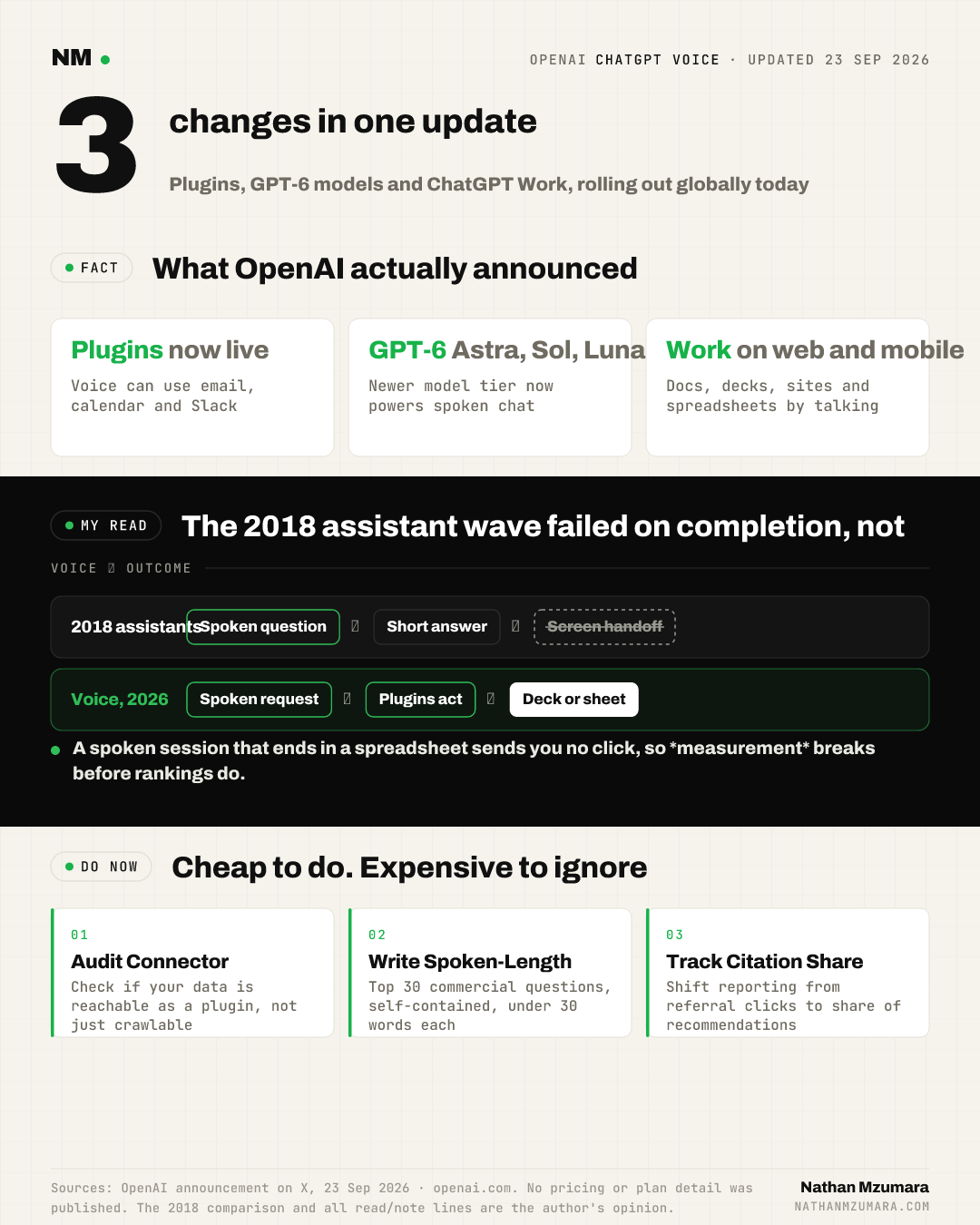
OpenAI updated ChatGPT Voice on 23 September 2026. Voice can now use plugins like your email, calendar and Slack, be powered by GPT-6 Astra, Sol and Luna, and be used in ChatGPT Work on web and mobile, where you can create docs, decks, sites and spreadsheets or tackle complex tasks in the browser just by talking. It is rolling out globally today in the latest version of the app.
OpenAI framed the change as a reply to user pressure. Its announcement post on X, published 23 September 2026, opens with four words: "We heard you loud and clear."
ChatGPT Voice is OpenAI's spoken interface for ChatGPT, and after this update it can act inside connected apps and produce finished work files rather than only talk back. That is the whole story for anyone running growth, search or brand discovery.
What changed in ChatGPT Voice on 23 September 2026
The update has three parts, exactly as OpenAI stated them:
- Plugins: ChatGPT Voice can now use plugins like your email, calendar and Slack.
- Models: ChatGPT Voice can now be powered by GPT-6 Astra, Sol and Luna.
- ChatGPT Work: Voice can now be used in ChatGPT Work on web and mobile, so you can create docs, decks, sites and spreadsheets or tackle complex tasks in the browser, just by talking.
OpenAI gave no pricing or plan details in the post. It said only that the rollout is global today in the latest version of the app.
Plugins turn speech into action
Email, calendar and Slack are not content surfaces. They are systems of record and coordination. Once a spoken request can reach them, the model is no longer retrieving a page and reading it out. It is reading your inbox, your diary and your team channel, then doing something.
Not everyone was impressed. One reply under the announcement, from the account @Sophty_ on 23 September 2026, read: "Ah yes an email plugin exactly what customers have been petitioning for." Fair scepticism about the headline feature. It misses what the plumbing implies.
GPT-6 Astra, Sol and Luna behind spoken interaction
Putting GPT-6 Astra, Sol and Luna behind Voice means the newer model tier now sits behind speech, not just typing. Better reasoning in the spoken channel raises the chance that a single verbal answer is treated as sufficient by the user.
One open question was raised in the replies and not answered in the post. The account @TokenGremlin asked on 23 September 2026 whether GPT-6 Sol and Luna are coming to Chat itself, not just ChatGPT Work and Codex. OpenAI's post does not say. If you are modelling cost and capability across surfaces, that gap matters, and it sits next to the pricing shifts I covered in GPT-6 Sol and Luna halve GPT-5.6 Sol prices.
ChatGPT Work makes voice an output channel
A ChatGPT voice chat used to end with words. In ChatGPT Work it can now end with a deck, a spreadsheet, a site or a document. That is the difference between a conversation and a deliverable. The useful question is no longer how to voice chat with ChatGPT, it is what a voice chat with ChatGPT hands back once the talking stops.
Why does voice matter more now than it did in 2018?
The 2018 voice assistant wave was loud and then quiet. Agencies built skills and actions, brands optimised for question phrasing, and very little converted. The reason was simple: the assistant could answer, but it could not finish the job. Anything complex bounced you back to a screen.
Plugins plus document creation are exactly the task completion that was missing. That is why this rollout deserves more attention than the last one did.
| Dimension | Voice assistants, 2018 wave | ChatGPT Voice, 23 September 2026 |
|---|---|---|
| Main job | Answer short questions, timers, music | Answer, then act and produce work |
| Task completion | Handed off to a screen for anything complex | Complex tasks tackled in the browser by talking |
| Connected systems | Limited third-party skills | Plugins like email, calendar and Slack |
| Output | Spoken reply only | Docs, decks, sites and spreadsheets |
| Model quality | Intent matching | GPT-6 Astra, Sol and Luna |
Comparison built only from OpenAI's 23 September 2026 announcement and the well-documented limits of the earlier assistant wave. It shows that the missing ingredient in 2018 was completion, not comprehension.
What this update means for growth leaders in plain English
A spoken query returns one answer. Not ten blue links, not a carousel, not a page you can scan for your brand. That single change reshapes three things growth teams are paid to manage.
- The citation ceiling collapses: visibility stops being "rank on page one" and becomes "be the one recommendation". There is no position four in a spoken answer.
- The retrieval path shifts: when Voice can use plugins, part of the answer comes from connected first-party systems and plugin endpoints rather than a public web crawl. Being crawlable is necessary and no longer sufficient.
- The analytics fingerprint fades: a voice session in ChatGPT Work leaves almost nothing in your referral reports. Sessions that end in a spreadsheet inside the browser do not send you a click.
My read is that the measurement gap will hurt in-house teams before the ranking gap does. Boards ask for attribution, and this surface does not produce it. I made the same argument about the API side in GPT-Live-1 makes voice cheap, nobody can measure it yet, and this update pushes the same problem into the consumer and work apps.
Three moves that respond to the update
- Audit reachability as a connector, not just a page. Ask whether your product, catalogue, booking flow or support data can be reached as a plugin or an MCP-style connector. If the only route in is a crawlable page, you are competing for a slot in a channel that increasingly reads from connected systems.
- Rewrite priority content into spoken-length answers. Take your top 30 commercial questions and write a self-contained answer for each that a model can read aloud in under 30 words. Facts first, subject named, no dependence on the paragraph above it.
- Move measurement from referrals to citation share. Sample prompts on a fixed schedule, record whether your brand is named, and track branded-query lift alongside it. Treat citation-share sampling as the primary metric for this channel and referral data as a bonus.
For the retrieval logic behind point one, my breakdown of how brand mentions survive or die at each stage of an AI answer sits in brand visibility in AI search.
What could go wrong
Governance is the obvious risk. A spoken instruction that reaches email, calendar and Slack touches customer data, contracts and internal plans. Security and legal teams will want rules before marketing teams start building connectors.
Commercially, OpenAI stated no pricing or plan details for this update, so cost per seat is unknown. Building a connector strategy on an unpriced surface carries real budget risk.
There is also a rollout risk. The update is shipping globally in the latest version of the app, which means staged availability in practice. If you find ChatGPT Voice not working with plugins yet, the version of the app you are on is the first thing to check.
The counter-view
The case against reacting hard is decent. Email, calendar and Slack are internal productivity connectors, not brand discovery surfaces, and nothing in OpenAI's post says a third-party brand can be surfaced through them. The commercial layer for this channel is still forming, as the arrival of ChatGPT sponsored agents suggests.
Voice also has a usage problem that better models do not solve. People type in open-plan offices. They do not dictate decks next to a colleague. In my opinion, adoption will run ahead in cars, kitchens and on the move, and lag badly in the places where B2B buying actually happens.
What ChatGPT Voice changes for your team this week
Do one thing before next Monday. Pick your ten highest-value commercial questions, ask them aloud in ChatGroup-free conditions using ChatGPT Voice on the latest version of the app, and record whether your brand is named in the spoken answer. That baseline takes an hour and it is the only honest starting point you will get.
Then brief your engineering lead on connector readiness, and tell your analytics lead that spoken sessions will not show up as referrals. Treat ChatGPT Voice as what it now is, a work surface rather than a novelty input, and the measurement problem stops being a surprise in six months.
ChatGPT Voice update published 23 September 2026. Last updated 23 September 2026.