GPT-6 Sol and GPT-6 Luna Halve GPT-5.6 Sol Prices

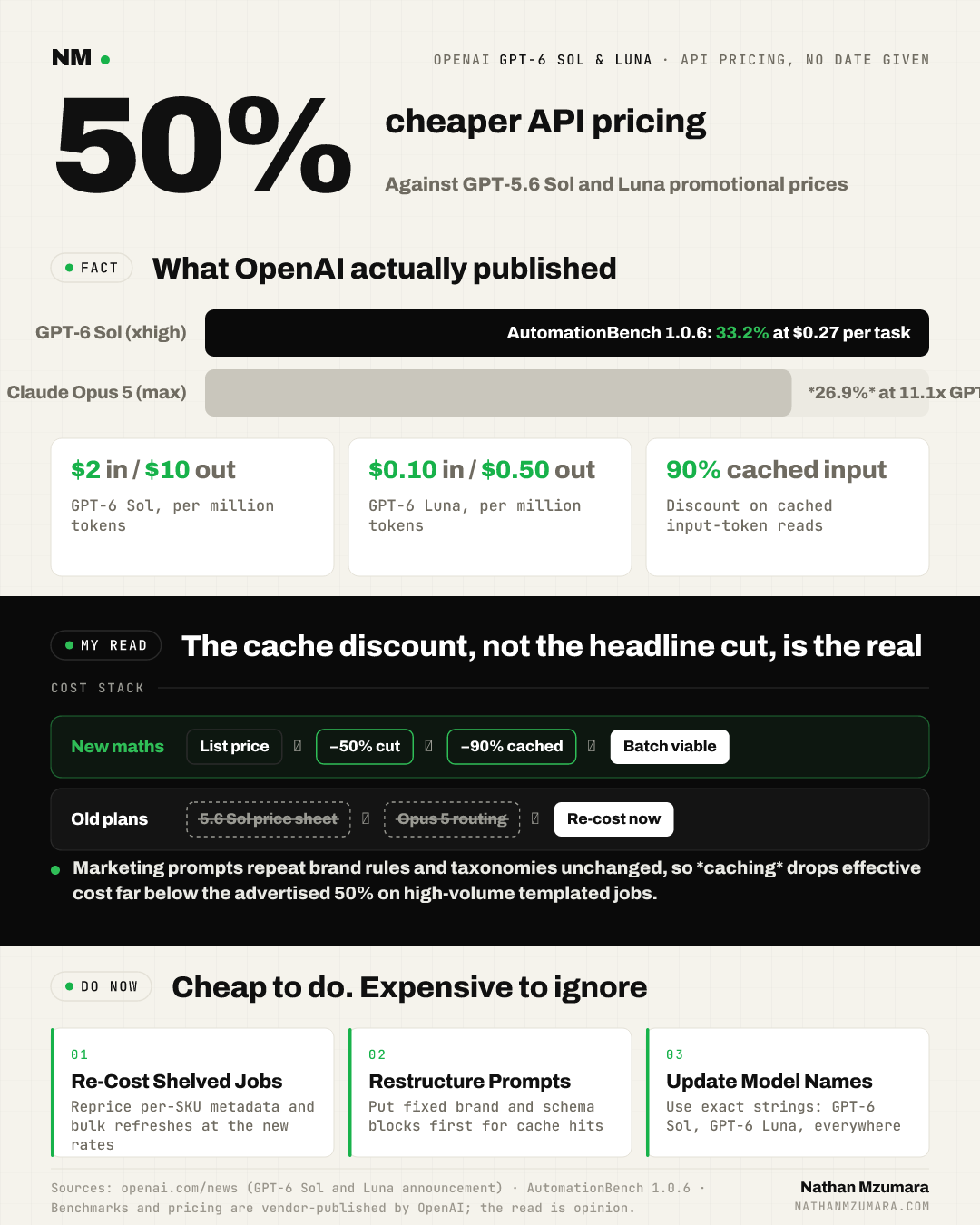
OpenAI has cut API prices for GPT-6 Sol and GPT-6 Luna by 50% against the GPT-5.6 Sol and GPT-5.6 Luna promotional pricing. GPT-6 Sol now costs $2 input and $10 output per million tokens. GPT-6 Luna costs $0.10 and $0.50. OpenAI's announcement gives no date and no rollout schedule.
The interesting part is not the benchmark table. It is that a whole class of marketing work that was too expensive to run at scale just got cheap enough to put on a budget line.
What changed in GPT-6 Sol and GPT-6 Luna pricing?
OpenAI has expanded the GPT-6 family with two models, GPT-6 Sol and GPT-6 Luna. In its post introducing GPT-6 Sol and Luna, OpenAI says improvements in caching and inference let it serve these models at lower cost, and that it is passing those savings directly on to users and customers.
| Model | Input | Output | Price reduction |
|---|---|---|---|
| GPT-5.6 Sol to GPT-6 Sol | $4 to $2 | $20 to $10 | 50% cheaper |
| GPT-5.6 Luna to GPT-6 Luna | $0.20 to $0.10 | $1.20 to $0.50 | 50% cheaper |
The takeaway from the pricing table above: every token-priced workflow you costed in the last quarter is now roughly twice as affordable. Prices are per 1 million tokens. Source: OpenAI.
On timing, be careful. OpenAI's announcement does not state a publication or availability date. It says GPT-6 Astra was introduced "earlier this month". No markets, plans or rollout schedule are given. Pricing is stated for the API only, so if you are hunting for a ChatGPT Sol or ChatGPT 5.6 Sol consumer plan, the announcement does not describe one.
What is GPT-5.6 Sol, and how does GPT-6 Sol differ?
GPT-5.6 Sol is the previous mid-tier OpenAI model, the one whose promotional price the new cut is measured against. GPT-6 Sol is a faster, more affordable model trained with similar methods to GPT-6 Astra.
That shared training is the substance of the news. OpenAI says it brings Astra's advances in professional work, factuality, coding, computer use and alignment into the cheaper tier. GPT-6 Astra continues to be OpenAI's best model across the board, and OpenAI recommends it when you want the best results and an uncompromising experience.
Anyone still working from an OpenAI GPT-5.6 Sol model price sheet is now planning against a superseded number. Keep the naming exact in your finance models, docs and prompts too: the model is GPT-6 Sol, not GPT Sol, and retrieval systems match entities on exact strings.
How do GPT-6 Sol and Luna compare with Claude Opus 5 and Fable 5?
OpenAI frames almost every comparison around cost per task rather than raw score. If your routing decisions rest on an Opus 5 vs GPT-5.6 Sol comparison, they are out of date.
AutomationBench 1.0.6
On AutomationBench 1.0.6, which tests agents on end-to-end business workflows using 47 tools across sales, marketing, operations, support, finance and HR, GPT-6 Sol at xhigh effort scores 33.2% at $0.27 per task. It outperforms Claude Opus 5 at max effort at 9% of Opus 5's cost per task. GPT-6 Luna at high effort improves on its predecessor by 5.4 percentage points at 58% lower cost per task.
| Model and effort | Score | Cost per task |
|---|---|---|
| GPT-6 Sol (xhigh) | 33.2% | $0.27 |
| GPT-6 Astra (low) | 30.3% | 3.9x GPT-6 Sol |
| Claude Opus 5 (max) | 26.9% | 11.1x GPT-6 Sol |
| Claude Fable 5.1 with Opus 5 fallback (max) | 31.4% | Over 8.9x GPT-6 Sol, fallback cost not reported |
The comparison table above shows why cost per task, not score, is the story. OpenAI notes the Claude Fable 5.1 figure understates its real cost, because it omits Opus 5 fallbacks that occurred on around 40% of tasks. Source: OpenAI, AutomationBench 1.0.6.
Agents' Last Exam V1
On Agents' Last Exam V1, which evaluates long-horizon professional workflows across 55 sub-industries, GPT-6 Sol at max effort scores 56.4%. That is above Claude Opus 5's highest score in the evaluation, at 60% lower cost per task.
DeepSWE v1.1
The old GPT-5.6 Sol vs Fable 5 comparison has been overtaken. On DeepSWE v1.1, GPT-6 Sol at max effort scores 68.8%, within 1.1 percentage points of Claude Fable 5's highest score of 69.9% at xhigh effort, at approximately 80% lower cost per task. GPT-6 Luna at max effort scores 66.6%, costing 93% less per task than Opus 5 and 96% less than Fable 5.
OSWorld 2.0 offline
On OSWorld 2.0 offline, using partial reward on the v2026.08.08 release, GPT-6 Sol at xhigh effort scores 60.5% against Claude Opus 5 at medium effort on 60.3%, at approximately 80% lower cost per task. GPT-6 Luna at max effort exceeds GPT-5.6 Sol at medium effort at one tenth of its cost.
Factuality
On OpenAI's internal factuality evaluation, GPT-6 Sol makes about half as many mistakes as its predecessor. GPT-6 Luna at higher effort levels matches GPT-5.6 Sol at about a hundredth its cost. The test uses de-identified ChatGPT conversations where users flagged a factual error from a prior model, and OpenAI states these error-inducing conversations are not representative of typical usage.
The 90% cached input discount matters more than the headline cut
Prompt caching for GPT-6 delivers higher cache hit rates by default, with discounts of 90% on cached input-token reads. OpenAI has added a Prompt Caching Dashboard, a diagnostics tool, cache-preserving changes to reasoning effort and tool availability, and explicit breakpoints for cached prefixes.
Marketing workloads are unusually cache-friendly. Brand guidelines, tone rules, product taxonomies and schema templates sit in the prompt unchanged across thousands of calls. Stack a 50% price cut on top of a 90% discount on repeated input and the effective cost of a templated, high-volume job falls much further than the headline number suggests.
What GPT-6 Sol and GPT-6 Luna change for marketers and growth leaders
In plain English: work you priced out last quarter is now viable. Five examples where the maths flips.
- Per-SKU metadata generation: title tags, descriptions and structured data across large catalogues become a routine batch job rather than a one-off project with a business case.
- Entity-level content refreshes: updating thousands of pages against changed facts stops being a sampling exercise and becomes full coverage.
- Query-cluster analysis: classifying and clustering millions of keywords for intent is cheap enough to re-run monthly instead of annually.
- Continuous AI visibility monitoring: tracking dozens of prompts across multiple answer engines every day is a cost you can defend, not a pilot.
- Build versus buy: when the token cost underneath a seat licence halves, every AI visibility and content tool on your invoice needs re-justifying on workflow, data and support rather than model access.
There is a cost signal in OpenAI's own usage. Valued at API prices, daily token usage has exceeded $600 for the median OpenAI researcher and $7,000 for researchers at the 90th percentile. Agentic work burns tokens at a rate most marketing teams have not yet budgeted for, which is exactly why a 50% cut lands hard. The same pattern showed up when Grok 4.7 arrived at Grok 4.6 prices with higher scores.
My own observation from routing reviews with in-house teams: the cheap tier is almost always under-used. Teams pick one model, wire it into everything, and never revisit it. That habit is now expensive.
What could go wrong
Four cautions before you rewrite the budget. First, the scores that beat Claude Opus 5 and Fable 5 are mostly at xhigh or max effort, which costs more than default settings. Second, OpenAI's factuality evaluation deliberately uses conversations where users flagged errors, so it is not a general accuracy claim. Third, the Fable 5.1 cost figure excludes Opus 5 fallbacks on around 40% of tasks, per OpenAI. Fourth, no release date or rollout schedule is stated anywhere in the announcement.
The counter-view
The argument against acting fast is simple: cheaper tokens mean more output, and more output is not more value. Halving the price of generating 400,000 product descriptions does not make 400,000 product descriptions a good idea. Cheap capacity tends to produce volume nobody reviews.
My read is that the winners here will be the teams with the tightest quality gates, not the biggest batch jobs. If your agent orchestration is already disciplined, as it needs to be when the agent loop becomes a hosted product, the price cut compounds. If it is not, the cut just buys you faster mistakes.
What to do this week to re-budget for GPT-6 Sol and GPT-6 Luna
- Re-run your model routing. Move high-volume, low-judgement work to GPT-6 Sol or GPT-6 Luna and keep GPT-6 Astra for the reasoning-heavy minority of tasks.
- Open the Prompt Caching Dashboard and check your hit rate. Restructure prompts so the stable prefix sits first and qualifies for the 90% cached-read discount.
- Rebuild your cost-per-output baseline. Price one real workflow end to end at the new rates before you renew anything.
- Re-price your tool stack against build cost, then decide which seat licences survive the comparison.
The short version: GPT-5.6 Sol pricing is no longer the benchmark your finance model should use. GPT-6 Sol and GPT-6 Luna reset the floor, and last quarter's assumptions about what AI-driven marketing work costs are already wrong.