AI Model & Product
GPT-6 Luna
Also known as: Luna, OpenAI GPT-6 Luna
GPT-6 Luna is a name that circulates in rumour, speculation and scraped content about a possible future OpenAI model. There is no confirmed OpenAI product released under this name, and no verified details about its capabilities, pricing or availability. Treat it as an unverified label rather than a shipped model.
What it is
GPT-6 Luna is best understood as a speculative codename rather than a documented product. Names like this usually emerge from forum posts, leaks of uncertain provenance, aggregator sites and AI-generated articles, then get repeated until they look established. Unless and until a vendor publishes model cards, documentation or pricing, nothing about the name should be treated as fact.
Why it matters
Speculative model names attract search and AI assistant queries long before anything ships, so they create a real content opportunity and a real accuracy risk. Publishing confident claims about an unreleased model is an easy way to get contradicted later, and assistants that cite you may repeat the error. Sites that handle unconfirmed names carefully, by stating clearly what is known and unknown, tend to be safer sources to cite and easier to keep current.
How it works
Practitioners monitor demand for the term, publish a short factual page that says what is confirmed and what is not, and date the page so readers and models can see how fresh it is. The page is then updated whenever official documentation appears, replacing speculation with sourced detail. Internally, teams avoid building roadmaps, pricing models or client promises around an unannounced name.
When it applies
This applies whenever an unreleased or unconfirmed model name starts generating search volume, media mentions or client questions, and during the gap between rumour and official announcement.
Examples
- A marketing team sees rising queries for "GPT-6 Luna pricing" and publishes a dated holding page that states no official pricing exists.
- An agency is asked by a client whether to wait for GPT-6 Luna before committing to a build, and advises planning around currently available models instead.
- A content audit finds an AI-generated blog post on the site listing invented context window and benchmark figures for GPT-6 Luna, and the claims are removed.
How it is measured
- Search volume and query growth for the term and its variants over time
- Share of assistant answers about the term that cite your page rather than speculative sources
- Accuracy audit: proportion of claims on the page backed by primary vendor documentation
- Time between an official announcement and your page being updated
Insights on GPT-6 Luna
Related terms in AI Model & Product
- Agents APIAn Agents API is a programming interface for building applications where a model plans, calls tools and completes multi-step tasks rather than returning a single reply. The term is most often used for OpenAI's agent building interfaces, though other vendors offer equivalents. Teams use it to connect models to search, internal data and actions such as booking, updating records or generating reports.
- AI assistantAn AI assistant is a software product that uses a language model to hold a conversation, answer questions and carry out tasks on a user's behalf. It sits on top of one or more underlying models and adds an interface, memory, tools and safety controls. Examples include ChatGPT, Google Gemini, Microsoft Copilot, Claude and voice assistants such as Siri and Alexa.
- AI transcriptionAI transcription is the automatic conversion of spoken audio into written text using speech recognition models. Modern systems often add speaker labels, punctuation, timestamps and language detection, and can feed the output into summarisation or search. It is also called automatic speech recognition or ASR.
- BingBing is Microsooft's web search engine, available at bing.com and integrated into Microsoft Copilot and other Microsoft products. It maintains its own crawler, Bingbot, and its own index, and provides Bing Webmaster Tools for site owners. Its index and APIs have also supplied results to third-party search products and AI assistants.
- ChatGPT VoiceChatGPT Voice is the spoken conversation mode in OpenAI's ChatGPT apps, which lets you talk to the assistant and hear its replies read aloud. Advanced Voice Mode processes speech directly, so exchanges feel closer to a phone call and you can interrupt mid-answer. People use it hands free on mobile, and it is also available on desktop.
- Claude CodeClaude Code is Anthropic's agentic coding tool that works directly with a codebase, reading files, proposing and making edits, and running commands with permission. It runs in the terminal and in supported development environments, driven by natural language instructions rather than manual file by file editing. Marketing and growth teams use it for technical SEO, structured data and data tasks that would otherwise wait for engineering.
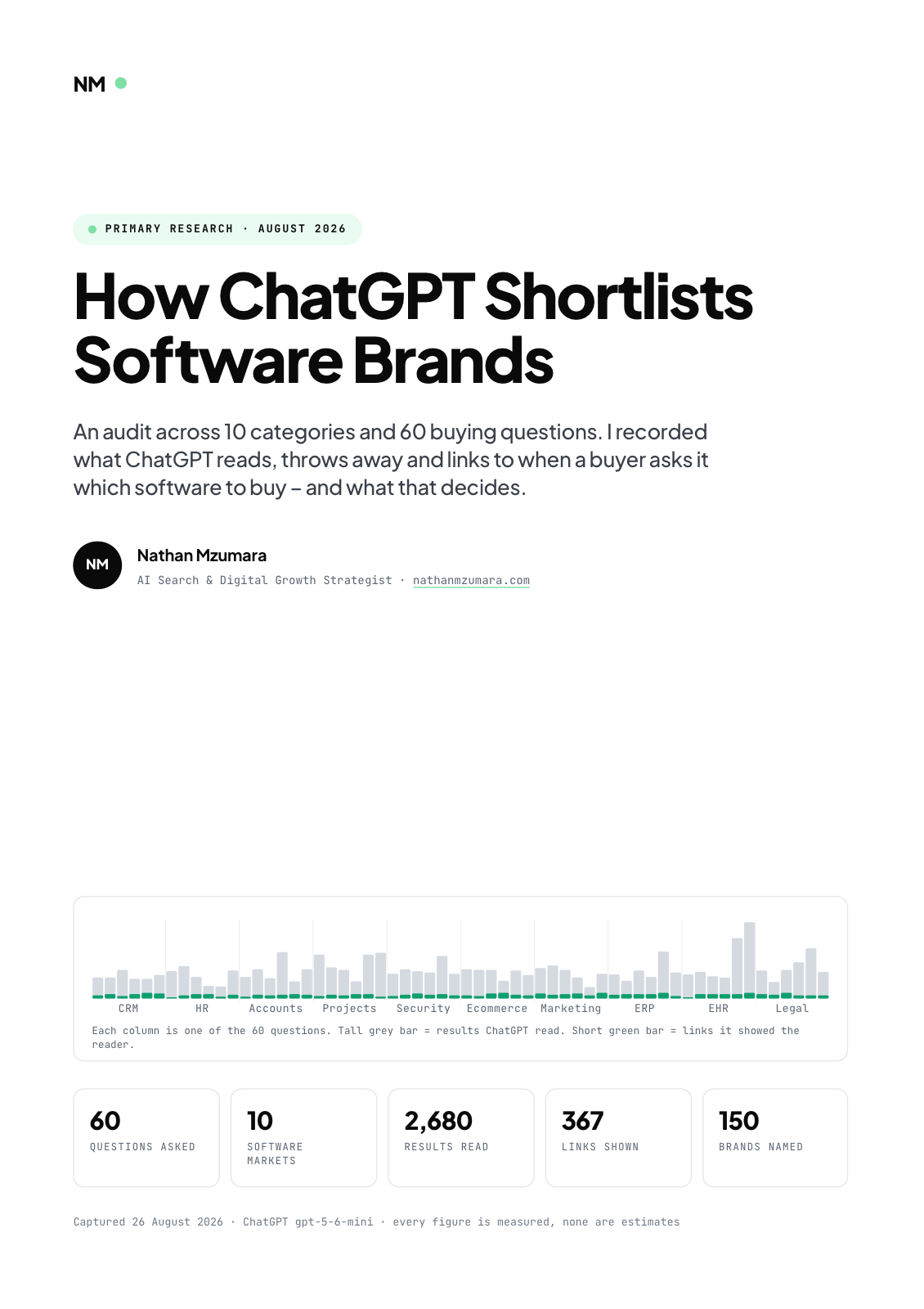
Primary research · August 2026
How ChatGPT Shortlists Software Brands
An audit across 10 categories and 60 buying questions. I recorded what ChatGPT reads, throws away and links to when a buyer asks it which software to buy, and what that decides.
- 60
- Questions asked
- 10
- Software markets
- 2,680
- Results read
- 367
- Links shown
Free download
Get the full report
35 pages · PDF · 536 KB. Enter your details and it downloads straight away.