AI Model & Product
Bing
Also known as: Microsoft Bing, bing.com
Bing is Microsooft's web search engine, available at bing.com and integrated into Microsoft Copilot and other Microsoft products. It maintains its own crawler, Bingbot, and its own index, and provides Bing Webmaster Tools for site owners. Its index and APIs have also supplied results to third-party search products and AI assistants.
What it is
Bing is a general web search engine that crawls, indexes and ranks pages independently of Google, with its own guidelines, spam policies and diagnostic tooling. It sits at the centre of Microsoft's search and AI stack, feeding conversational answers in Copilot as well as conventional results pages. Site owners interact with it mainly through Bing Webmaster Tools and the IndexNow protocol, which lets publishers push URL changes for faster discovery.
Why it matters
Bing's share of traditional search is much smaller than Google's in most markets, but its index has outsized influence because AI products have drawn on it for web grounding. That means a crawling or indexing problem in Bing can quietly cut you out of assistant answers even when Google visibility looks healthy. Bing also skews towards desktop and workplace usage in some markets, which can matter for B2B and enterprise categories.
How it works
Practitioners verify the site in Bing Webmaster Tools, check that Bingbot is not blocked in robots.txt or by bot mitigation and CDN rules, submit sitemaps, and use IndexNow to notify Bing of new and updated URLs. They review Bing's own reports on crawl errors, indexed pages and query performance, then compare keyword coverage with Google to find gaps caused by technical issues rather than content quality. Bing rewards clear on-page relevance and clean technical foundations, so fixes are often mundane: accessible HTML, unique titles, working canonicals and reachable pages.
When it applies
It applies to any site that wants visibility in Microsoft Copilot and other assistants that lean on Microsoft's index, and to businesses in markets or segments where Bing usage is significant.
Examples
- A B2B software site finds its documentation is blocked to Bingbot by a firewall rule, fixes it, and starts appearing in Copilot answers.
- An ecommerce team adds IndexNow to its publishing workflow so price and stock changes reach Bing quickly.
- A publisher compares Bing Webmaster Tools and Search Console data and discovers thousands of pages indexed in Google but missing from Bing.
How it is measured
- Indexed pages and crawl errors reported in Bing Webmaster Tools
- Bing organic clicks, impressions and average position by page group
- Bingbot crawl requests and response codes in server logs
- Share of priority keywords ranking in the top 10 on Bing versus Google
Related terms in AI Model & Product
- Agents APIAn Agents API is a programming interface for building applications where a model plans, calls tools and completes multi-step tasks rather than returning a single reply. The term is most often used for OpenAI's agent building interfaces, though other vendors offer equivalents. Teams use it to connect models to search, internal data and actions such as booking, updating records or generating reports.
- AI assistantAn AI assistant is a software product that uses a language model to hold a conversation, answer questions and carry out tasks on a user's behalf. It sits on top of one or more underlying models and adds an interface, memory, tools and safety controls. Examples include ChatGPT, Google Gemini, Microsoft Copilot, Claude and voice assistants such as Siri and Alexa.
- AI transcriptionAI transcription is the automatic conversion of spoken audio into written text using speech recognition models. Modern systems often add speaker labels, punctuation, timestamps and language detection, and can feed the output into summarisation or search. It is also called automatic speech recognition or ASR.
- ChatGPT VoiceChatGPT Voice is the spoken conversation mode in OpenAI's ChatGPT apps, which lets you talk to the assistant and hear its replies read aloud. Advanced Voice Mode processes speech directly, so exchanges feel closer to a phone call and you can interrupt mid-answer. People use it hands free on mobile, and it is also available on desktop.
- Claude CodeClaude Code is Anthropic's agentic coding tool that works directly with a codebase, reading files, proposing and making edits, and running commands with permission. It runs in the terminal and in supported development environments, driven by natural language instructions rather than manual file by file editing. Marketing and growth teams use it for technical SEO, structured data and data tasks that would otherwise wait for engineering.
- Claude CoworkClaude Cowork is an agentic working environment from Anthropic aimed at non-developers, extending the delegated, multi-step approach of Claude Code to general knowledge work. It is designed so a user can hand over a task involving files, folders and connected tools and let the agent work through it. It was introduced as a limited preview product rather than a general release.
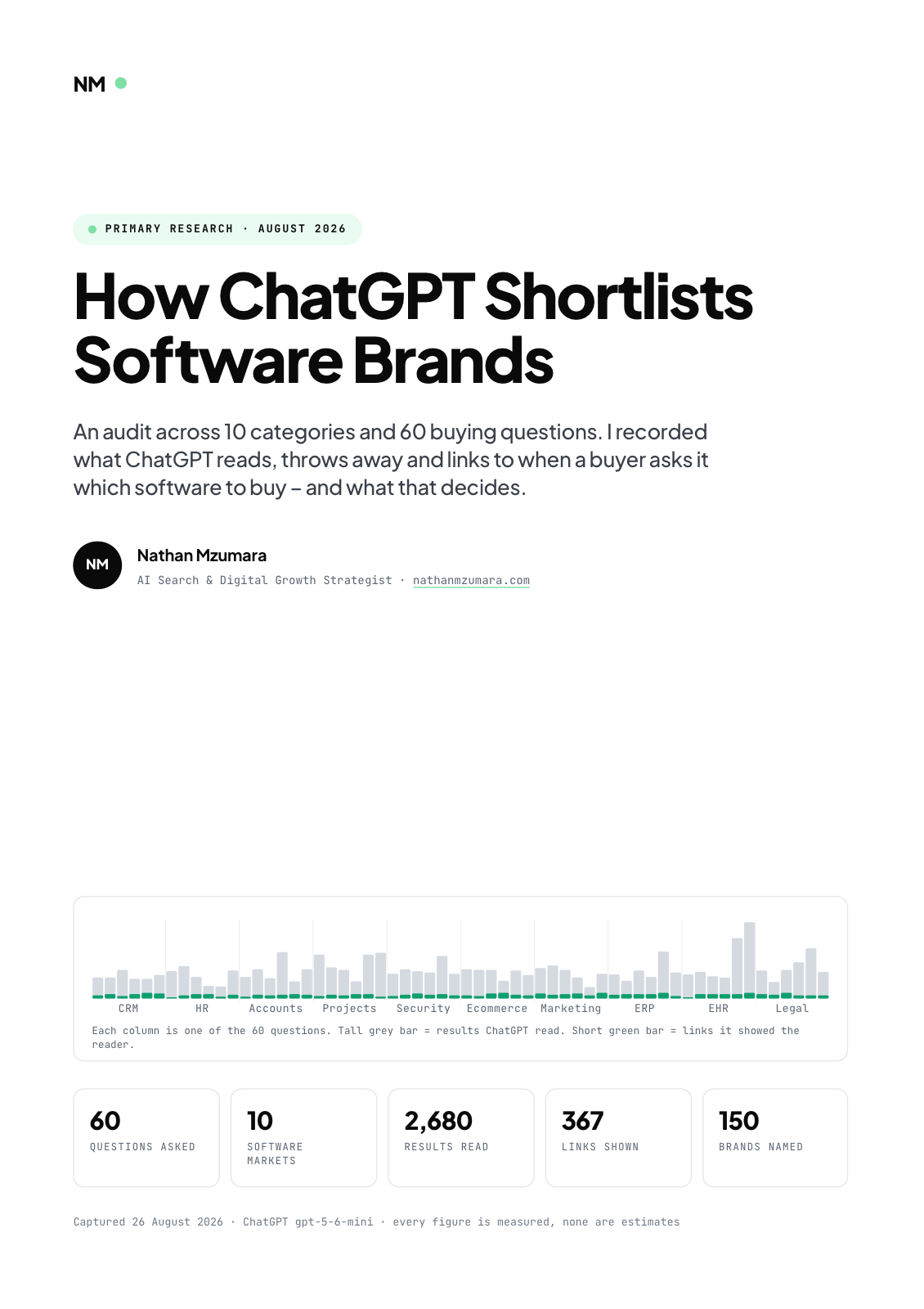
Primary research · August 2026
How ChatGPT Shortlists Software Brands
An audit across 10 categories and 60 buying questions. I recorded what ChatGPT reads, throws away and links to when a buyer asks it which software to buy, and what that decides.
- 60
- Questions asked
- 10
- Software markets
- 2,680
- Results read
- 367
- Links shown
Free download
Get the full report
35 pages · PDF · 536 KB. Enter your details and it downloads straight away.