AI Model & Product
AI transcription
Also known as: automatic speech recognition, ASR, AI speech-to-text
AI transcription is the automatic conversion of spoken audio into written text using speech recognition models. Modern systems often add speaker labels, punctuation, timestamps and language detection, and can feed the output into summarisation or search. It is also called automatic speech recognition or ASR.
What it is
An AI transcription system takes an audio or video file, or a live stream, and produces a text transcript. Quality depends on audio conditions, accents, domain vocabulary and whether the model has been adapted with custom terms. Many products pair transcription with a language model that turns the raw text into summaries, actions or structured notes.
Why it matters
Transcription turns spoken content into indexable, quotable text, which is the format both search engines and AI assistants can actually use. Webinars, podcasts, demos and recorded calls become discoverable assets once transcribed and published properly. It also feeds internal knowledge: sales calls and support conversations become searchable evidence for product and content decisions.
How it works
Practitioners run recordings through a transcription service, correct names and product terms, then publish cleaned transcripts alongside the media with headings and timestamps. Accuracy improves when you supply custom vocabularies, use good microphones and separate speakers where possible. Internally, teams pipe transcripts into search or analysis tools to find recurring questions and objections.
When it applies
Applies whenever you record spoken content for publishing, research or compliance, and whenever audio or video assets need to be searchable rather than locked inside a media file.
Examples
- A podcast team publishes a corrected transcript with section headings under each episode page.
- A B2B team transcribes discovery calls and tags the questions buyers ask most often.
- A webinar recording is transcribed and turned into a written summary plus three short articles.
How it is measured
- Word error rate on a sample of your own recordings after correction
- Organic and AI referral traffic to pages that carry published transcripts
- Proportion of recorded content that has a published or indexed transcript
- Time from recording to published transcript
Related terms in AI Model & Product
- Agents APIAn Agents API is a programming interface for building applications where a model plans, calls tools and completes multi-step tasks rather than returning a single reply. The term is most often used for OpenAI's agent building interfaces, though other vendors offer equivalents. Teams use it to connect models to search, internal data and actions such as booking, updating records or generating reports.
- AI assistantAn AI assistant is a software product that uses a language model to hold a conversation, answer questions and carry out tasks on a user's behalf. It sits on top of one or more underlying models and adds an interface, memory, tools and safety controls. Examples include ChatGPT, Google Gemini, Microsoft Copilot, Claude and voice assistants such as Siri and Alexa.
- BingBing is Microsooft's web search engine, available at bing.com and integrated into Microsoft Copilot and other Microsoft products. It maintains its own crawler, Bingbot, and its own index, and provides Bing Webmaster Tools for site owners. Its index and APIs have also supplied results to third-party search products and AI assistants.
- ChatGPT VoiceChatGPT Voice is the spoken conversation mode in OpenAI's ChatGPT apps, which lets you talk to the assistant and hear its replies read aloud. Advanced Voice Mode processes speech directly, so exchanges feel closer to a phone call and you can interrupt mid-answer. People use it hands free on mobile, and it is also available on desktop.
- Claude CodeClaude Code is Anthropic's agentic coding tool that works directly with a codebase, reading files, proposing and making edits, and running commands with permission. It runs in the terminal and in supported development environments, driven by natural language instructions rather than manual file by file editing. Marketing and growth teams use it for technical SEO, structured data and data tasks that would otherwise wait for engineering.
- Claude CoworkClaude Cowork is an agentic working environment from Anthropic aimed at non-developers, extending the delegated, multi-step approach of Claude Code to general knowledge work. It is designed so a user can hand over a task involving files, folders and connected tools and let the agent work through it. It was introduced as a limited preview product rather than a general release.
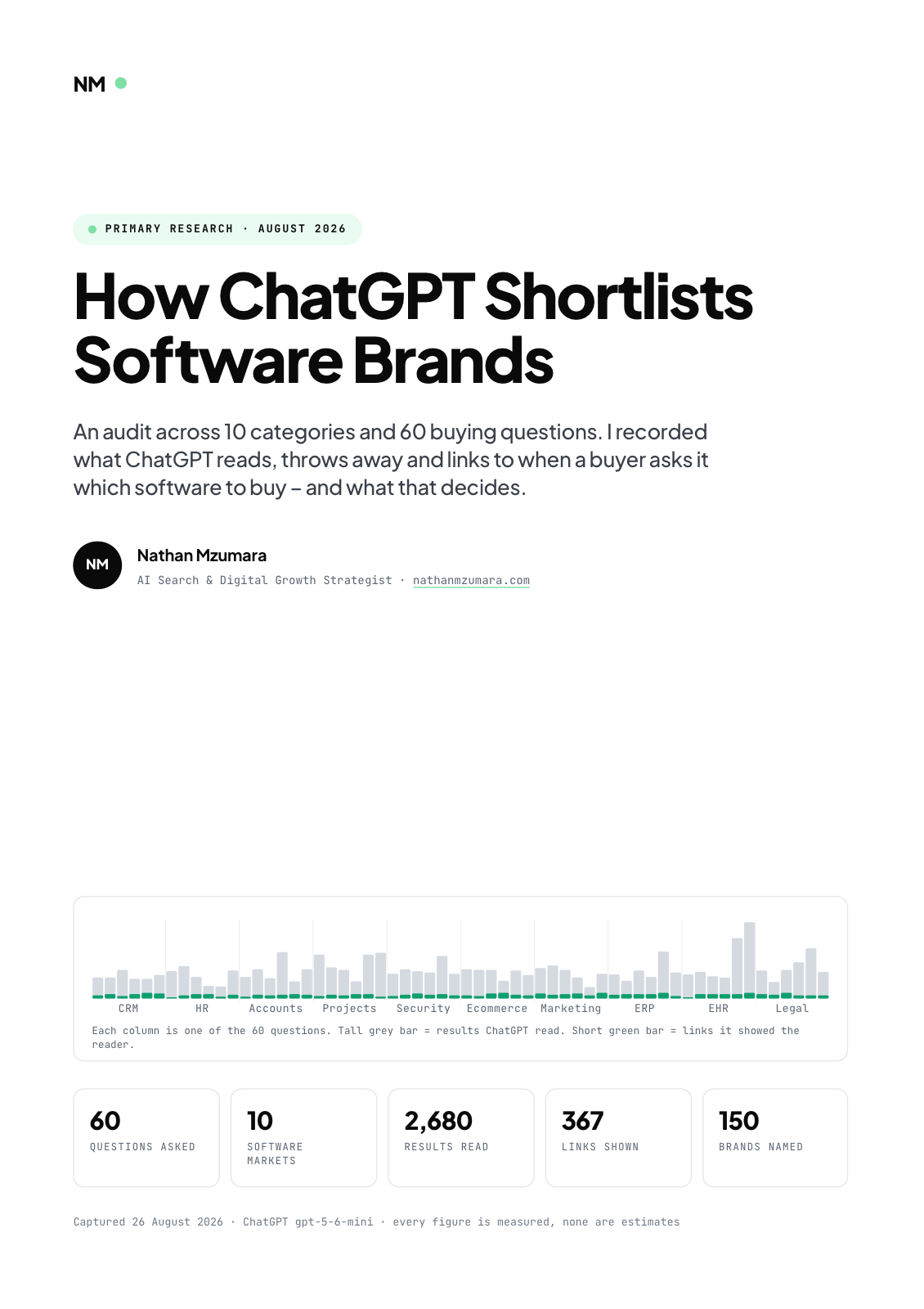
Primary research · August 2026
How ChatGPT Shortlists Software Brands
An audit across 10 categories and 60 buying questions. I recorded what ChatGPT reads, throws away and links to when a buyer asks it which software to buy, and what that decides.
- 60
- Questions asked
- 10
- Software markets
- 2,680
- Results read
- 367
- Links shown
Free download
Get the full report
35 pages · PDF · 536 KB. Enter your details and it downloads straight away.