AI Model & Product
Claude Code
Also known as: Anthropic Claude Code
Claude Code is Anthropic's agentic coding tool that works directly with a codebase, reading files, proposing and making edits, and running commands with permission. It runs in the terminal and in supported development environments, driven by natural language instructions rather than manual file by file editing. Marketing and growth teams use it for technical SEO, structured data and data tasks that would otherwise wait for engineering.
What it is
Claude Code is a command line and editor based agent built on Anthropic's Claude models. Rather than answering questions in a chat window and leaving you to copy code out, it operates in a project directory: it can explore the repository, read and change files, run tests and commands, and work through multi step tasks. Access requires an Anthropic account or API access, and permissions control what it is allowed to do.
Why it matters
A large share of discovery work is technical: schema markup, internal linking, redirects, sitemaps, rendering issues and log or crawl analysis. Tools that can act on a codebase shorten the loop between diagnosing a problem and shipping the fix, which matters when AI search surfaces reward clean, machine readable pages. It also lowers the barrier for non engineers to prototype scripts and audits, though review by developers remains necessary.
How it works
Practitioners point it at a repository or working folder, describe the task in plain language, and review the proposed changes before approving them. Typical use is iterative: ask it to explain how something is implemented, then request a change, then have it run checks or tests. Teams add project instructions and guardrails, keep work on branches with pull request review, and restrict which commands and directories it may touch.
When it applies
It applies when you have access to the codebase or a local project and a task involves reading, writing or checking many files or running repeatable technical work. It is a poor fit where you cannot review the output, where change control forbids agent edits, or where the work needs no code at all.
Examples
- A technical SEO asks it to add Product and FAQPage structured data to a template, then validates the rendered output against a testing tool.
- A growth lead has it write a script that crawls a sitemap, flags pages with missing or duplicate titles and meta descriptions, and exports a CSV.
- An in house team uses it to trace and fix a redirect chain across several configuration files, working on a branch that a developer reviews before merge.
How it is measured
- Time from issue identified to fix merged, compared with the previous engineering backlog wait
- Share of agent proposed changes accepted at review, and rework or rollback rate
- Volume of technical fixes shipped per sprint, for example schema coverage or crawl errors resolved
- Downstream discovery outcomes such as valid structured data items, indexed page count and crawl error trend
Related terms in AI Model & Product
- Agents APIAn Agents API is a programming interface for building applications where a model plans, calls tools and completes multi-step tasks rather than returning a single reply. The term is most often used for OpenAI's agent building interfaces, though other vendors offer equivalents. Teams use it to connect models to search, internal data and actions such as booking, updating records or generating reports.
- AI assistantAn AI assistant is a software product that uses a language model to hold a conversation, answer questions and carry out tasks on a user's behalf. It sits on top of one or more underlying models and adds an interface, memory, tools and safety controls. Examples include ChatGPT, Google Gemini, Microsoft Copilot, Claude and voice assistants such as Siri and Alexa.
- AI transcriptionAI transcription is the automatic conversion of spoken audio into written text using speech recognition models. Modern systems often add speaker labels, punctuation, timestamps and language detection, and can feed the output into summarisation or search. It is also called automatic speech recognition or ASR.
- BingBing is Microsooft's web search engine, available at bing.com and integrated into Microsoft Copilot and other Microsoft products. It maintains its own crawler, Bingbot, and its own index, and provides Bing Webmaster Tools for site owners. Its index and APIs have also supplied results to third-party search products and AI assistants.
- ChatGPT VoiceChatGPT Voice is the spoken conversation mode in OpenAI's ChatGPT apps, which lets you talk to the assistant and hear its replies read aloud. Advanced Voice Mode processes speech directly, so exchanges feel closer to a phone call and you can interrupt mid-answer. People use it hands free on mobile, and it is also available on desktop.
- Claude CoworkClaude Cowork is an agentic working environment from Anthropic aimed at non-developers, extending the delegated, multi-step approach of Claude Code to general knowledge work. It is designed so a user can hand over a task involving files, folders and connected tools and let the agent work through it. It was introduced as a limited preview product rather than a general release.
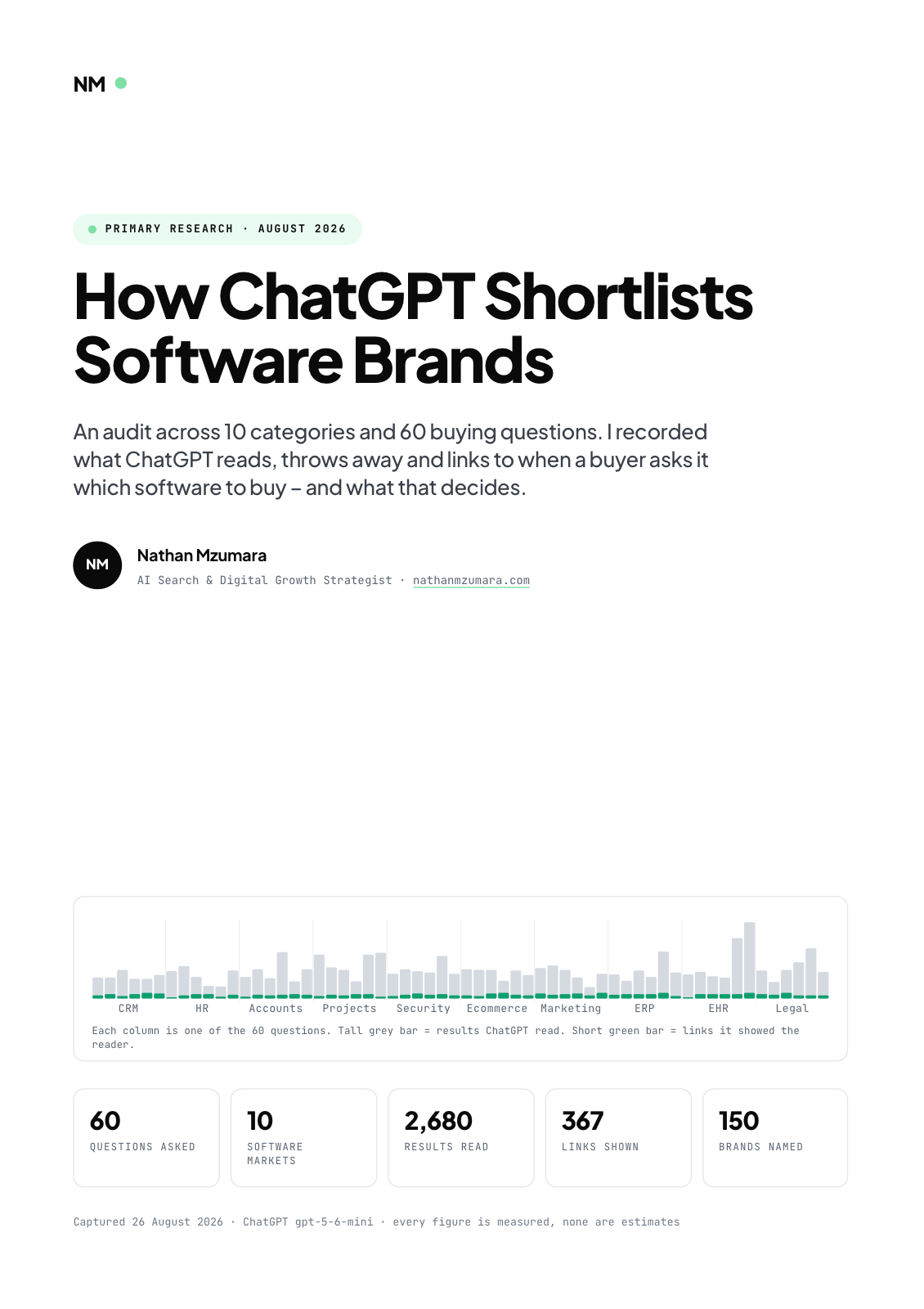
Primary research · August 2026
How ChatGPT Shortlists Software Brands
An audit across 10 categories and 60 buying questions. I recorded what ChatGPT reads, throws away and links to when a buyer asks it which software to buy, and what that decides.
- 60
- Questions asked
- 10
- Software markets
- 2,680
- Results read
- 367
- Links shown
Free download
Get the full report
35 pages · PDF · 536 KB. Enter your details and it downloads straight away.