AI Model & Product
ChatGPT Voice
Also known as: ChatGPT voice mode, Advanced Voice Mode
ChatGPT Voice is the spoken conversation mode in OpenAI's ChatGPT apps, which lets you talk to the assistant and hear its replies read aloud. Advanced Voice Mode processes speech directly, so exchanges feel closer to a phone call and you can interrupt mid-answer. People use it hands free on mobile, and it is also available on desktop.
What it is
ChatGPT Voice is a feature inside the ChatGPT app rather than a separate product, offering a choice of synthetic voices. The earlier version chained together speech recognition, a text model and text to speech, while Advanced Voice Mode handles audio more directly and responds with less delay and more natural intonation. Answers can draw on the same capabilities as typed chat, including web results when the assistant looks something up.
Why it matters
Voice moves part of the question from typed keywords to natural spoken language, and the reply comes back as a single spoken answer with few or no visible links. That means visibility depends on whether your brand is named and described correctly inside the answer, not on where you rank on a page. It also puts weight on plain phrasing, short factual statements and a brand name that is easy to say and recognise.
How it works
Users tap the voice control, ask a question in conversation, and can follow up or interrupt. Marketers test it by asking their own category and brand questions aloud, then noting whether the brand is mentioned, whether the facts are right, and whether a source is offered. Findings feed back into clearer on-page copy, better structured facts about the business, and corrected details on third party sources the assistant is likely to rely on.
When it applies
It applies when your audience asks questions hands free, in the car, in the kitchen or on the move, and whenever you plan for answers delivered without a screen.
Examples
- A commuter asks ChatGPT Voice which local garages are open on a Sunday while driving
- A marketer runs a fixed list of twenty spoken prompts each month to see whether their brand is named among suggested providers
- A team checks how the assistant pronounces and spells their product name, then adds a plain description and pronunciation guide to their site
How it is measured
- Brand mention rate across a fixed set of spoken prompts
- Accuracy score for claims the assistant makes about your products, pricing and locations
- Referral sessions and assisted conversions attributed to ChatGPT
- Prompt coverage, the share of your priority questions where the assistant gives a usable answer that includes your category
Insights on ChatGPT Voice
Related terms in AI Model & Product
- Agents APIAn Agents API is a programming interface for building applications where a model plans, calls tools and completes multi-step tasks rather than returning a single reply. The term is most often used for OpenAI's agent building interfaces, though other vendors offer equivalents. Teams use it to connect models to search, internal data and actions such as booking, updating records or generating reports.
- AI assistantAn AI assistant is a software product that uses a language model to hold a conversation, answer questions and carry out tasks on a user's behalf. It sits on top of one or more underlying models and adds an interface, memory, tools and safety controls. Examples include ChatGPT, Google Gemini, Microsoft Copilot, Claude and voice assistants such as Siri and Alexa.
- AI transcriptionAI transcription is the automatic conversion of spoken audio into written text using speech recognition models. Modern systems often add speaker labels, punctuation, timestamps and language detection, and can feed the output into summarisation or search. It is also called automatic speech recognition or ASR.
- BingBing is Microsooft's web search engine, available at bing.com and integrated into Microsoft Copilot and other Microsoft products. It maintains its own crawler, Bingbot, and its own index, and provides Bing Webmaster Tools for site owners. Its index and APIs have also supplied results to third-party search products and AI assistants.
- Claude CodeClaude Code is Anthropic's agentic coding tool that works directly with a codebase, reading files, proposing and making edits, and running commands with permission. It runs in the terminal and in supported development environments, driven by natural language instructions rather than manual file by file editing. Marketing and growth teams use it for technical SEO, structured data and data tasks that would otherwise wait for engineering.
- Claude CoworkClaude Cowork is an agentic working environment from Anthropic aimed at non-developers, extending the delegated, multi-step approach of Claude Code to general knowledge work. It is designed so a user can hand over a task involving files, folders and connected tools and let the agent work through it. It was introduced as a limited preview product rather than a general release.
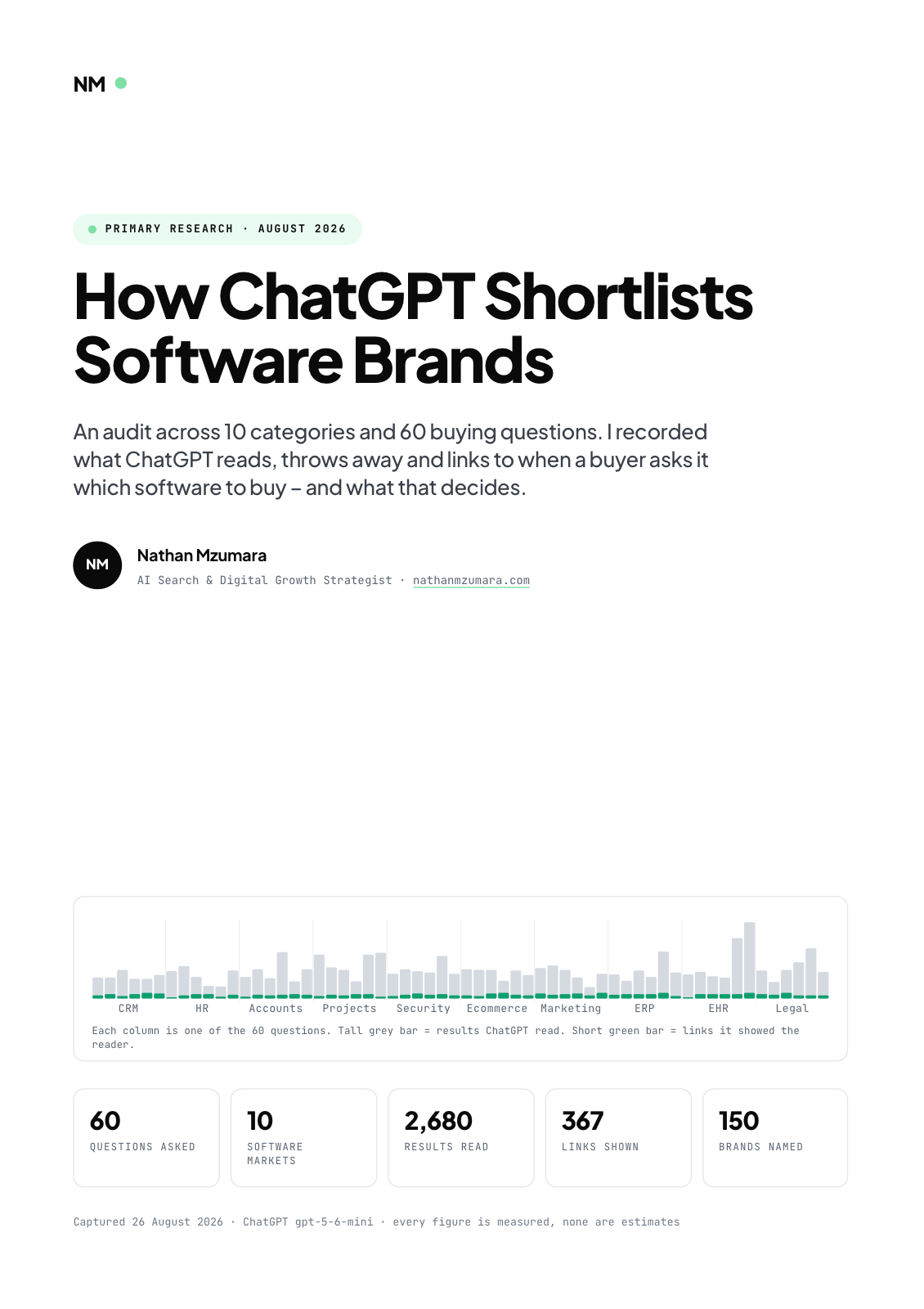
Primary research · August 2026
How ChatGPT Shortlists Software Brands
An audit across 10 categories and 60 buying questions. I recorded what ChatGPT reads, throws away and links to when a buyer asks it which software to buy, and what that decides.
- 60
- Questions asked
- 10
- Software markets
- 2,680
- Results read
- 367
- Links shown
Free download
Get the full report
35 pages · PDF · 536 KB. Enter your details and it downloads straight away.