AI Model & Product
AI assistant
Also known as: digital assistant, virtual assistant
An AI assistant is a software product that uses a language model to hold a conversation, answer questions and carry out tasks on a user's behalf. It sits on top of one or more underlying models and adds an interface, memory, tools and safety controls. Examples include ChatGPT, Google Gemini, Microsoft Copilot, Claude and voice assistants such as Siri and Alexa.
What it is
An AI assistant is the product layer people actually interact with, rather than the raw model underneath it. It typically combines a chat or voice interface, a system prompt that shapes behaviour, access to tools such as web search, code execution or file reading, and some form of conversation history. The same underlying model can power very different assistants depending on how it is configured and what it is allowed to do.
Why it matters
Assistants are becoming a starting point for research, comparison and buying decisions, which means they now sit between your brand and the customer in the same way search engines do. When an assistant answers a question it may summarise, recommend or omit brands without the user ever seeing a results page. Understanding how a given assistant retrieves and cites information tells you whether your content can be surfaced at all.
How it works
Practitioners test the assistants their audience uses by running realistic prompts, recording which sources are cited and how the brand is described, then fixing the gaps in content, structured data and third-party coverage that explain weak answers. Some assistants browse live and cite links, others rely mostly on training data, so tactics differ by product. Teams also use assistants internally for research, drafting and analysis, with human review before anything is published.
When it applies
It applies whenever buyers might ask a question in a chat interface instead of typing a query into a search box, and whenever you are planning content or measurement for conversational discovery.
Examples
- A buyer asks ChatGPT to shortlist three payroll tools for a 30 person UK agency, and the answer cites two vendor comparison pages plus a review site.
- A marketing team runs the same 40 category prompts across Gemini, ChatGPT and Copilot each month to track which brands appear.
- A retailer finds an assistant is quoting an outdated returns policy from a cached help page and updates the live page so future answers are correct.
How it is measured
- Brand mention rate across a fixed set of prompts, tracked by assistant
- Share of answers that cite your domain as a source
- Referral sessions and assisted conversions from assistant traffic sources
- Accuracy score for how your products, pricing and policies are described
Insights on AI assistant
Related terms in AI Model & Product
- Agents APIAn Agents API is a programming interface for building applications where a model plans, calls tools and completes multi-step tasks rather than returning a single reply. The term is most often used for OpenAI's agent building interfaces, though other vendors offer equivalents. Teams use it to connect models to search, internal data and actions such as booking, updating records or generating reports.
- AI transcriptionAI transcription is the automatic conversion of spoken audio into written text using speech recognition models. Modern systems often add speaker labels, punctuation, timestamps and language detection, and can feed the output into summarisation or search. It is also called automatic speech recognition or ASR.
- BingBing is Microsooft's web search engine, available at bing.com and integrated into Microsoft Copilot and other Microsoft products. It maintains its own crawler, Bingbot, and its own index, and provides Bing Webmaster Tools for site owners. Its index and APIs have also supplied results to third-party search products and AI assistants.
- ChatGPT VoiceChatGPT Voice is the spoken conversation mode in OpenAI's ChatGPT apps, which lets you talk to the assistant and hear its replies read aloud. Advanced Voice Mode processes speech directly, so exchanges feel closer to a phone call and you can interrupt mid-answer. People use it hands free on mobile, and it is also available on desktop.
- Claude CodeClaude Code is Anthropic's agentic coding tool that works directly with a codebase, reading files, proposing and making edits, and running commands with permission. It runs in the terminal and in supported development environments, driven by natural language instructions rather than manual file by file editing. Marketing and growth teams use it for technical SEO, structured data and data tasks that would otherwise wait for engineering.
- Claude CoworkClaude Cowork is an agentic working environment from Anthropic aimed at non-developers, extending the delegated, multi-step approach of Claude Code to general knowledge work. It is designed so a user can hand over a task involving files, folders and connected tools and let the agent work through it. It was introduced as a limited preview product rather than a general release.
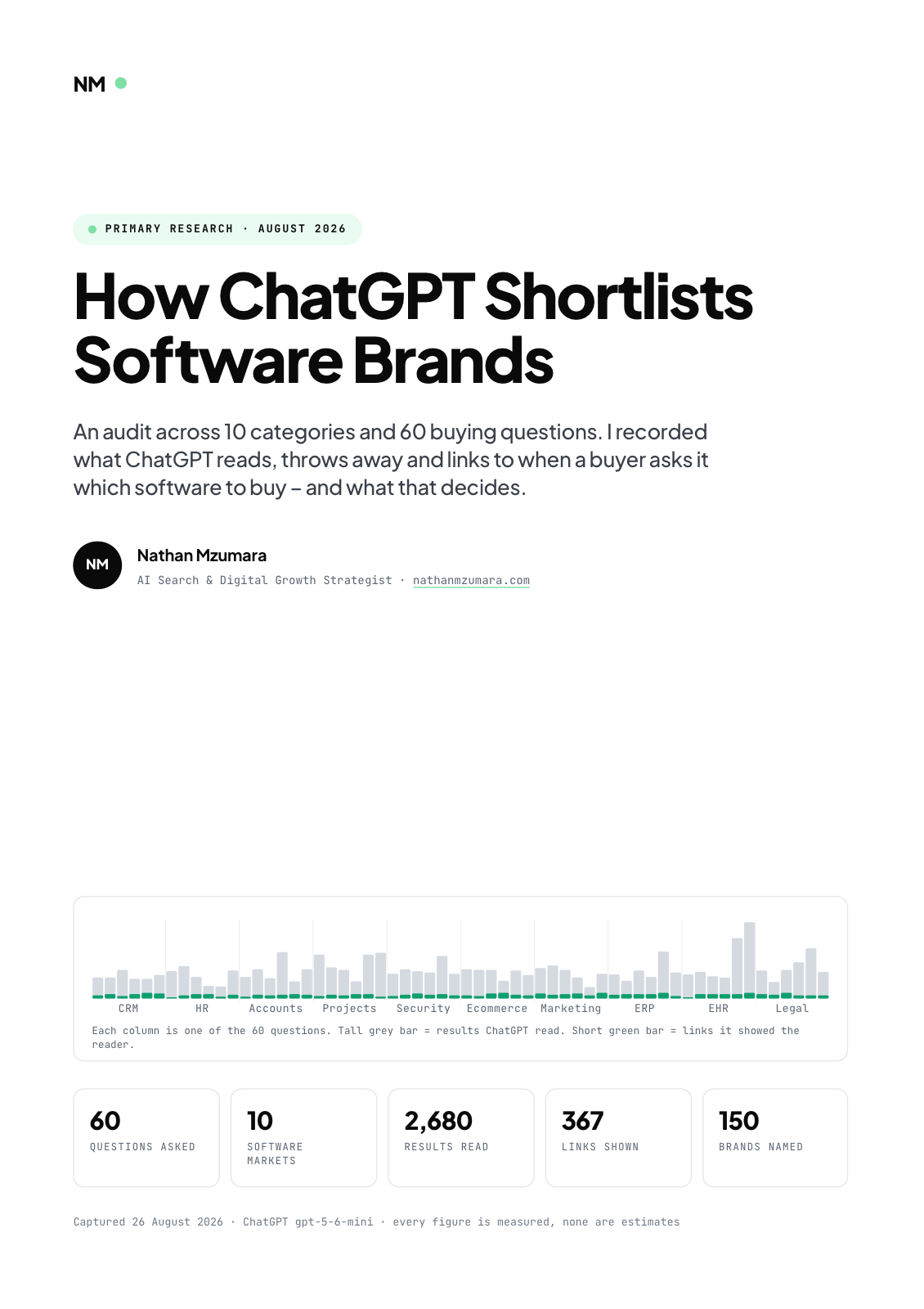
Primary research · August 2026
How ChatGPT Shortlists Software Brands
An audit across 10 categories and 60 buying questions. I recorded what ChatGPT reads, throws away and links to when a buyer asks it which software to buy, and what that decides.
- 60
- Questions asked
- 10
- Software markets
- 2,680
- Results read
- 367
- Links shown
Free download
Get the full report
35 pages · PDF · 536 KB. Enter your details and it downloads straight away.