Google AI Edge Eloquent: Free Dictation, No Subscription
Google has published Google AI Edge Eloquent, a voice dictation app that cleans up spoken text and copies the result to your clipboard. The Google AI Edge Eloquent product page offers downloads for iOS and macOS and sells it as "Premium AI voice dictation without subscription". The page carries no launch date.
What is Google AI Edge Eloquent?
Google AI Edge Eloquent is a speech-to-text app that rewrites what you say into clean, usable text. Google's page describes the flow as "Record your ideas, Eloquent polishes them instantly". On iOS, according to Google's own FAQ, "you are able to use it as an independent app, opening up its interface, and speaking without having to first plan out what you want to say. Our AI will clean up the text for you and automatically copy to clipboard."
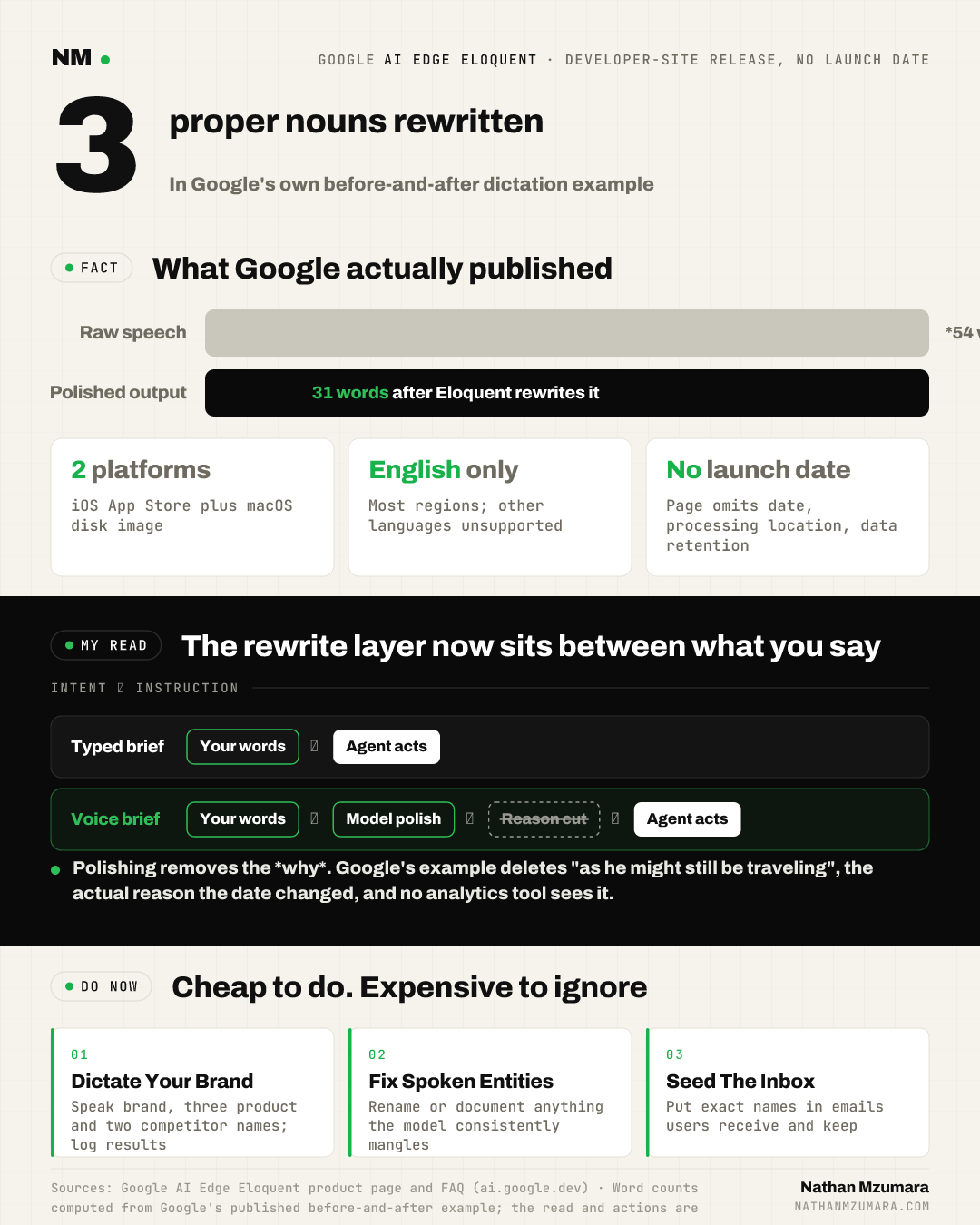
Two downloads are listed: an iOS app on the App Store and a direct macOS disk image. The page also promotes three features: turning thoughts into different text styles, showing how fast your thoughts flow, and personalising the app with your unique vocabulary.
What does the before-and-after example actually show?
Google publishes one worked example on the page. It is worth reading closely, because it shows how much editorial licence the model takes.
| Raw input | Polished output |
|---|---|
| "Um can we push the project review with uh Surreal to next Tuesday? Actually let's make it Wednesday as he might still be traveling. And uh also ask Amy to send over the latest uh feedback dock. I mean the user feedback doc. So Morgan can include that in the uh presentation as well." | "Can we push the project review with Suril to next Wednesday? Also, please ask Ami to send over the latest user feedback doc so Mogan can include it in the presentation." |
Three things happen there, and only the first is ordinary dictation. Filler words go. The speaker's self-correction is resolved, so Tuesday becomes Wednesday. And three proper nouns are rewritten: Surreal to Suril, Amy to Ami, Morgan to Mogan.
Note what else disappears. The clause "as he might still be traveling" is cut. That was the reason for the change, not filler. My read is that this is the trade in every polishing model: you gain readability and lose the reasoning behind the instruction. If you dictate briefs, that matters.
Why one line in the FAQ matters more than the app
Asked whether the app will reach other platforms, Google answers: "Stay tuned. We are evaluating other platforms including desktop for tasks like dictating docs, code and prompting to AI agents."
"Prompting to AI agents" is the tell. Google is describing voice as an input layer for agent instruction, not just a typing replacement. If the instruction that reaches an agent is a model-rewritten version of what you said, then a rewrite layer now sits between human intent and machine action. That is a new place for meaning to go missing, and it is invisible in every analytics tool you own. The same measurement gap applies to cheap voice interfaces generally.
What the vocabulary list means for brand names
Google's FAQ explains the personalisation feature plainly: "With your permission, Google AI Edge Eloquent can optionally access your workspace data (e.g. your Gmail) in order to generate a vocabulary list of unique words. This dictionary helps the model better understand your speech."
Read that next to the worked example, where three names were corrected, and a practical point follows for anyone who owns a brand.
- Unusual brand names get normalised: a dictation model that confidently rewrites "Surreal" as "Suril" will do the same to an invented product name it has never seen.
- Your inbox becomes the fix: names that appear in a user's Gmail can enter the personal vocabulary list. Names that do not appear anywhere in their workspace data have no such route in.
- Spoken spelling is now an asset: if your brand, product and feature names are hard to say and absent from a user's mail, voice input is a weak channel for you.
This is the input-side version of the entity problem that already shapes answer engine optimisation. Getting cited depends on a machine recognising your name. So does getting dictated.
What the page does not tell you
Be careful what you assume. Google's page states that the app is available "in English only, in most regions", and that the team is working on expanding availability. On other languages it is blunt: "the app only officially supports English. While the systems may occasionally transcribe words in other languages (such as Hindi), this feature is not currently supported." Multilingual support is described as future work.
The page also does not answer its own question. Under the heading "Is Google sign-in required to use Eloquent?", the answer only describes optional workspace access. No launch date, no processing location and no data-retention detail are given. For procurement, that is three unanswered questions.
One more signal. This launched on the developer site, not on Google's main blog, and the linked Google AI Edge Eloquent video sits on a channel with 24 subscribers. That is an experiment, not a flagship.
What to do this week about Google AI Edge Eloquent
Install Google AI Edge Eloquent on iOS and dictate one paragraph containing your brand name, your top three product names and two competitor names. Record exactly what comes back. If the polished text mangles them, you have a spoken-entity problem to fix in your naming, your help content and your public documentation. Do this before voice becomes the way people brief agents rather than the way they write notes, because Google AI Edge Eloquent shows the rewrite layer is already here.
Tags