AI Model & Product
Google AI Edge Eloquent
Also known as: AI Edge Eloquent, Eloquent
Google AI Edge Eloquent is a name associated with Google's AI Edge on-device AI work, referring to model and tooling efforts for running language capabilities locally on phones and other devices. Public documentation under this specific name is limited, so it is best treated as an evolving label within the wider Google AI Edge stack. Anyone building on it should confirm current scope and availability in Google's official AI Edge documentation.
What it is
The term sits inside Google AI Edge, Google's set of tools and runtimes for on-device inference such as LiteRT, MediaPipe tasks and the LLM Inference API. In that context, an Eloquent branded component would relate to running small generative or language models on device rather than in the cloud. Because naming in this area changes quickly, treat the label as a pointer to a family of on-device capabilities rather than a fixed product specification.
Why it matters
On-device language features change where answers come from: a model running locally can respond without a network call, without server logs and sometimes without a search query being issued at all. For marketers that means some discovery moments become invisible in analytics and are answered from model weights or local data rather than from your site. Understanding the on-device layer helps teams judge which queries will still reach the open web and which will be absorbed by the device.
How it works
Practitioners encounter this layer through developer tooling: converting or downloading a compact model, running it with an on-device runtime, and wiring it into an app with tight memory and latency budgets. On the marketing side, teams test how on-device assistants summarise or cite content, keep authoritative facts on crawlable pages, and use retrieval so the device can ground answers in current data rather than stale weights. Verify current names, model sizes and licences against Google's published AI Edge documentation before making commitments.
When it applies
Relevant when your audience uses mobile or embedded assistants, when privacy or offline use rules out cloud inference, or when you are tracking how much discovery shifts to on-device answering.
Examples
- A mobile app team evaluates on-device versus cloud inference for a support chat feature and measures latency and battery cost for each.
- A brand tests whether an offline device assistant can describe its returns policy accurately, and finds the answer is out of date because it is not retrieved live.
- A developer converts a small open model to an on-device runtime format and benchmarks memory use on mid range Android handsets.
How it is measured
- Share of assistant interactions handled on device versus sent to a cloud endpoint
- Accuracy and freshness of on-device answers about your brand, checked against a fixed question set
- Latency and memory footprint of the on-device model in your app
- Referral or branded search lift following on-device assistant interactions
Insights on Google AI Edge Eloquent
Related terms in AI Model & Product
- Agents APIAn Agents API is a programming interface for building applications where a model plans, calls tools and completes multi-step tasks rather than returning a single reply. The term is most often used for OpenAI's agent building interfaces, though other vendors offer equivalents. Teams use it to connect models to search, internal data and actions such as booking, updating records or generating reports.
- AI assistantAn AI assistant is a software product that uses a language model to hold a conversation, answer questions and carry out tasks on a user's behalf. It sits on top of one or more underlying models and adds an interface, memory, tools and safety controls. Examples include ChatGPT, Google Gemini, Microsoft Copilot, Claude and voice assistants such as Siri and Alexa.
- AI transcriptionAI transcription is the automatic conversion of spoken audio into written text using speech recognition models. Modern systems often add speaker labels, punctuation, timestamps and language detection, and can feed the output into summarisation or search. It is also called automatic speech recognition or ASR.
- BingBing is Microsooft's web search engine, available at bing.com and integrated into Microsoft Copilot and other Microsoft products. It maintains its own crawler, Bingbot, and its own index, and provides Bing Webmaster Tools for site owners. Its index and APIs have also supplied results to third-party search products and AI assistants.
- ChatGPT VoiceChatGPT Voice is the spoken conversation mode in OpenAI's ChatGPT apps, which lets you talk to the assistant and hear its replies read aloud. Advanced Voice Mode processes speech directly, so exchanges feel closer to a phone call and you can interrupt mid-answer. People use it hands free on mobile, and it is also available on desktop.
- Claude CodeClaude Code is Anthropic's agentic coding tool that works directly with a codebase, reading files, proposing and making edits, and running commands with permission. It runs in the terminal and in supported development environments, driven by natural language instructions rather than manual file by file editing. Marketing and growth teams use it for technical SEO, structured data and data tasks that would otherwise wait for engineering.
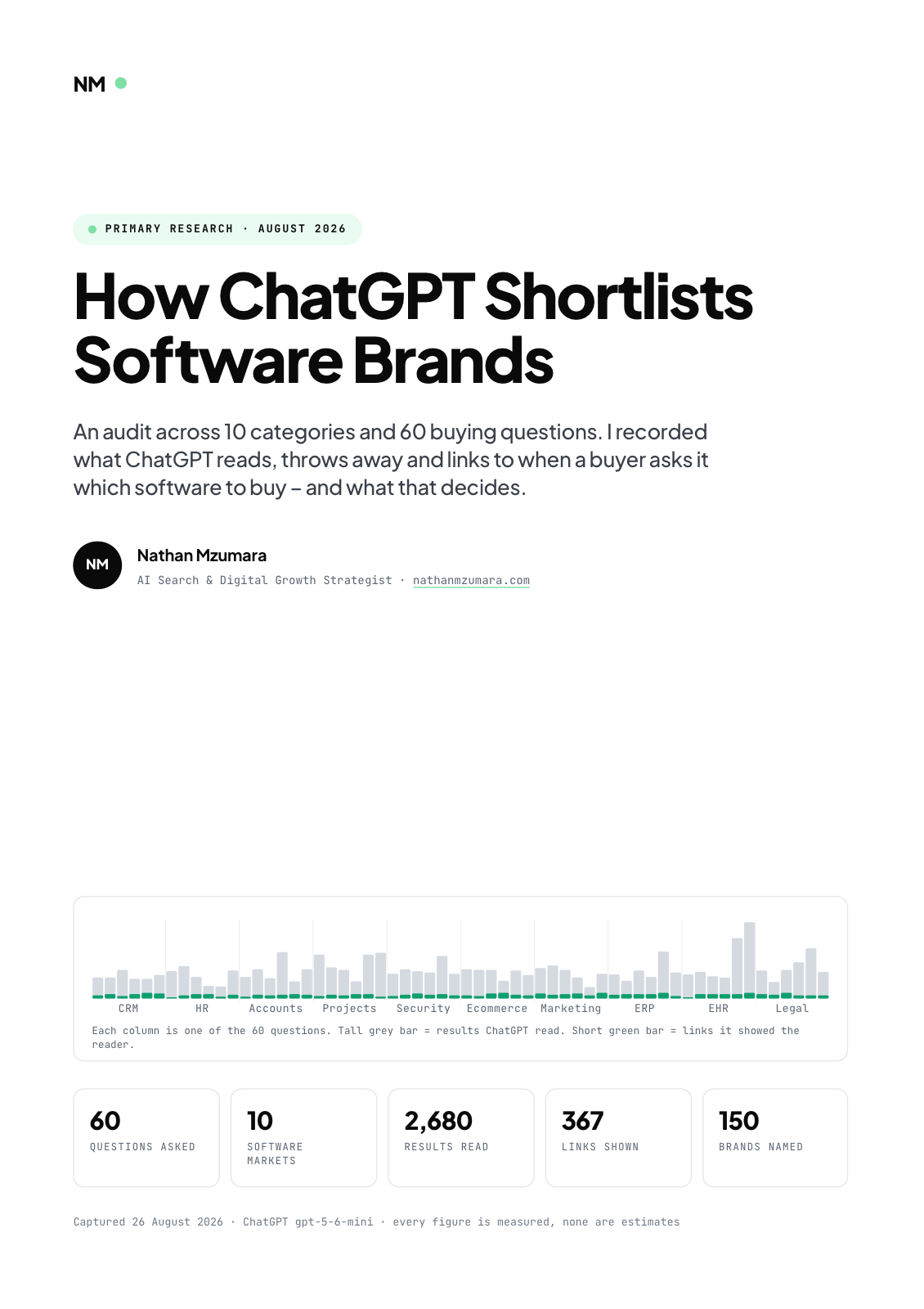
Primary research · August 2026
How ChatGPT Shortlists Software Brands
An audit across 10 categories and 60 buying questions. I recorded what ChatGPT reads, throws away and links to when a buyer asks it which software to buy, and what that decides.
- 60
- Questions asked
- 10
- Software markets
- 2,680
- Results read
- 367
- Links shown
Free download
Get the full report
35 pages · PDF · 536 KB. Enter your details and it downloads straight away.