Consumer Behaviour
Voice search
Also known as: spoken search
Voice search is the act of speaking a query to a device or assistant and receiving a spoken or on screen answer. It covers smart speakers, phone assistants, in car systems, TV remotes and voice input inside search and shopping apps. Spoken queries tend to be longer and more conversational than typed ones, and often return a single answer rather than a list.
What it is
Voice search combines speech recognition, query understanding and answer selection. The system transcribes what was said, interprets intent, then picks a response, which may be read aloud from a single source, shown as a results page, or handled by a device action such as calling a shop. Assistants built on large language models also handle follow up questions in the same conversation.
Why it matters
When the answer is spoken there is usually one result, so ranking second often means no visibility at all. Voice queries skew towards local, factual, transactional and hands free tasks, which makes them commercially useful for retail, hospitality, services and support. The conversational phrasing also shows how people actually ask questions, which is useful for content and AI answer optimisation more broadly.
How it works
Practitioners write clear question and answer sections that can be lifted as a spoken response, keep business listings and opening hours accurate, use structured data for products, recipes, FAQs and local details, and keep pages fast and accessible. They test real spoken phrasing on the devices their audience uses and check which source the assistant credits. Content is written to answer the question in the first sentence, then support it.
When it applies
It applies to local, on the move, in kitchen, in car and accessibility contexts, and to any category where people ask short factual or task based questions. It matters most where a single spoken answer can win or lose the whole query.
Examples
- A driver asks a phone assistant for the nearest garage open now and is read one business name, address and phone number.
- A cook asks a smart speaker how long to boil new potatoes and hears a step read from a single recipe page.
- A shopper says 'reorder my usual dog food' into a retailer app and the basket is filled from purchase history.
How it is measured
- Impressions and clicks for long, question shaped queries in search console data
- Calls, direction requests and clicks to website from local business listings
- Share of tested spoken prompts where the brand is the cited source
- Position and presence in featured snippets or answer boxes for target questions
Related terms in Consumer Behaviour
- Agentic browserA browser (or browsing layer) that uses an LLM agent to interpret pages, summarise content, and take actions on behalf of the user. Arc Search, Perplexity Comet, Browser Company's Dia, Dia browser, and similar.
- Brand demandSearch volume for branded terms. In an AI-search world, brand demand is the single strongest moat, generic queries are absorbed by AI Overviews and ChatGPT, while branded queries route users directly to brand properties.
- Brand discoveryBrand discovery is the process by which someone encounters a brand for the first time, or becomes newly aware it can solve their problem. It happens across search results, AI assistants, social feeds, communities, creators, reviews, marketplaces and word of mouth. Marketers study it to work out which surfaces introduce them to future customers.
- Consumer behaviour signalObservable patterns in how users phrase queries, refine searches, and choose answers, used by both ranking systems and generative models to infer intent and quality.
- Conversational searchConversational search is the pattern of finding information through a back and forth dialogue rather than a single keyword query, with each follow-up interpreted in the context of what came before. Users ask broad questions, then narrow with refinements such as cheaper, nearby or without the subscription. It shifts discovery from ranked link lists towards answers that must survive several rounds of questioning.
- Facebook SearchFacebook Search is the search function inside Facebook that lets people find posts, people, Pages, Groups, events, videos and Marketplace listings. It is a platform search experience rather than a general web search engine, so results are shaped by what is published on Facebook and by the searcher's connections and activity. For businesses it affects whether a Page, Group or listing is found by people already inside the app.
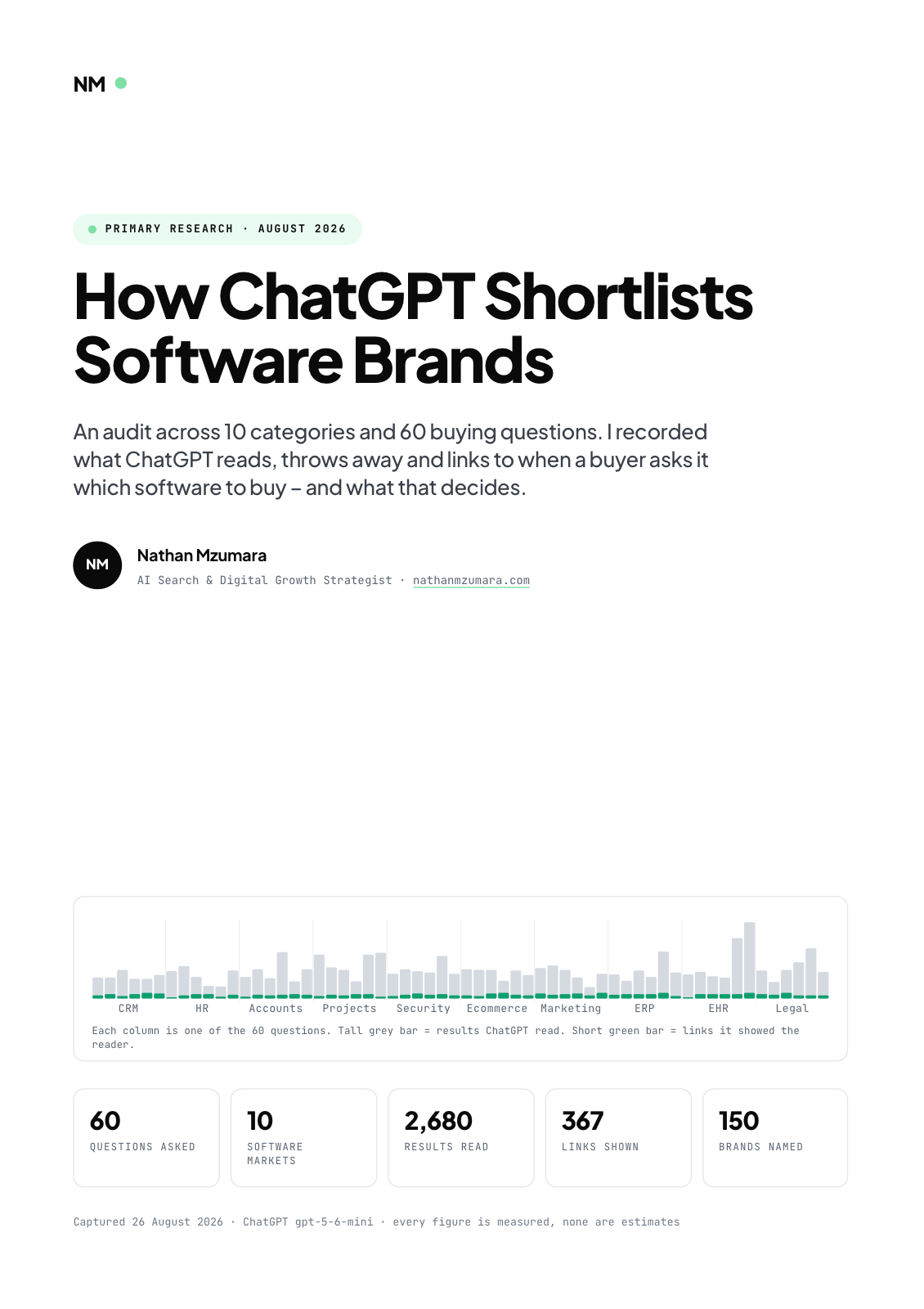
Primary research · August 2026
How ChatGPT Shortlists Software Brands
An audit across 10 categories and 60 buying questions. I recorded what ChatGPT reads, throws away and links to when a buyer asks it which software to buy, and what that decides.
- 60
- Questions asked
- 10
- Software markets
- 2,680
- Results read
- 367
- Links shown
Free download
Get the full report
35 pages · PDF · 536 KB. Enter your details and it downloads straight away.