Consumer Behaviour
Agentic browser
Also known as: AI browser
A browser (or browsing layer) that uses an LLM agent to interpret pages, summarise content, and take actions on behalf of the user. Arc Search, Perplexity Comet, Browser Company's Dia, Dia browser, and similar.
What it is
An agentic browser is a browser or browsing layer that uses an LLM agent to interpret pages, summarise content, and carry out actions for the user. Arc Search, Perplexity Comet, and Dia are early examples.
Why it matters
It changes who reads the page: the agent consumes and condenses content before the human sees it, so visibility depends on being machine readable and quotable rather than on attracting a click.
How it works
The agent fetches pages, parses their structure and main content, synthesises an answer or completes a task such as filling a form, and presents a condensed result to the user.
When it applies
It applies when users delegate browsing or research to an assistant rather than navigating sites directly.
Examples
- A user asks the browser to compare three products and receives one synthesised summary instead of three tabs.
- An agent reads a recipe page and returns only the ingredients and steps, skipping the surrounding article.
- The browser books or pre fills a form on the user's behalf after reading the page.
How it is measured
- Share of sessions where content is summarised rather than read in full
- Rate of agent visits versus human page views
- Inclusion or citation rate within agent generated summaries
- Actions completed by the agent per visit
Related terms in Consumer Behaviour
- Agentic commerceAgentic commerce is buying and selling in which an AI agent completes part or all of the purchase on a person's behalf, from finding products to placing the order. Instead of browsing a site, the shopper states an intent and the agent searches, compares, fills the cart and sometimes pays. It shifts the point of decision away from the merchant's own interface and towards the assistant.
- App discoveryApp discovery is the set of ways people find and decide to install mobile apps, including store search and browse, editorial placements, web search, social feeds, advertising, AI assistants and word of mouth. It covers the whole path from first awareness to tapping install. Growth teams study it to work out which surfaces create demand and which only capture it.
- Brand demandSearch volume for branded terms. In an AI-search world, brand demand is the single strongest moat, generic queries are absorbed by AI Overviews and ChatGPT, while branded queries route users directly to brand properties.
- Brand discoveryBrand discovery is the process by which someone encounters a brand for the first time, or becomes newly aware it can solve their problem. It happens across search results, AI assistants, social feeds, communities, creators, reviews, marketplaces and word of mouth. Marketers study it to work out which surfaces introduce them to future customers.
- Consumer behaviour signalObservable patterns in how users phrase queries, refine searches, and choose answers, used by both ranking systems and generative models to infer intent and quality.
- Conversational searchConversational search is the pattern of finding information through a back and forth dialogue rather than a single keyword query, with each follow-up interpreted in the context of what came before. Users ask broad questions, then narrow with refinements such as cheaper, nearby or without the subscription. It shifts discovery from ranked link lists towards answers that must survive several rounds of questioning.
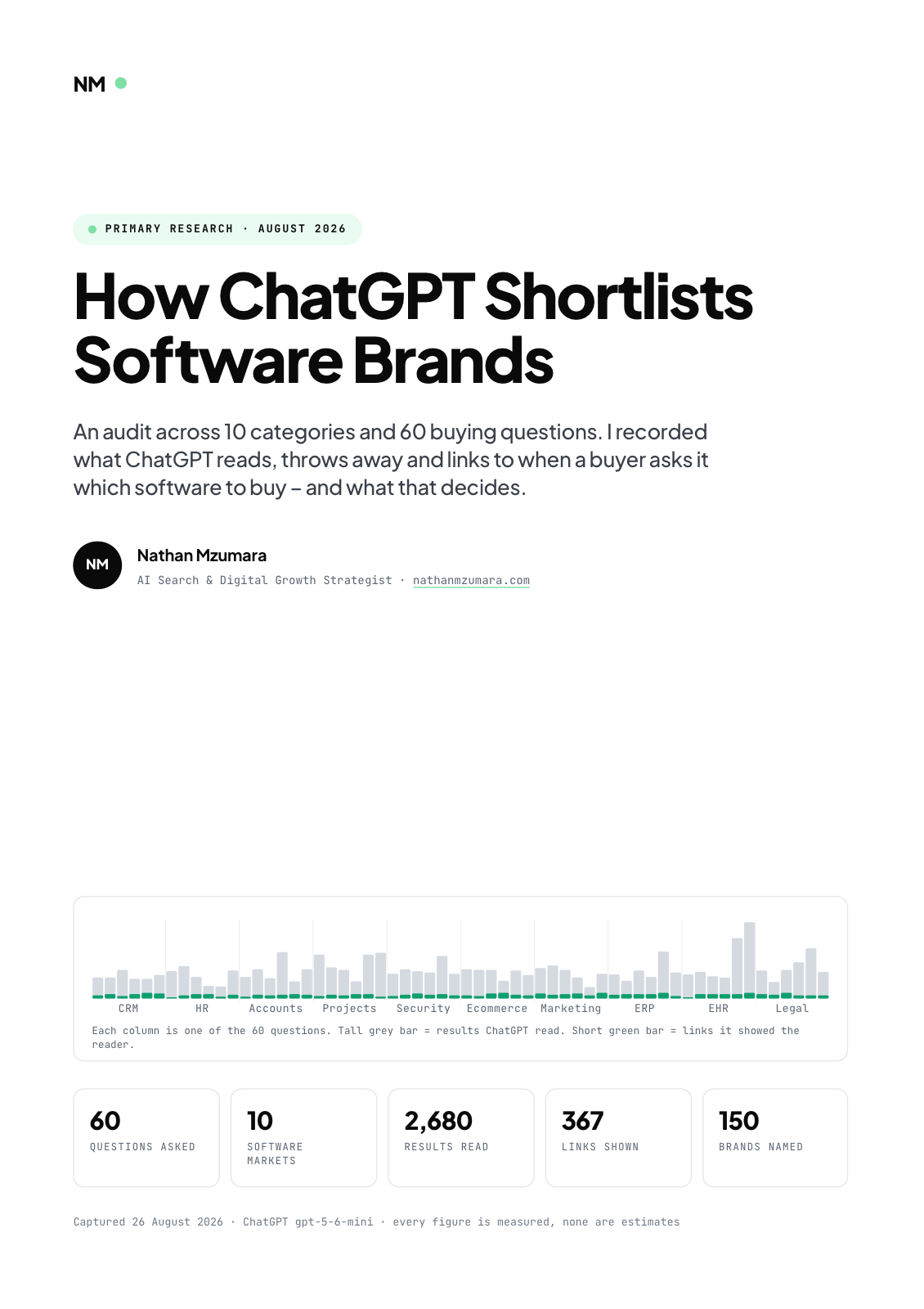
Primary research · August 2026
How ChatGPT Shortlists Software Brands
An audit across 10 categories and 60 buying questions. I recorded what ChatGPT reads, throws away and links to when a buyer asks it which software to buy, and what that decides.
- 60
- Questions asked
- 10
- Software markets
- 2,680
- Results read
- 367
- Links shown
Free download
Get the full report
35 pages · PDF · 536 KB. Enter your details and it downloads straight away.