Consumer Behaviour
Agentic commerce
Also known as: agent-led commerce, AI agent shopping, agentic checkout
Agentic commerce is buying and selling in which an AI agent completes part or all of the purchase on a person's behalf, from finding products to placing the order. Instead of browsing a site, the shopper states an intent and the agent searches, compares, fills the cart and sometimes pays. It shifts the point of decision away from the merchant's own interface and towards the assistant.
What it is
Agentic commerce describes transactions mediated by an AI assistant that can take actions, not just answer questions. The agent may read product feeds, call merchant APIs, apply saved payment credentials and confirm the order inside the chat or assistant surface. Merchants participate by exposing structured product, stock and pricing data and by supporting checkout protocols that agents can call.
Why it matters
When an agent selects the shortlist, classic ranking, merchandising and on site persuasion have less influence on the outcome. Visibility depends on whether your catalogue is machine readable, accurate and trusted by the systems agents rely on. Merchants who are absent from those pipes can lose sales without ever seeing a lost session in analytics.
How it works
Practitioners start by cleaning product data: complete titles, attributes, GTINs, stock status, pricing and delivery terms in feeds and structured data. They then check eligibility for agent facing checkout routes, such as OpenAI's Instant Checkout built on the Agentic Commerce Protocol with Stripe, and equivalent programmes from other platforms. Finally they instrument referrals from assistant domains so agent driven orders can be separated from ordinary organic and paid traffic.
When it applies
It applies to any business selling products or bookable services where an assistant could plausibly complete the task, especially repeat purchases, commodities and comparison heavy categories. It matters most once a meaningful share of research starts inside an AI assistant rather than a search engine.
Examples
- A shopper asks an assistant to reorder the same coffee beans and the order is placed without visiting the retailer's site.
- A homeware retailer fixes missing size and material attributes in its feed so agents can match it to specific queries.
- A DTC brand enables an agent facing checkout route and tags the resulting orders separately in its order management system.
How it is measured
- Orders and revenue attributed to AI assistant referrers or agent checkout routes
- Product feed completeness and error rate across required attributes
- Rate at which your products appear in assistant generated shortlists for tracked prompts
- Return and cancellation rate on agent sourced orders compared with site orders
Insights on Agentic commerce
Related terms in Consumer Behaviour
- Agentic browserA browser (or browsing layer) that uses an LLM agent to interpret pages, summarise content, and take actions on behalf of the user. Arc Search, Perplexity Comet, Browser Company's Dia, Dia browser, and similar.
- Brand demandSearch volume for branded terms. In an AI-search world, brand demand is the single strongest moat, generic queries are absorbed by AI Overviews and ChatGPT, while branded queries route users directly to brand properties.
- Brand discoveryBrand discovery is the process by which someone encounters a brand for the first time, or becomes newly aware it can solve their problem. It happens across search results, AI assistants, social feeds, communities, creators, reviews, marketplaces and word of mouth. Marketers study it to work out which surfaces introduce them to future customers.
- Consumer behaviour signalObservable patterns in how users phrase queries, refine searches, and choose answers, used by both ranking systems and generative models to infer intent and quality.
- Conversational searchConversational search is the pattern of finding information through a back and forth dialogue rather than a single keyword query, with each follow-up interpreted in the context of what came before. Users ask broad questions, then narrow with refinements such as cheaper, nearby or without the subscription. It shifts discovery from ranked link lists towards answers that must survive several rounds of questioning.
- Facebook SearchFacebook Search is the search function inside Facebook that lets people find posts, people, Pages, Groups, events, videos and Marketplace listings. It is a platform search experience rather than a general web search engine, so results are shaped by what is published on Facebook and by the searcher's connections and activity. For businesses it affects whether a Page, Group or listing is found by people already inside the app.
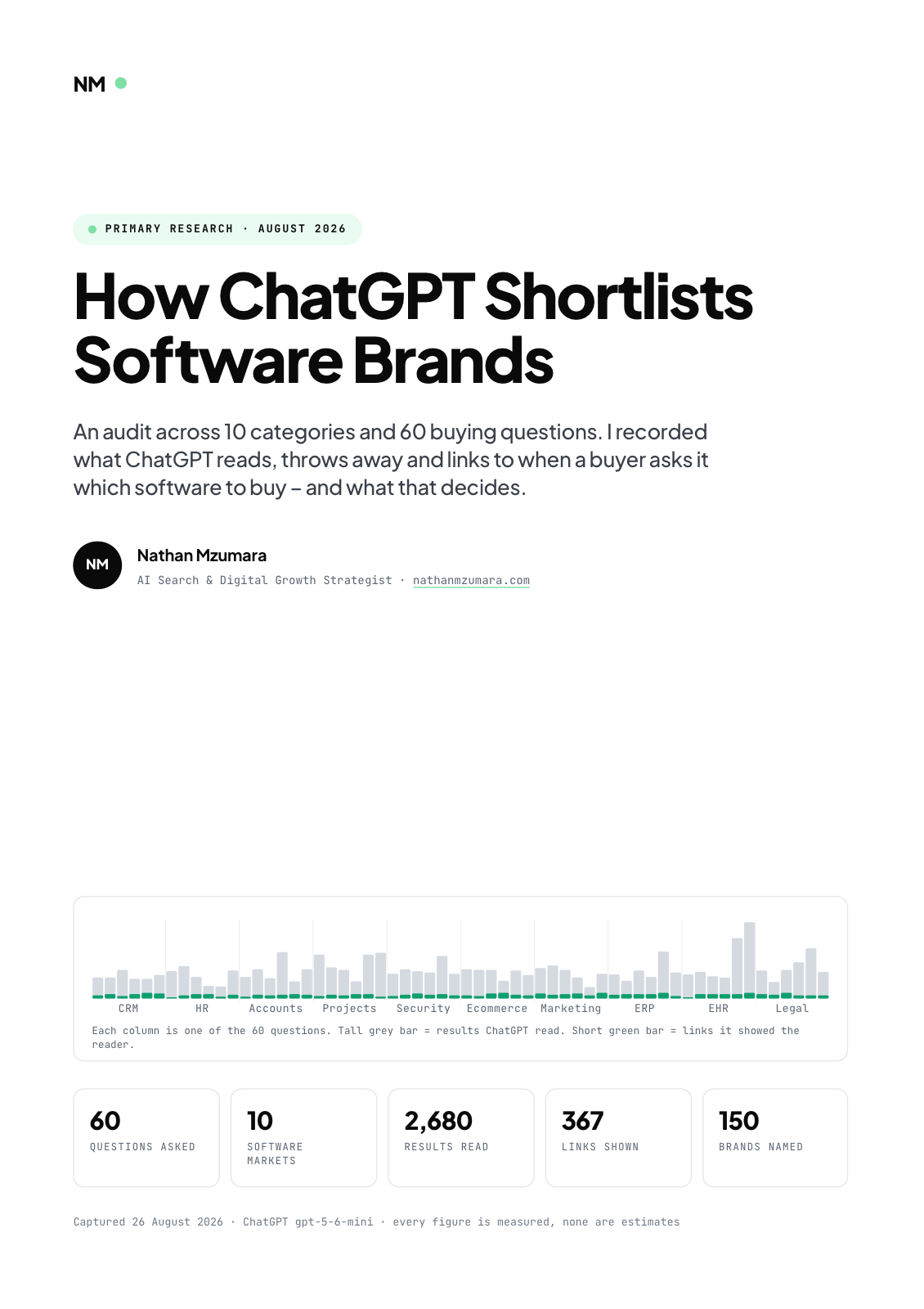
Primary research · August 2026
How ChatGPT Shortlists Software Brands
An audit across 10 categories and 60 buying questions. I recorded what ChatGPT reads, throws away and links to when a buyer asks it which software to buy, and what that decides.
- 60
- Questions asked
- 10
- Software markets
- 2,680
- Results read
- 367
- Links shown
Free download
Get the full report
35 pages · PDF · 536 KB. Enter your details and it downloads straight away.