Consumer Behaviour
Conversational search
Also known as: conversational query, multi-turn search, chat-based search
Conversational search is the pattern of finding information through a back and forth dialogue rather than a single keyword query, with each follow-up interpreted in the context of what came before. Users ask broad questions, then narrow with refinements such as cheaper, nearby or without the subscription. It shifts discovery from ranked link lists towards answers that must survive several rounds of questioning.
What it is
In conversational search the system keeps session context, resolves pronouns and implied references, and treats the whole thread as the query. Turns are usually longer and more natural than keyword searches, often full sentences with constraints and context about the person's situation. It appears in AI assistants, AI modes inside search engines and on-site chat interfaces.
Why it matters
Because intent is revealed across turns, a page that only answers the opening question can be dropped once the conversation gets specific. Pages that cover comparisons, exceptions, pricing conditions and edge cases stay relevant deeper into the thread, which is where buying decisions are made. It also changes measurement, since a single conversation may replace what used to be several separate sessions and queries.
How it works
Practitioners map likely conversation paths for a topic, from first question through common follow-ups and objections, then make sure the content answers each step in extractable form with headings, direct answers and supporting detail. They run the same threads through several assistants to see where their brand drops out and what gets cited instead. Structured data, clear entity naming and consistent facts across the site help systems keep attributing answers to the same source through multiple turns.
When it applies
It applies to any considered purchase or research topic where people ask follow-up questions, which includes most B2B evaluation, financial products, travel planning and technical troubleshooting.
Examples
- A user asks for project tools for a small team, then which are free, then which integrate with Xero.
- A shopper asks about a running shoe, then about wide fits, then about returns from the Republic of Ireland.
- A prospect asks what a compliance standard covers, then whether it applies to under ten staff, then what an audit costs.
How it is measured
- Brand inclusion rate at turn one versus turn three of tested conversation paths
- Coverage of mapped follow-up questions across your content set
- On-site assistant metrics such as turns per session and resolution rate
- Referral and conversion data from AI assistant sources over time
Related terms in Consumer Behaviour
- Agentic browserA browser (or browsing layer) that uses an LLM agent to interpret pages, summarise content, and take actions on behalf of the user. Arc Search, Perplexity Comet, Browser Company's Dia, Dia browser, and similar.
- Brand demandSearch volume for branded terms. In an AI-search world, brand demand is the single strongest moat, generic queries are absorbed by AI Overviews and ChatGPT, while branded queries route users directly to brand properties.
- Brand discoveryBrand discovery is the process by which someone encounters a brand for the first time, or becomes newly aware it can solve their problem. It happens across search results, AI assistants, social feeds, communities, creators, reviews, marketplaces and word of mouth. Marketers study it to work out which surfaces introduce them to future customers.
- Consumer behaviour signalObservable patterns in how users phrase queries, refine searches, and choose answers, used by both ranking systems and generative models to infer intent and quality.
- Facebook SearchFacebook Search is the search function inside Facebook that lets people find posts, people, Pages, Groups, events, videos and Marketplace listings. It is a platform search experience rather than a general web search engine, so results are shaped by what is published on Facebook and by the searcher's connections and activity. For businesses it affects whether a Page, Group or listing is found by people already inside the app.
- Job-to-be-done (search)The functional outcome a searcher is trying to achieve when they issue a query. Distinct from the literal query text. The unit of analysis for intent-aligned content strategy.
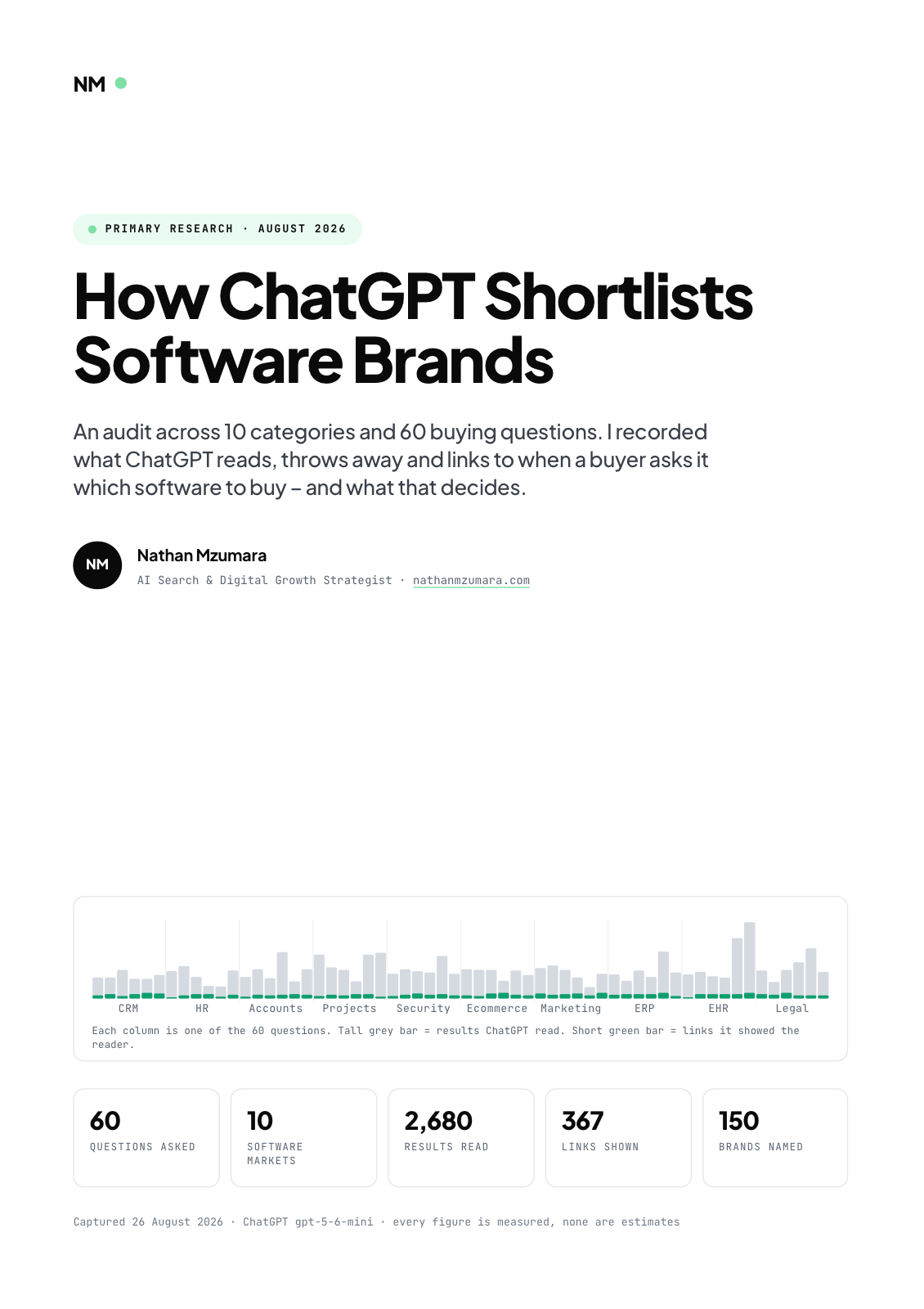
Primary research · August 2026
How ChatGPT Shortlists Software Brands
An audit across 10 categories and 60 buying questions. I recorded what ChatGPT reads, throws away and links to when a buyer asks it which software to buy, and what that decides.
- 60
- Questions asked
- 10
- Software markets
- 2,680
- Results read
- 367
- Links shown
Free download
Get the full report
35 pages · PDF · 536 KB. Enter your details and it downloads straight away.