Meta Just Launched Muse, A Personal AI agent

Meta launched Muse on 8 September 2026, a personal AI agent that opens a browser, fills out forms, negotiates and checks out on a person's behalf. For marketers, the practical effect is a permanent skip to content: the buyer hands over the job, and a machine goes straight to the task, past your navigation, your hero image and your persuasion.
Muse is a personal AI agent that runs on its own dedicated cloud computer, called Muse Secure VM, and works across the apps a person chooses to connect. Meta announced it on the Meta Newsroom on 8 September 2026.
What Meta launched on 8 September 2026
Muse is rolling out in the US on iOS, Android and muse.ai, with AI glasses coming soon. Meta says it is free for most of what people need, with subscription plans for people who want to do more.
People talk to Muse in the Muse app or directly in WhatsApp, which Meta says works just like messaging another person. It is powered by Muse Spark, which Meta describes as its most capable model to date, built for real-world agentic work.
How does Muse actually do the work?
Meta describes four behaviours that matter commercially.
- Plans: once a person shares a goal, Muse helps develop a personalised plan, coordinates their time and resources, then advances the work on its own.
- Browses: Muse can open a browser, fill out forms and negotiate on the person's behalf.
- Persists: Muse keeps working after the person closes the app, and comes back when something changes or when it needs approval, such as before it sends an email or makes a purchase.
- Remembers: Muse can turn a recipe reel saved on Instagram into a grocery list, suggest a dinner party menu, and remember friends' dietary restrictions before it sends the invites.
Look at the three results Meta uses as examples: selling a car for more, lowering a bill, and adjusting a training plan. Two of those three are negotiations conducted against a business. Automated haggling is now a launch feature, not a research demo.
Checkout changes: Link built by Stripe and one-time cards
Muse can check out with Link built by Stripe, and Meta says it is the first AI agent covered by Link's purchase protections. Those cover damaged or lost items, price drops, no-fee returns, and a return guarantee on eligible purchases, at no cost to the buyer.
Link's wallet for agents generates a one-time-use card so the buyer's real card details stay hidden. Shop Pay is coming soon as another payment option, along with 1Password support so Muse can use logins a person already has.
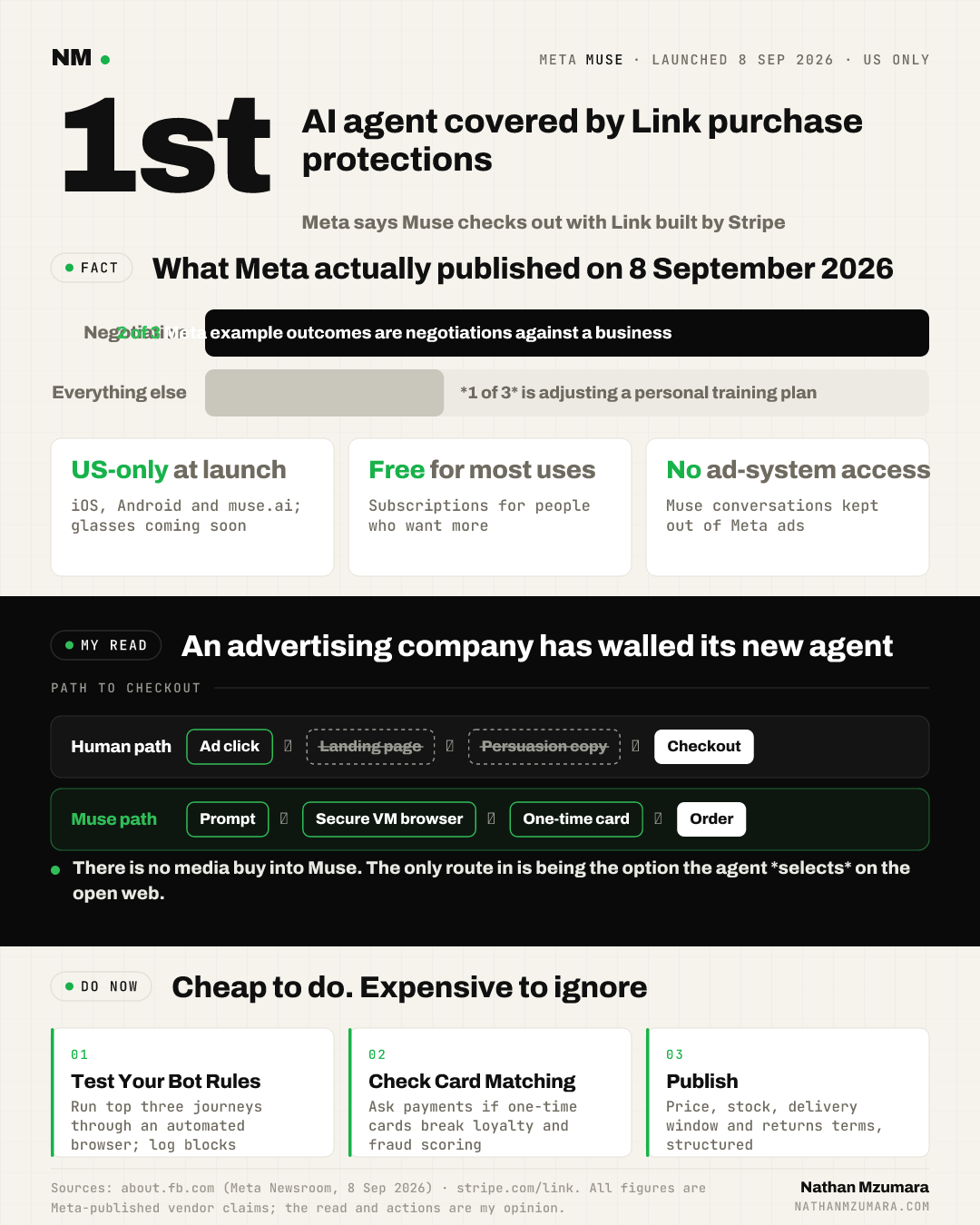
That single detail breaks a lot of quiet assumptions. If your checkout sees a fresh one-time card on every order, card-based repeat customer matching, stored-card loyalty and fraud rules that reward a known card will all misread agent purchases. Price-drop cover and no-fee returns also lower the cost of buying early and sending it back.
Meta says Muse conversations stay out of its ad systems
Meta states that Muse does not share a person's conversations or the data in their VM with Meta's ad systems. People can also opt out of their interactions being used to train Meta's AI models, and can tell Muse to forget specific things it has learned.
Later this year Meta will introduce Muse Confidential VM, where the whole virtual machine, including the person's data and conversations, is encrypted with a key only they hold, so not even Meta can access it. Meta explains the architecture in How We Built Safety Into Muse.
My read is that this is the most commercially interesting choice in the announcement. An advertising company has walled its new agent off from its advertising business, which is the opposite direction to OpenAI putting sponsored placements inside conversations. If there is no media buy into Muse, the only route in is being the option the agent selects on the open web.
The risk sits in your bot rules, not your creative
Muse runs on its own dedicated computer in the cloud with its own browser. A separate Sentinel agent runs on the same machine, kept apart from Muse at the system level, and nothing Muse does reaches the internet unless Sentinel approves it.
So the traffic hitting your site is a headless-style browser inside a virtual machine, acting for a real customer with a real card. If your bot management, form validation or login flow rejects it, you lose the order and never see a reason in the data. This is the retrieval and access problem described in our work on brand visibility in AI search, moved from citation to checkout.
The counter-view
Muse is US-only at launch, on iOS, Android and muse.ai. Meta published no usage numbers, no subscription pricing and no merchant-facing documentation in the announcement. Nobody outside Meta has run it at volume yet. Treat this as a readiness exercise, not a channel with a budget line.
What to do this week when buyers skip to content
- Run your top three conversion journeys through an automated browser and log where bot rules, CAPTCHAs or form validation stop the session.
- Ask your payments lead whether one-time virtual cards break repeat-customer matching, loyalty or fraud scoring in your stack.
- Publish the facts an agent needs in machine-readable form: price, stock, delivery window, returns terms. Persuasion copy does not help a buyer who never sees the page.
- Give your pricing and retention teams a written policy for automated negotiation, because Meta lists lowering a bill as a core use case.
- Read How We Designed Muse before you brief anyone internally.
Nothing breaks tomorrow while Muse sits in the US. The direction is clear though. When a buyer delegates the job, they skip to content in the most literal sense, and what arrives at your site is a machine with a task, a one-time card and an audit trail. Build for that reader now, while it is still cheap to do.