Tooling
Also known as: WhatsApp Business, Meta WhatsApp
WhatsApp is Meta's messaging app, used by people and businesses for one to one and group conversation across mobile and web. Businesses reach customers through the WhatsApp Business app for smaller teams or the WhatsApp Business Platform for programmatic messaging at scale. It functions as a support, transaction and retention channel rather than a public, indexable content surface.
What it is
WhatsApp is an encrypted messaging service owned by Meta and one of the most widely used messaging apps globally. Business use runs on two tracks: a free app aimed at small businesses with profiles, catalogues and quick replies, and an API based platform for CRM integrations, template messages and automated flows. Messaging to customers generally requires an opt in and, outside an open conversation window, approved message templates.
Why it matters
Messaging captures high intent conversations that never appear in web analytics, including questions that would otherwise be typed into a search engine. Click to WhatsApp ads give paid social a direct response route that ends in a conversation rather than a landing page, which suits considered purchases and local services. As AI assistants absorb more informational queries, owned conversational channels become a more reliable way to reach existing customers.
How it works
Teams connect WhatsApp to their CRM or helpdesk through the Business Platform, define opt in points on site and in ads, and build template messages for order updates, reminders and reactivation. Conversations are routed to agents or handled by automated flows, with handover rules for complex cases. Performance is tracked by conversation volume, response time and downstream orders, with unsubscribes watched closely because heavy templated messaging erodes trust fast.
When it applies
It applies in markets where WhatsApp is a default communication channel, and in any business where sales depend on back and forth questions, quotes or bookings. It is also relevant for post purchase updates and retention where email open rates are weak.
Examples
- A local kitchen fitter runs click to WhatsApp ads so enquiries arrive as chats with photos attached.
- An online pharmacy sends order dispatch and delivery updates through approved WhatsApp templates instead of SMS.
- A travel agent uses the Business Platform to route incoming chats to the right consultant based on destination keywords.
How it is measured
- Conversations started, by source, including click to WhatsApp ads and on site entry points
- Cost per qualified conversation and conversation to order rate
- Median first response time and resolution time
- Opt in growth and opt out or block rate per campaign
Insights on WhatsApp
Related terms in Tooling
- Ahrefs Brand RadarAhrefs' AI-visibility module tracking brand mentions and impressions inside AI answers. Surfaces shifts in how brands appear across ChatGPT, Gemini, and other LLM surfaces.
- AI content detectionAI content detection is the use of software to estimate whether a piece of text, image, audio or video was generated by an AI model. Detectors return a probability or classification rather than proof, and accuracy varies with length, language, editing and model used. Because of that uncertainty, results are treated as a signal for review, not a verdict.
- AI watermarkingAI watermarking is the practice of embedding a signal into AI generated text, images, audio or video so the output can later be identified as machine produced. The signal is usually designed to be imperceptible to people but detectable by software that holds the matching key or detector. It is one of several provenance approaches used alongside metadata standards and content credentials.
- Bot detectionBot detection is the practice of identifying automated traffic to a website or API and separating it from human visitors. It distinguishes wanted automation, such as search engine and AI crawlers, from unwanted activity like scraping, credential stuffing and click fraud. Detection results feed decisions about what to allow, challenge, rate limit or block.
- Brave BrowserBrave is a Chromium based web browser from Brave Software that blocks third party trackers and most ads by default. It bundles privacy controls, Brave Search as the default engine, and an AI assistant called Leo. Because it strips tracking scripts, visits from Brave users are often harder to attribute in analytics.
- Brave SearchBrave Search is a search engine from Brave Software that serves results from its own web index rather than reselling another engine's results. It is the default engine in the Brave browser, offers AI generated answer summaries, and is sold to developers as the Brave Search API. That API makes it a grounding source for other search and AI products.
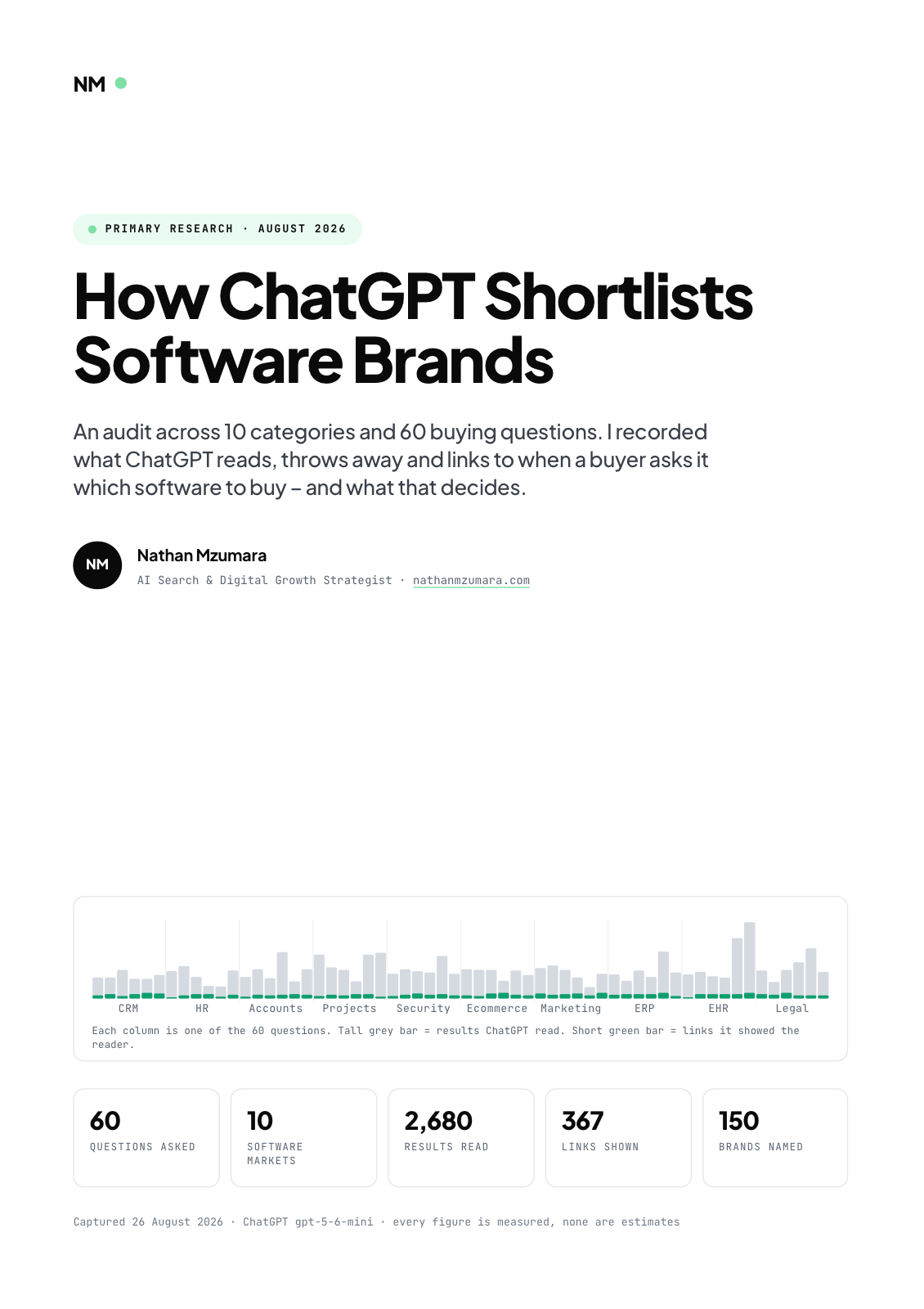
Primary research · August 2026
How ChatGPT Shortlists Software Brands
An audit across 10 categories and 60 buying questions. I recorded what ChatGPT reads, throws away and links to when a buyer asks it which software to buy, and what that decides.
- 60
- Questions asked
- 10
- Software markets
- 2,680
- Results read
- 367
- Links shown
Free download
Get the full report
35 pages · PDF · 536 KB. Enter your details and it downloads straight away.