Tooling
AI content detection
Also known as: AI detector, AI content detector, AI text detection
AI content detection is the use of software to estimate whether a piece of text, image, audio or video was generated by an AI model. Detectors return a probability or classification rather than proof, and accuracy varies with length, language, editing and model used. Because of that uncertainty, results are treated as a signal for review, not a verdict.
What it is
AI content detectors analyse statistical patterns in the output, such as predictability of word choice in text or artefacts in images, and compare them against patterns typical of model generated content. Some tools use watermark detection where a watermark exists, while most rely on classifiers trained on human and machine samples. Outputs are usually expressed as a score or a confidence band.
Why it matters
Editorial teams, marketplaces, universities and some clients want to know the origin of content, and detection tools are the first thing many reach for. For marketers the practical risk is both directions: human written work being wrongly flagged, and unedited machine output slipping into publication without review. Understanding the limits of detection helps teams set policies that are enforceable rather than performative.
How it works
Practitioners paste or upload content, review the score, then use it to trigger a human check rather than an automatic decision. Better processes combine detection with editorial evidence such as drafts, version history, briefs and source citations, which are far stronger proof of process than a classifier score. Many teams also test detectors against known human samples to understand false positive rates before relying on them.
When it applies
It applies when commissioning freelance or agency content, vetting user generated submissions, auditing inherited site content, or responding to a claim that published work is machine generated. It is also used internally to check whether AI assisted drafts have been edited enough to meet quality standards.
Examples
- An editor runs a freelance article through a detector, gets a high score, then asks for the draft history and research notes before deciding.
- A marketplace screens new seller listings for bulk generated descriptions and routes flagged listings to manual review.
- A site owner auditing 400 inherited blog posts uses detection to prioritise which pages a human reviewer reads first.
How it is measured
- False positive rate measured against a known set of human written samples
- Share of flagged items that fail human editorial review
- Median time from flag to editorial decision
- Proportion of commissioned content submitted with drafts or version history as evidence
Insights on AI content detection
Related terms in Tooling
- Ahrefs Brand RadarAhrefs' AI-visibility module tracking brand mentions and impressions inside AI answers. Surfaces shifts in how brands appear across ChatGPT, Gemini, and other LLM surfaces.
- AI watermarkingAI watermarking is the practice of embedding a signal into AI generated text, images, audio or video so the output can later be identified as machine produced. The signal is usually designed to be imperceptible to people but detectable by software that holds the matching key or detector. It is one of several provenance approaches used alongside metadata standards and content credentials.
- Bot detectionBot detection is the practice of identifying automated traffic to a website or API and separating it from human visitors. It distinguishes wanted automation, such as search engine and AI crawlers, from unwanted activity like scraping, credential stuffing and click fraud. Detection results feed decisions about what to allow, challenge, rate limit or block.
- Brave BrowserBrave is a Chromium based web browser from Brave Software that blocks third party trackers and most ads by default. It bundles privacy controls, Brave Search as the default engine, and an AI assistant called Leo. Because it strips tracking scripts, visits from Brave users are often harder to attribute in analytics.
- Brave SearchBrave Search is a search engine from Brave Software that serves results from its own web index rather than reselling another engine's results. It is the default engine in the Brave browser, offers AI generated answer summaries, and is sold to developers as the Brave Search API. That API makes it a grounding source for other search and AI products.
- Coding agentA coding agent is an AI system that can carry out multi-step software tasks with limited supervision, reading a codebase, editing files, running commands and tests, and proposing changes for review. It differs from simple code completion because it plans, acts and checks its own work across several steps. Marketing and SEO teams increasingly use coding agents to ship technical fixes that would otherwise wait in an engineering backlog.
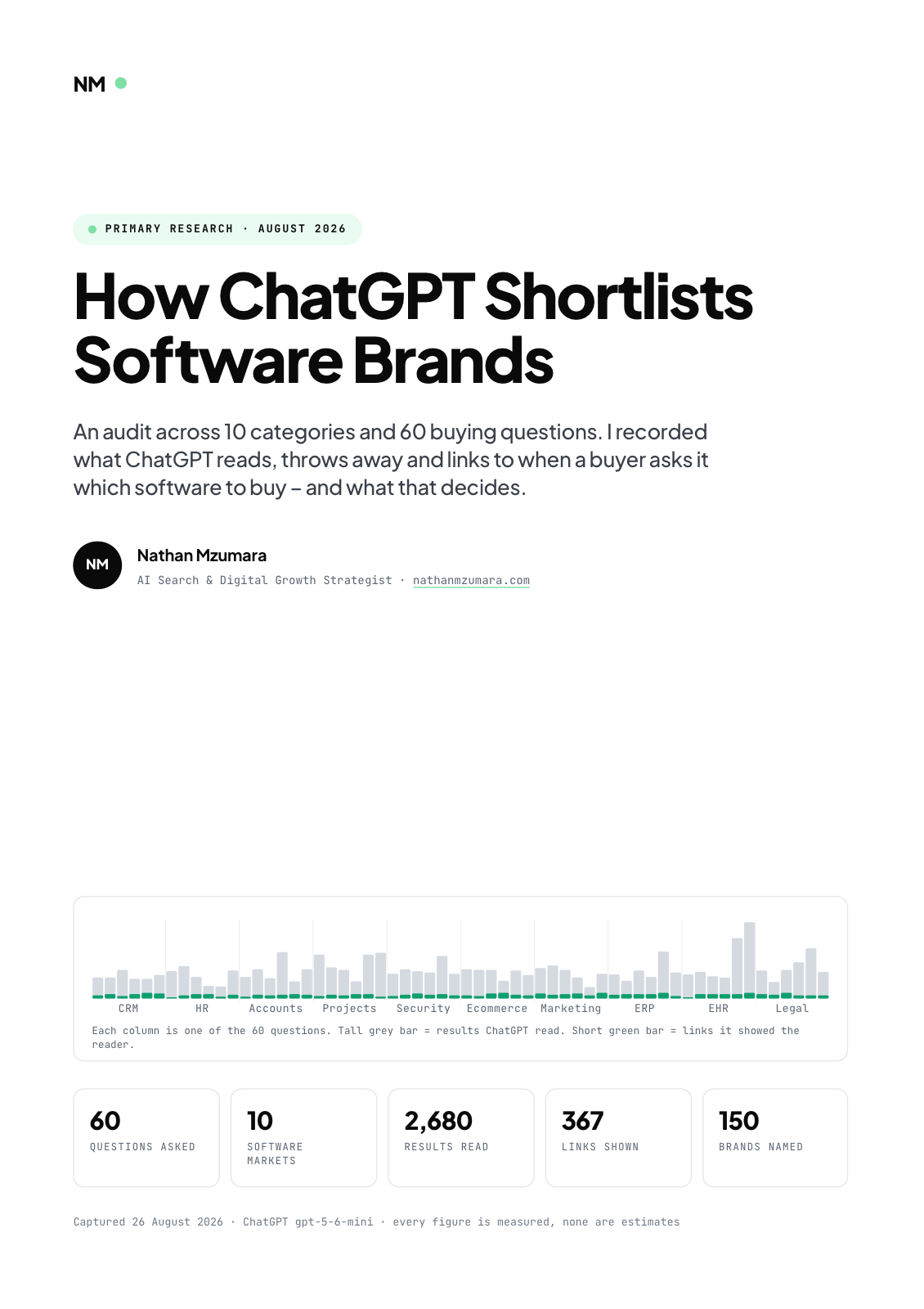
Primary research · August 2026
How ChatGPT Shortlists Software Brands
An audit across 10 categories and 60 buying questions. I recorded what ChatGPT reads, throws away and links to when a buyer asks it which software to buy, and what that decides.
- 60
- Questions asked
- 10
- Software markets
- 2,680
- Results read
- 367
- Links shown
Free download
Get the full report
35 pages · PDF · 536 KB. Enter your details and it downloads straight away.