Tooling
Bot detection
Also known as: bot management, automated traffic detection
Bot detection is the practice of identifying automated traffic to a website or API and separating it from human visitors. It distinguishes wanted automation, such as search engine and AI crawlers, from unwanted activity like scraping, credential stuffing and click fraud. Detection results feed decisions about what to allow, challenge, rate limit or block.
What it is
Bot detection combines identity signals with behavioural analysis to classify each request. Identity signals include the declared user agent, IP address range and reverse DNS verification, while behavioural signals cover request rate, navigation patterns, header consistency and browser fingerprint. Most implementations sit in a CDN, WAF or dedicated bot management product.
Why it matters
AI assistants, agents and training crawlers now generate a meaningful share of requests, so teams need to know which automation is visiting before they can decide access policy or read their analytics correctly. Misclassification cuts both ways: blocking a legitimate AI crawler can remove you from answer engines, while counting bots as humans inflates sessions and distorts conversion rates. Accurate classification is the foundation for both visibility and reporting.
How it works
Practitioners verify declared crawlers against published IP ranges or reverse DNS rather than trusting the user agent, then apply graded responses such as allow, rate limit, challenge or block by category. Server logs and CDN reports are segmented by agent so crawl volume from search and AI systems can be tracked separately from human sessions. Rules are reviewed regularly as new agents appear and as spoofing patterns change.
When it applies
It applies whenever you are setting crawler access policy, investigating unexplained traffic spikes, protecting login or checkout endpoints, or reconciling analytics with server logs.
Examples
- A publisher verifies requests claiming to be an AI crawler against the vendor's published IP list and blocks the spoofed ones.
- An ecommerce site rate limits scrapers hitting product pages every few seconds while leaving verified search crawlers untouched.
- An analytics team excludes identified bot traffic from a report after a session spike with a near-zero conversion rate.
How it is measured
- Share of requests classified as human, verified bot and unverified or suspected bot
- Verified versus spoofed request volume per declared crawler
- False positive rate, measured through challenge pass rates and user complaints
- Crawl requests and bytes served by agent, tracked month on month
Insights on Bot detection
Related terms in Tooling
- Ahrefs Brand RadarAhrefs' AI-visibility module tracking brand mentions and impressions inside AI answers. Surfaces shifts in how brands appear across ChatGPT, Gemini, and other LLM surfaces.
- AI content detectionAI content detection is the use of software to estimate whether a piece of text, image, audio or video was generated by an AI model. Detectors return a probability or classification rather than proof, and accuracy varies with length, language, editing and model used. Because of that uncertainty, results are treated as a signal for review, not a verdict.
- AI watermarkingAI watermarking is the practice of embedding a signal into AI generated text, images, audio or video so the output can later be identified as machine produced. The signal is usually designed to be imperceptible to people but detectable by software that holds the matching key or detector. It is one of several provenance approaches used alongside metadata standards and content credentials.
- Brave BrowserBrave is a Chromium based web browser from Brave Software that blocks third party trackers and most ads by default. It bundles privacy controls, Brave Search as the default engine, and an AI assistant called Leo. Because it strips tracking scripts, visits from Brave users are often harder to attribute in analytics.
- Brave SearchBrave Search is a search engine from Brave Software that serves results from its own web index rather than reselling another engine's results. It is the default engine in the Brave browser, offers AI generated answer summaries, and is sold to developers as the Brave Search API. That API makes it a grounding source for other search and AI products.
- Coding agentA coding agent is an AI system that can carry out multi-step software tasks with limited supervision, reading a codebase, editing files, running commands and tests, and proposing changes for review. It differs from simple code completion because it plans, acts and checks its own work across several steps. Marketing and SEO teams increasingly use coding agents to ship technical fixes that would otherwise wait in an engineering backlog.
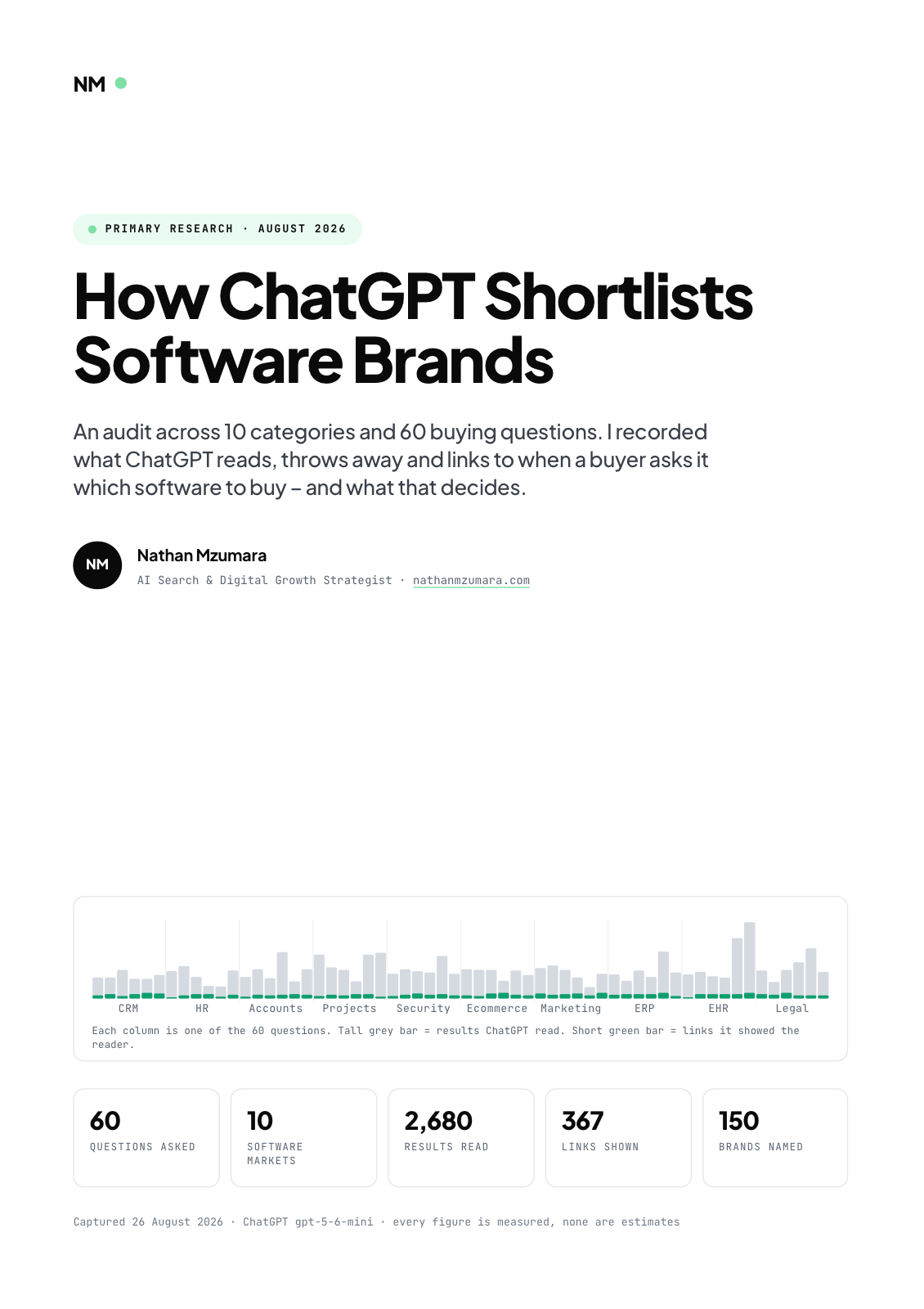
Primary research · August 2026
How ChatGPT Shortlists Software Brands
An audit across 10 categories and 60 buying questions. I recorded what ChatGPT reads, throws away and links to when a buyer asks it which software to buy, and what that decides.
- 60
- Questions asked
- 10
- Software markets
- 2,680
- Results read
- 367
- Links shown
Free download
Get the full report
35 pages · PDF · 536 KB. Enter your details and it downloads straight away.