Tooling
AI watermarking
Also known as: watermarking, generative watermarking, invisible watermark
AI watermarking is the practice of embedding a signal into AI generated text, images, audio or video so the output can later be identified as machine produced. The signal is usually designed to be imperceptible to people but detectable by software that holds the matching key or detector. It is one of several provenance approaches used alongside metadata standards and content credentials.
What it is
AI watermarking covers techniques that alter generated output in patterned ways, for example by biasing token selection in text or adjusting pixel values in images, so a detector can recognise the pattern. It differs from visible labels such as a corner logo, and from metadata provenance, which records how a file was made rather than marking the content itself. Some model providers and image tools apply watermarks by default to their own outputs.
Why it matters
Discovery platforms, publishers and buyers increasingly want to know whether a piece of content was machine generated, and watermarking is one of the mechanisms being built to answer that. For marketers it matters because provenance signals may feed into platform policies, advertising rules and disclosure expectations. It also shapes how brands document their own use of generative tools when clients or regulators ask.
How it works
Practitioners rarely build watermarking themselves; they inherit it from the tools they use and then decide how to handle it. Typical work involves checking whether a generation tool watermarks output, testing whether editing, cropping, compressing or paraphrasing removes the mark, and recording which assets were produced with which tool. Teams often pair this with their own labelling and disclosure policy rather than relying on a watermark surviving downstream processing.
When it applies
It applies whenever a brand publishes AI assisted images, video, audio or text and needs to show provenance or comply with platform and client rules. It is most relevant in regulated sectors, news adjacent publishing, and paid media where platforms ask advertisers to disclose synthetic content.
Examples
- A design team confirms which image generator applies a watermark to exports before using those images in a campaign landing page.
- A content lead tests whether a watermark survives resizing and compression when an image is pushed to social channels.
- An agency records the generation tool, prompt and date for every synthetic asset in its digital asset manager so client legal teams can audit provenance.
How it is measured
- Share of published AI assisted assets with recorded provenance or tool attribution
- Detection rate when watermarked assets are re-tested after editing and compression
- Number of assets flagged by platform synthetic content checks
- Percentage of campaigns that pass internal disclosure review before launch
Related terms in Tooling
- Ahrefs Brand RadarAhrefs' AI-visibility module tracking brand mentions and impressions inside AI answers. Surfaces shifts in how brands appear across ChatGPT, Gemini, and other LLM surfaces.
- AI content detectionAI content detection is the use of software to estimate whether a piece of text, image, audio or video was generated by an AI model. Detectors return a probability or classification rather than proof, and accuracy varies with length, language, editing and model used. Because of that uncertainty, results are treated as a signal for review, not a verdict.
- Bot detectionBot detection is the practice of identifying automated traffic to a website or API and separating it from human visitors. It distinguishes wanted automation, such as search engine and AI crawlers, from unwanted activity like scraping, credential stuffing and click fraud. Detection results feed decisions about what to allow, challenge, rate limit or block.
- Brave BrowserBrave is a Chromium based web browser from Brave Software that blocks third party trackers and most ads by default. It bundles privacy controls, Brave Search as the default engine, and an AI assistant called Leo. Because it strips tracking scripts, visits from Brave users are often harder to attribute in analytics.
- Brave SearchBrave Search is a search engine from Brave Software that serves results from its own web index rather than reselling another engine's results. It is the default engine in the Brave browser, offers AI generated answer summaries, and is sold to developers as the Brave Search API. That API makes it a grounding source for other search and AI products.
- Coding agentA coding agent is an AI system that can carry out multi-step software tasks with limited supervision, reading a codebase, editing files, running commands and tests, and proposing changes for review. It differs from simple code completion because it plans, acts and checks its own work across several steps. Marketing and SEO teams increasingly use coding agents to ship technical fixes that would otherwise wait in an engineering backlog.
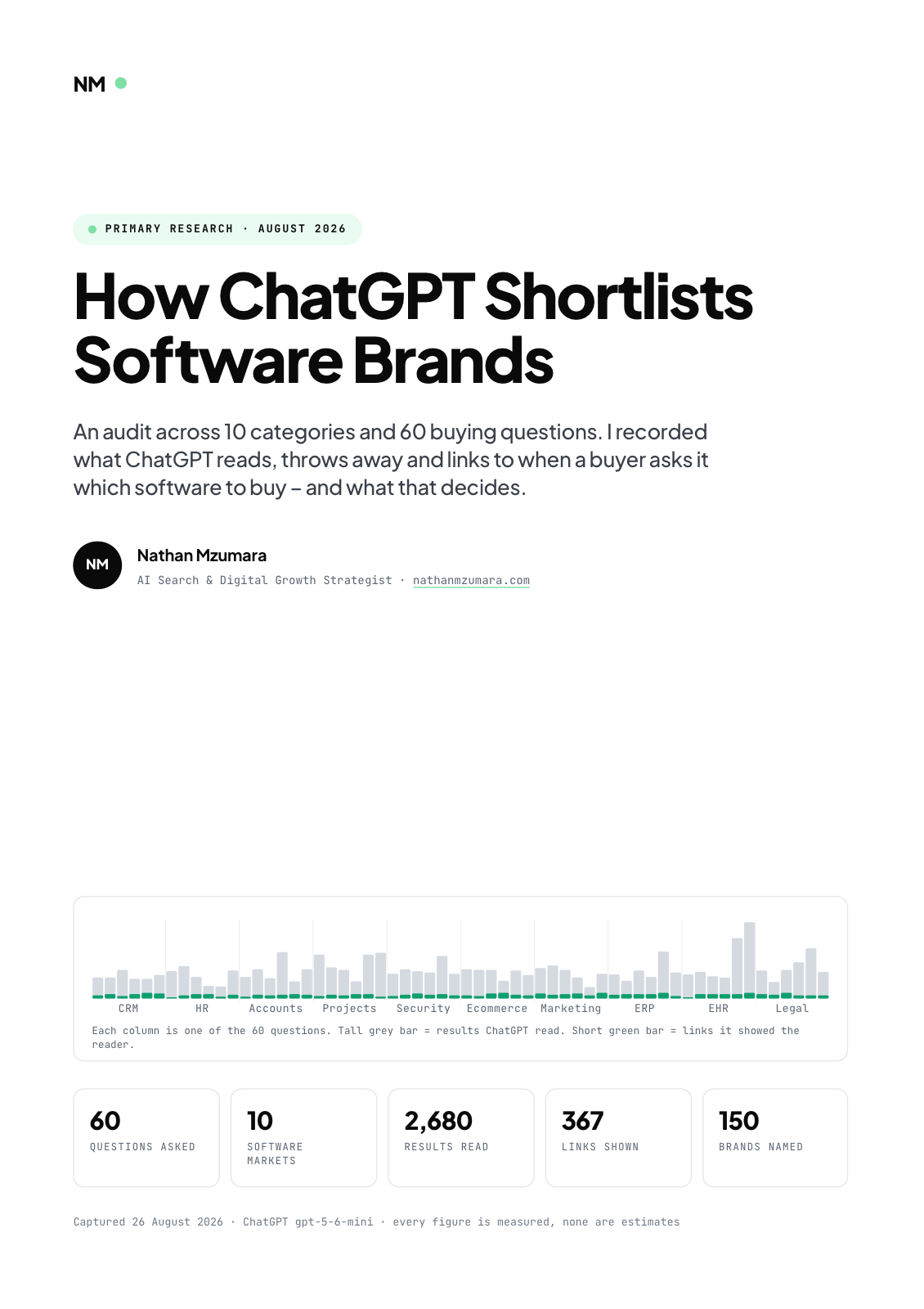
Primary research · August 2026
How ChatGPT Shortlists Software Brands
An audit across 10 categories and 60 buying questions. I recorded what ChatGPT reads, throws away and links to when a buyer asks it which software to buy, and what that decides.
- 60
- Questions asked
- 10
- Software markets
- 2,680
- Results read
- 367
- Links shown
Free download
Get the full report
35 pages · PDF · 536 KB. Enter your details and it downloads straight away.