Tooling
Coding agent
Also known as: AI coding agent, software engineering agent, agentic coding
A coding agent is an AI system that can carry out multi-step software tasks with limited supervision, reading a codebase, editing files, running commands and tests, and proposing changes for review. It differs from simple code completion because it plans, acts and checks its own work across several steps. Marketing and SEO teams increasingly use coding agents to ship technical fixes that would otherwise wait in an engineering backlog.
What it is
Coding agents combine a large language model with tools: file access, a terminal, a test runner, version control and sometimes a browser. Given a task described in plain language, the agent inspects the repository, makes a plan, edits code, runs tests and iterates until the task passes or it gets stuck. Output is usually a branch, a diff or a pull request that a human reviews before merge.
Why it matters
A large share of technical SEO and site performance work is small, well specified and perpetually deprioritised, and agents shorten the gap between diagnosis and deployment. Faster remediation of crawl, rendering, schema and speed issues compounds into better indexing and more reliable presence in both classic results and AI answers. There is a risk side too, since unreviewed agent output can introduce regressions that damage exactly the things you are trying to improve.
How it works
Practitioners write a precise task description with acceptance criteria, point the agent at the relevant repository and give it a testable definition of done. Guardrails matter: branch protection, required human review, automated tests, staging deployment and limits on which files or commands the agent can touch. Teams typically start with low risk, high volume tasks such as markup and metadata changes, then extend scope as trust builds.
When it applies
It applies when a change is well defined, verifiable and reversible, and when the technical backlog is the bottleneck rather than the decision itself. It is a poor fit for architecture decisions, anything touching payments or personal data, and work where the requirements are still vague.
Examples
- An SEO asks an agent to add valid Article and Breadcrumb structured data to a templated blog layout and open a pull request.
- An agent fixes a batch of broken internal links and legacy redirect chains flagged by a crawl, then runs the test suite before review.
- A growth engineer has an agent implement lazy loading and correct image dimensions across product templates to address Core Web Vitals issues.
How it is measured
- Share of agent-authored pull requests merged without substantive human rewriting
- Cycle time from issue logged to change deployed for technical SEO tickets
- Regression rate, including reverts, failed tests and post-deploy incidents linked to agent changes
- Volume of backlog items closed per sprint compared with the pre-agent baseline
Insights on Coding agent
Related terms in Tooling
- Ahrefs Brand RadarAhrefs' AI-visibility module tracking brand mentions and impressions inside AI answers. Surfaces shifts in how brands appear across ChatGPT, Gemini, and other LLM surfaces.
- AI content detectionAI content detection is the use of software to estimate whether a piece of text, image, audio or video was generated by an AI model. Detectors return a probability or classification rather than proof, and accuracy varies with length, language, editing and model used. Because of that uncertainty, results are treated as a signal for review, not a verdict.
- AI watermarkingAI watermarking is the practice of embedding a signal into AI generated text, images, audio or video so the output can later be identified as machine produced. The signal is usually designed to be imperceptible to people but detectable by software that holds the matching key or detector. It is one of several provenance approaches used alongside metadata standards and content credentials.
- Bot detectionBot detection is the practice of identifying automated traffic to a website or API and separating it from human visitors. It distinguishes wanted automation, such as search engine and AI crawlers, from unwanted activity like scraping, credential stuffing and click fraud. Detection results feed decisions about what to allow, challenge, rate limit or block.
- Brave BrowserBrave is a Chromium based web browser from Brave Software that blocks third party trackers and most ads by default. It bundles privacy controls, Brave Search as the default engine, and an AI assistant called Leo. Because it strips tracking scripts, visits from Brave users are often harder to attribute in analytics.
- Brave SearchBrave Search is a search engine from Brave Software that serves results from its own web index rather than reselling another engine's results. It is the default engine in the Brave browser, offers AI generated answer summaries, and is sold to developers as the Brave Search API. That API makes it a grounding source for other search and AI products.
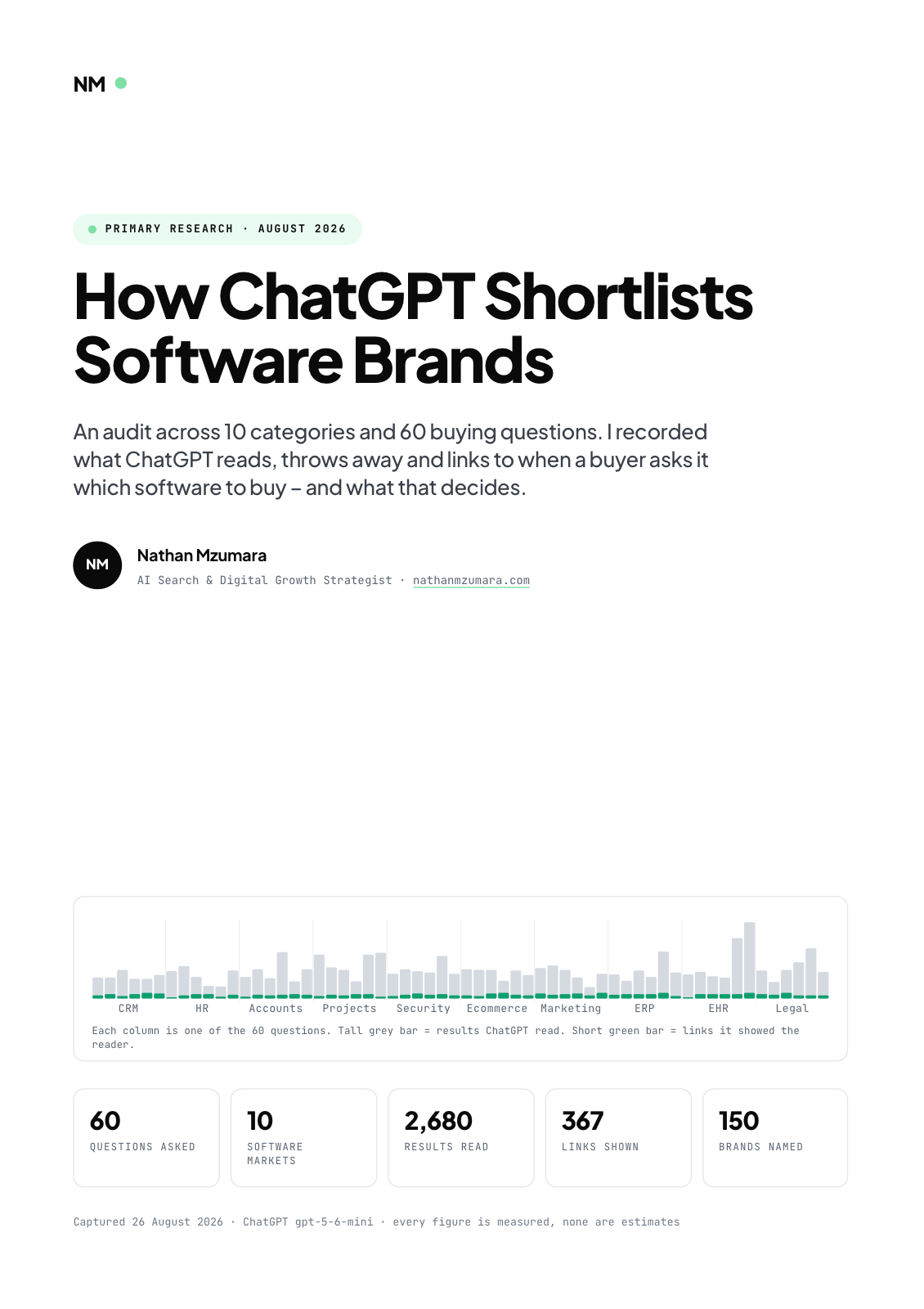
Primary research · August 2026
How ChatGPT Shortlists Software Brands
An audit across 10 categories and 60 buying questions. I recorded what ChatGPT reads, throws away and links to when a buyer asks it which software to buy, and what that decides.
- 60
- Questions asked
- 10
- Software markets
- 2,680
- Results read
- 367
- Links shown
Free download
Get the full report
35 pages · PDF · 536 KB. Enter your details and it downloads straight away.