Brand Visibility in AI Search: 2.8% Without Retrieval, 91.4% With It

A new arXiv paper puts hard numbers on brand visibility in AI search. When neither the target brand nor its own domain appears in the observable live retrieval path, target mention rates are 2.8% on GPT and 3.8% on Gemini. When both own-domain exposure and a branded fan-out occur, mention rates reach 91.4% and 100%. Retrieval, not persuasion, decides whether you get recommended.
The paper is From Prompt to Recommendation: A Fitted Stage Model of Brand Visibility in AI Search, by Benjamin Tannenbaum, submitted to arXiv on 19 September 2026 as arXiv:2609.23162 under Information Retrieval. It runs to 29 pages and 10 figures, and ships aggregate results and figure-reproduction code.
What the study actually measured
Tannenbaum analyses 34,960 unbranded prompt-engine observations drawn from 75 anonymised Aiso projects. Those cover 2,854 distinct monitored prompts, with repeated GPT and Gemini runs between June and September 2026.
Unbranded prompts matter here. These are questions where the user never types your name, which is the category most commercial discovery now falls into. The study asks a single question: under what retrieval conditions does a brand get mentioned at all?
Two conditions do the heavy lifting. The first is own-domain exposure, meaning your own domain appears as a citation in the live retrieval path. The second is branded fan-out, meaning the engine issues a follow-up search that contains your brand name.
The three retrieval states, and what each is worth
| Retrieval state | GPT mention rate | Gemini mention rate |
|---|---|---|
| Neither brand nor own domain in the observable live retrieval path | 2.8% | 3.8% |
| Own-domain citation, no branded fan-out | 49.0% | 58.4% |
| Own-domain exposure plus branded fan-out | 91.4% | 100% |
Source: arXiv:2609.23162, Tannenbaum, 19 September 2026. Figures cover 34,960 unbranded prompt-engine observations from June to September 2026.
The jump from 2.8% to 49.0% on GPT is the whole argument for treating crawlability, citation-worthiness and page-level relevance as revenue work. If your domain is not in the retrieval path, you are competing for roughly a one-in-thirty-five chance of being named.
Does the effect hold within the same prompt?
Yes, and this is the most important robustness check in the paper. Tannenbaum looks at prompt cells that vary in own-domain exposure while holding branded fan-out absent, within the same project, prompt and engine across repeated runs.
Inside those cells, own-domain exposure is associated with a mean mention-rate increase of 40.2 percentage points on GPT and 49.0 percentage points on Gemini. The pattern is not an artefact of easy prompts or strong brands sitting in one bucket.
Past visibility predicts future visibility
Prior visibility is independently persistent in the data. A previous non-mention combined with no current own-domain exposure yields next-run mention rates of just 1.6% on GPT and 1.9% on Gemini.
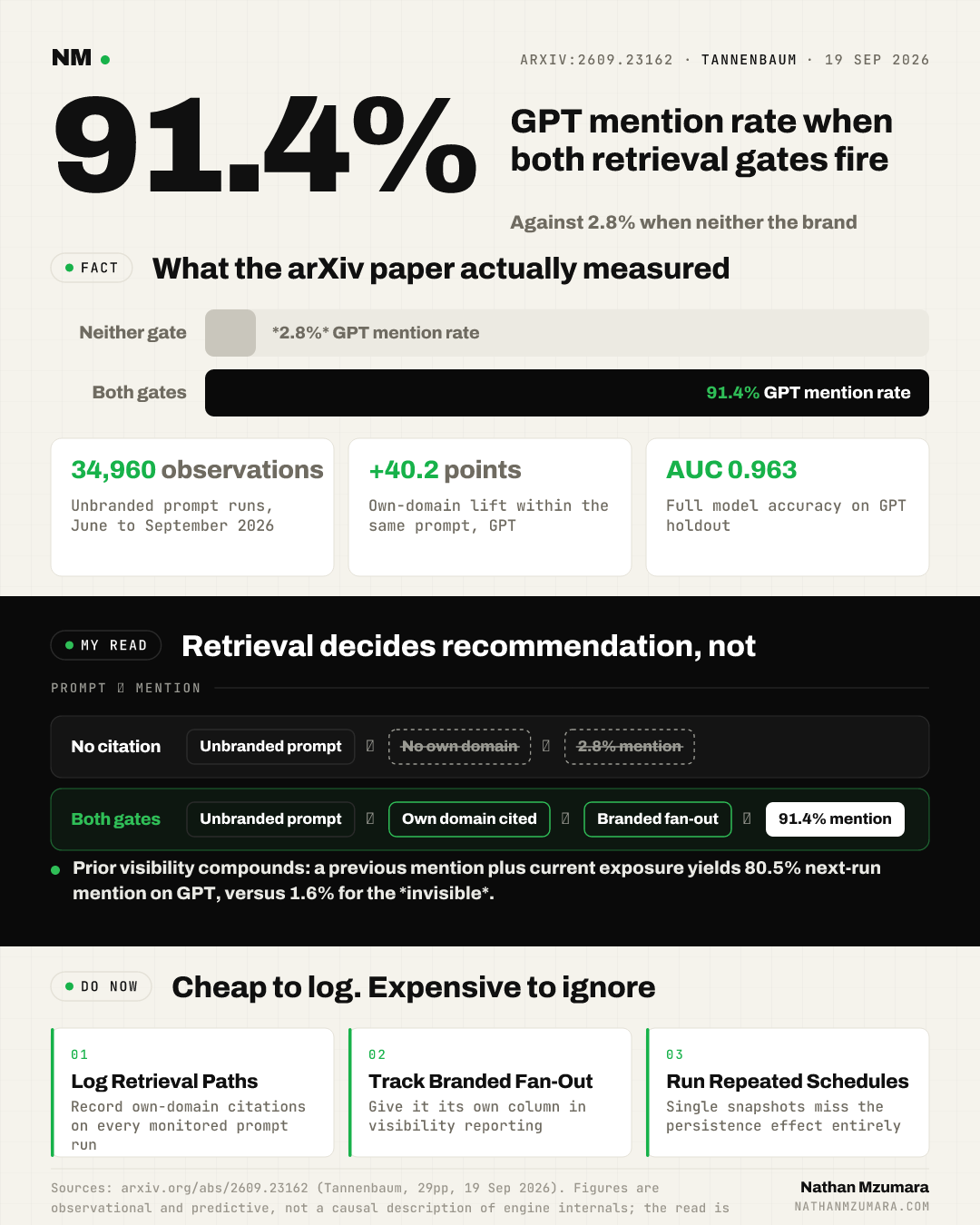
A previous mention combined with current exposure yields 80.5% and 83.7%. Visibility compounds, and so does invisibility. That is a budgeting argument as much as a technical one, because the cost of being absent grows with every run you sit out.
How predictable is any of this?
Tannenbaum fits a chronological diagnostic model using prior-run history and contemporaneous retrieval indicators: logit P(Mt=1) = αe + βe logit(P̃t−1) + γeEt + δeFt + θe⊤X.
On the latest 30% holdout, the full model reaches AUC 0.963 on GPT and 0.942 on Gemini. Prior history alone reaches 0.937 and 0.917. Live retrieval signals alone reach 0.880 and 0.840. A manually curated prompt sensitivity gives nearly identical results at 0.960 and 0.943.
Read that ordering carefully. History is the single strongest predictor, live signals are close behind, and together they get you close to a solved forecasting problem. Brand mention in AI answers is measurable and predictable, which is more than most teams can currently say about their reporting. It is the same gap I flagged when GPT-Live-1 made voice cheap before anyone could measure it.
Relevance matters more on Gemini than on GPT
A separate 199-prompt page-corpus validation tests whether prompt-page match predicts exposure. It predicts Gemini exposure at AUC 0.641 and GPT exposure at only 0.545.
Tannenbaum's reading is that relevance sits upstream of a larger engine-mediated exposure effect. Writing a page that matches the prompt helps, more visibly on Gemini, but the engine's own retrieval behaviour still decides most of the outcome.
The limit the author states himself
The paper is explicit: "The equation is predictive and observational, not a causal description of proprietary engine internals." Getting your domain cited is associated with mention, and the within-prompt evidence is strong, but this is not a mechanism disclosure from OpenAI or Google.
Treat it as a diagnostic instrument. It tells you where to look and what to track, not what a specific model is doing inside. That distinction matters more now that answer engines are being regulated as search surfaces, as the ChatGPT DSA designation in the EU showed.
How to act on brand visibility in AI search this week
- Log the retrieval path, not just the answer. Record whether your own domain appears as a citation on every monitored prompt run. Mention rate without that field is unreadable.
- Track branded fan-out separately. It is the difference between roughly half and near-certain mention, so it deserves its own column in your reporting.
- Move to repeated runs. Single snapshots cannot see the 1.6% to 80.5% persistence effect. Run the same prompts on a fixed schedule.
- Fix prompt-page match on your highest-value prompts. It is the lever you fully control, and it shows up more clearly on Gemini.
- Pull the data. The full PDF and the aggregate results file let your analysts replicate the figures rather than take them on trust.
The practical conclusion is uncomfortable and clarifying at once. Brand visibility in AI search is mostly won or lost before the model starts writing, at the moment retrieval decides which domains enter the context window. Everything downstream is negotiation over a shortlist you either made or did not.
Tags