Enterprise AI
AI agents
Also known as: agentic AI, autonomous agents
AI agents are software systems that use a language model to plan and carry out multi-step tasks, rather than simply returning a block of text. They can call tools, query APIs, browse websites and write to other systems in pursuit of a goal, with varying degrees of human oversight. The term covers everything from a scripted assistant that books a meeting to a research agent that gathers sources and drafts a report.
What it is
An AI agent combines a model that reasons about what to do next with a set of tools it is allowed to use, plus memory of what it has already done. Unlike a single prompt and response, an agent loops: it decides on an action, observes the result, and decides again until the task is finished or it gives up. Most production agents run inside guardrails that limit which tools they can touch and when a human must approve a step.
Why it matters
Agents change who or what is reading your website. When a buyer asks an agent to shortlist suppliers or compare prices, the agent visits pages, parses them and summarises them, so machine-readable content, clear pricing and accessible product data matter as much as persuasive copy. Agents also show up in server logs as a distinct class of non-human traffic that most analytics tools will not count as a session.
How it works
Teams build agents on frameworks that handle tool calling, retrieval and state, and connect them to internal systems through APIs or standards such as the Model Context Protocol. Marketers use them internally for research, reporting and content operations, and externally by making sure key pages load without JavaScript gymnastics, expose structured data and avoid blocking legitimate agent traffic in robots.txt. Testing is done by running the same task repeatedly and scoring the outcome, not by reading a single impressive demo.
When it applies
Agents are worth considering when a task has clear success criteria, repeatable steps and tolerable failure costs. For discovery work, the agent lens applies whenever buyers might delegate research, comparison or purchasing to an assistant rather than doing it in a browser themselves.
Examples
- A procurement agent reads three supplier sites, pulls pricing tiers and returns a comparison table for a buyer to check.
- An internal marketing agent pulls last month's search data, flags pages that lost impressions and drafts a briefing note.
- A support agent looks up an order in the CRM, issues a refund within a set limit and escalates anything above it to a human.
How it is measured
- Task completion rate: share of attempts that reach the intended outcome without human rescue
- Human intervention rate: how often a person has to correct, approve or take over
- Cost and latency per completed task, including tool calls and retries
- Agent and bot traffic in server logs, split by user agent, against pages served successfully
Insights on AI agents
- Google AI Edge Eloquent: Free Dictation, No Subscription
- What Is Claude Cowork Now? It Just Merged Into Chat
- OpenAI Agents API: The Agent Loop Is Now a Free Hosted Product
- Anthropic's AI Threat Intelligence Report: Agents Now Rewrite Malware
- Research Acceleration: OpenAI's Agent Metrics Marketers Should Copy
- OpenAI Wiki Incident: When AI Agents Write to the Open Web
- How to Disect the AI 2040 Plan A Scenario for Marketers
- Anthropic Claude Fable 5.1: Cheaper Caching Beats the Benchmarks
Related terms in Enterprise AI
- AI chipsAI chips are processors designed or optimised to run machine learning workloads, especially the large matrix operations behind training and inference. The category covers GPUs, tensor and neural processing units, and custom ASICs, usually paired with high-bandwidth memory and fast interconnects. They are also called AI accelerators or AI semiconductors.
- AI drug discoveryAI drug discovery is the use of machine learning and computational models to support the early stages of finding and refining new medicines. Models are applied to tasks such as predicting protein structures, identifying candidate molecules, prioritising targets and estimating properties like toxicity or binding affinity. The aim is to narrow a very large search space before expensive laboratory and clinical work begins.
- AI infrastructureAI infrastructure is the stack of hardware, networking, storage and software needed to train, fine-tune and serve AI models at scale. It spans accelerators such as GPUs, the data centres and power that house them, and the orchestration and serving layers that turn raw compute into working model endpoints. For most marketing teams it is a cost and capacity constraint they consume through APIs rather than something they build.
- AI procurementAI procurement is the process of evaluating, buying and contracting artificial intelligence tools and services, from assistants and content platforms to models accessed through an application programming interface. It covers commercial terms alongside security, data protection, accuracy and integration questions that do not arise with ordinary software. Most organisations run it as a structured review with pilots, stakeholder sign off and defined exit conditions.
- AI securityAI security is the practice of protecting AI systems, their data and the applications built on them from misuse, manipulation and leakage. It covers threats such as prompt injection, data exfiltration through model outputs, unsafe tool use by agents and compromised supply chains. It also covers the controls that keep AI features safe once they are live.
- AI triageAI triage is the use of machine learning or language models to sort, prioritise and route incoming cases so that the most urgent or most suitable ones reach the right person first. It is used in clinical settings for symptom assessment and in service operations for tickets, leads and enquiries. The system classifies and ranks, while a human usually makes the final decision.
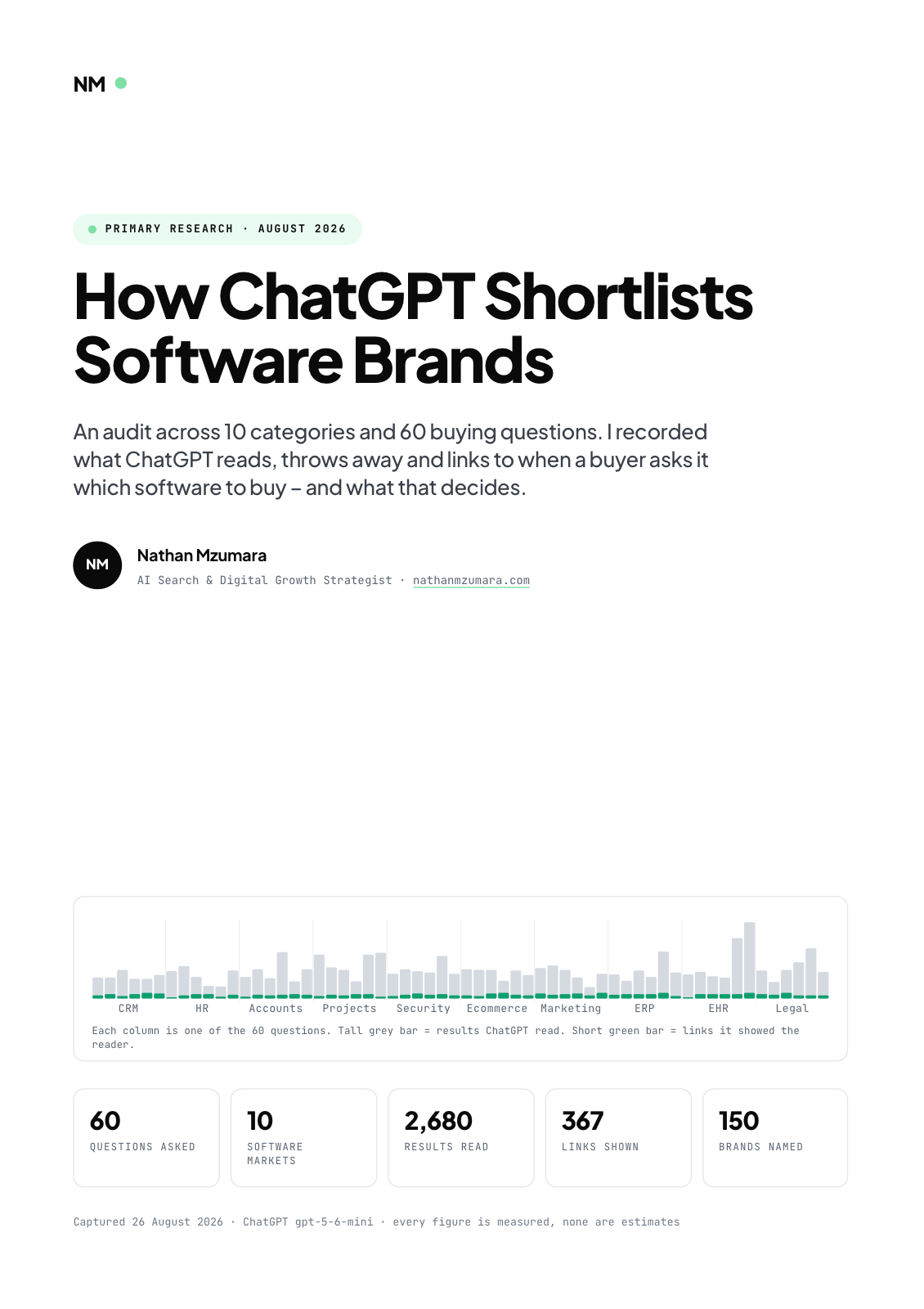
Primary research · August 2026
How ChatGPT Shortlists Software Brands
An audit across 10 categories and 60 buying questions. I recorded what ChatGPT reads, throws away and links to when a buyer asks it which software to buy, and what that decides.
- 60
- Questions asked
- 10
- Software markets
- 2,680
- Results read
- 367
- Links shown
Free download
Get the full report
35 pages · PDF · 536 KB. Enter your details and it downloads straight away.