Claude Haiku 5.5 Lands at Around 75% Less to Run

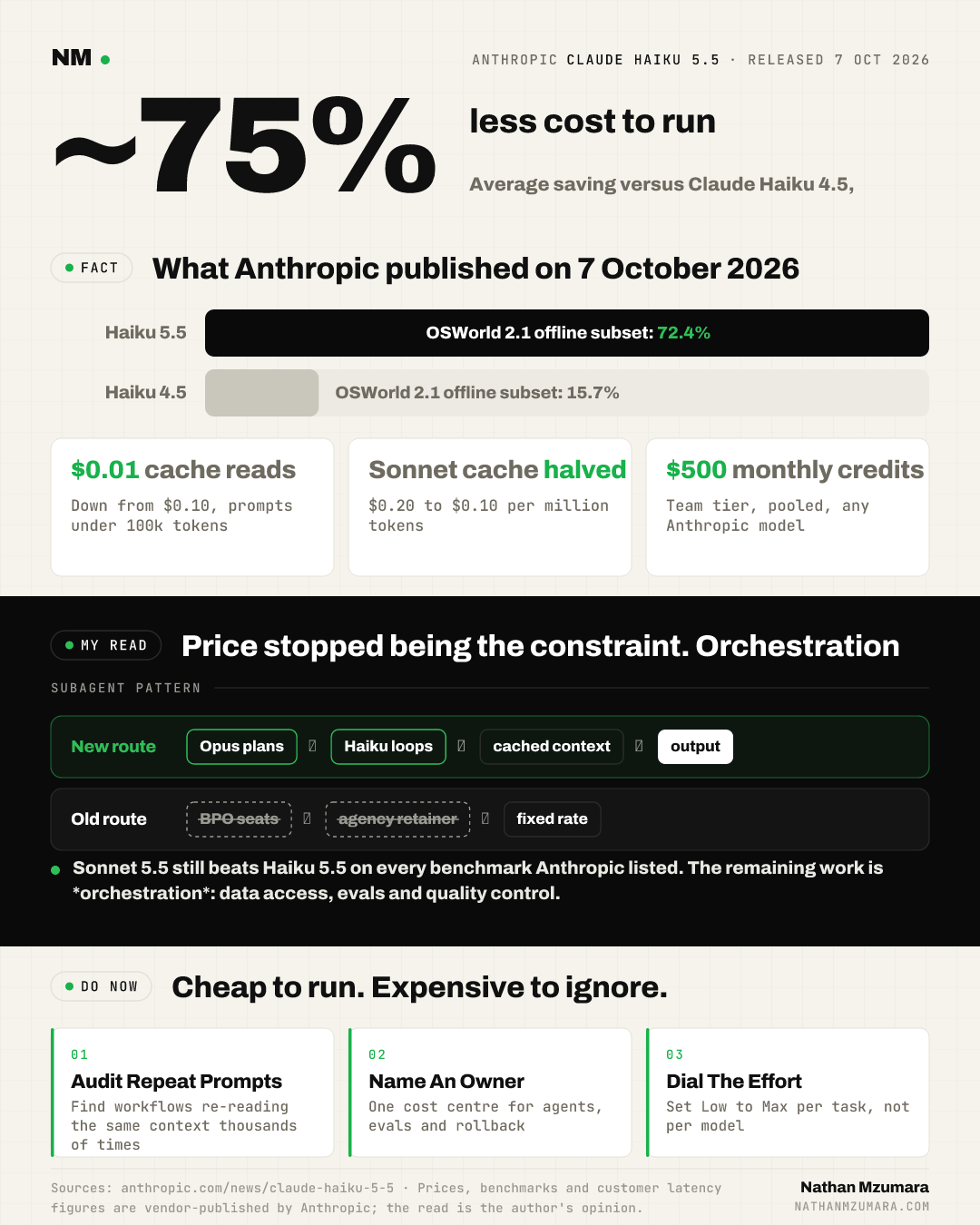
Anthropic released Claude Haiku 5.5 on 7 October 2026. The company says the model costs on average around 75% less to run than Haiku 4.5. It is available now on all platforms, including Amazon Web Services, Google Cloud and Microsoft Azure. Anthropic also cut Claude Sonnet 5.5 cache read prices by half from the same day.
What Anthropic changed on 7 October 2026
Anthropic calls Claude Haiku 5.5 the cheapest, fastest and most capable small model it has ever released. On the Claude Platform, developers call it with the model string claude-haiku-5-5.
Three changes shipped together, according to Anthropic's Claude Haiku 5.5 announcement:
- The new small model: Claude Haiku 5.5 is available now on all platforms, built for high-volume, cost-sensitive work such as summaries, compactions, database queries and classification requests.
- A cache read price cut: Claude Sonnet 5.5 cache reads now cost $0.10 per million tokens rather than $0.20. Anthropic says that makes Sonnet 5.5 around 20% cheaper on most agentic tasks. The cut starts today.
- New monthly API credits: $100 a month for Claude Max 5x users, $200 for Max 20x users, and up to $500 for Team subscribers, pooled across their users. The credits work on any Anthropic model and roll out this week.
Anthropic frames the credits as a way for people to experiment with building tools, apps and agents that call the API. That is a budget line most marketing teams do not currently have.
How much does Claude Haiku 5.5 cost to run?
Claude Haiku 5.5 is priced in two bands, split by prompt size. Anthropic says prompts up to 100,000 tokens make up around 90% of requests to its previous Haiku model, so most real workloads sit in the cheaper band.
| Price per 1 million tokens | Haiku 5.5, up to 100k | Haiku 5.5, over 100k | Haiku 4.5 |
|---|---|---|---|
| Input | $0.10 | $0.50 | $1.00 |
| Output | $0.50 | $2.50 | $5.00 |
| Cache reads | $0.01 | $0.05 | $0.10 |
| Cache writes | $0.125 | $0.625 | $1.25 |
Read the bottom row carefully. Cache reads fall from $0.10 to $0.01 per million tokens in the sub-100k band. For any workflow that reads the same brand guidelines, product catalogue or support policy thousands of times a day, that single line is the cost story.
What the benchmarks say about Claude Haiku vs Sonnet
The price drop would matter less if quality had held flat. It did not. Anthropic's published results show large jumps against Haiku 4.5 and against GPT-6 Luna.
| Benchmark | Haiku 5.5 | Haiku 4.5 | GPT-6 Luna |
|---|---|---|---|
| GDPval-AA v2.1 (Elo) | 1620 | 735 | 1437 |
| OSWorld 2.1, offline subset | 72.4% | 15.7% | 48.9% |
| Humanity's Last Exam, no tools | 45.9% | 10.2% | not listed |
| Humanity's Last Exam, with tools | 57.4% | 18.7% | not listed |
| Terminal-Bench 4.0 | 39.2% | 0.0% | 16.4% |
| FrontierCode 1.1 (Main) | 46.4% | not listed | 42.4% |
| Chartography, no tools | 46.4% | 6.4% | 29.1% |
One caveat sits underneath all of it. Sonnet 5.5 scores higher than Claude Haiku 5.5 on every benchmark Anthropic listed. The small model closed a gap, it did not erase one.
The effort setting
Claude Haiku 5.5 is the first Haiku-class model with an adjustable effort setting, running Low, Med, High, Xhigh and Max. You choose whether to optimise for cost or for intelligence on a per-task basis. That turns model spend into a dial rather than a fixed rate, which matters when one workflow runs ten thousand times a day and another runs ten times.
Claude Haiku vs Sonnet vs Opus on real work
Anthropic is explicit about the split. Sonnet 5.5 and Opus 5.5 remain the better choices for complex agentic coding tasks. Claude Haiku 5.5 is best suited to narrowly scoped work such as compaction, summarisation or subagent tasks, and it pairs with Opus 5.5 and Sonnet 5.5 as a subagent on coding work. Because it is also Anthropic's fastest model to date, it suits speed-sensitive tasks like live customer support and browser use.
Early customers back the speed claim. Asana reported over a 30% reduction in latency for task completions and up to 2.5x faster inference per agent turn. Box scored Claude Haiku 5.5 eleven points higher than Haiku 4.5 at about half the latency. AlphaSense ran 400 queries and measured 0.84 against 0.76 for Haiku 4.5. HubSpot recorded 92.8% averaged over three runs on its simulated CRM portal suite, the best score it had seen on that suite.
What this means for marketing, growth and support leaders
Here is the plain English version. The repetitive work you currently buy as headcount, agency retainers or BPO seats just got roughly four times cheaper to run as software, and the quality floor moved up at the same time.
- Summarisation and classification: call transcript summaries, review tagging, lead qualification notes, content briefs from research dumps. All named by Anthropic as core Haiku workloads, and all currently sitting in someone's job description.
- Live customer support chat: Anthropic positions Claude Haiku 5.5 for speed-sensitive tasks including live customer support. Tier one deflection economics change when the per-conversation cost falls to fractions of a penny.
- Browser use: 72.4% on the OSWorld 2.1 offline subset, against 15.7% for Haiku 4.5, is the number that makes competitor monitoring, listing checks and portal data entry viable at volume.
- Subagent patterns: a larger model plans the work, Claude Haiku 5.5 does the thousand small lookups underneath it. That is the architecture that actually lands, and it is why the Sonnet 5.5 cache read cut matters as much as the new model.
My read is that model capability and price stopped being the constraint on 7 October. What is left is orchestration, access to your own data, and quality control. Those are organisational problems, not procurement ones.
Who owns the agent layer?
This is the decision the update forces, and most companies have not made it. Routine marketing and service work is usually bought by the function that consumes it. Support buys BPO seats. Content buys an agency. Ops buys contractors.
Agents do not fit that pattern. They need a shared owner, a cost centre, an eval suite and a rollback plan. In the teams I have worked with, the version that fails is the one where four departments each spin up their own agents on their own credentials with no shared measurement. The version that works puts one named owner over the layer, with the consuming teams defining acceptance criteria.
Use the new API credits as the funding mechanism for a first test. Max 20x subscribers get $200 a month, Team subscribers get up to $500 pooled, and both work on any Anthropic model. That is a real budget for a pilot that needs no approval cycle. If you have already piloted Claude inside everyday tools, the Claude add-on for Docs, Sheets and Slides is the obvious place to look for workflows worth promoting to the API.
Where this goes wrong
Three risks are worth naming before you re-price anything.
Quality control debt. Cheap inference means more calls, and more calls means more silent failures. AlphaSense measured 0.84 against 0.76 on 400 queries, which is a real gain and also a reminder that these systems are scored, not assumed. Build the eval set before you build the agent.
Safeguard boundaries. Anthropic says Claude Haiku 5.5's cybersecurity safeguards are more restrictive than Haiku 4.5's, though somewhat less restrictive than other recent models. They permit a wider range of defensive tasks than Sonnet 5.5's safeguards, but still block penetration testing and other attacker techniques. Its biology safeguards match Sonnet 5, Sonnet 5.5 and Opus 5. Security teams should read the Haiku 5.5 system card before approving anything.
Model sprawl. With five effort settings and three model tiers, the number of plausible configurations gets unwieldy fast. Standardise the defaults centrally or you will spend next quarter auditing them.
The counter-view
The case against moving quickly is straightforward. Anthropic itself says Sonnet 5.5 and Opus 5.5 remain better for complex agentic work, and Sonnet 5.5 beats Claude Haiku 5.5 on every published benchmark. If your workflows are not genuinely narrow, the cheap model will cost you more in rework than it saves in tokens.
There is also a pattern worth noting. Pricing on this tier has moved repeatedly, and speed is now being priced separately across the market. Anyone who rebuilt a stack around Haiku 4.5 pricing a year ago is rebuilding again. Design for model portability, not for one price card.
What to do about Claude Haiku 5.5 this week
Pick one workflow that runs more than a thousand times a month and currently sits on a retainer, a BPO contract or a junior headcount. List its inputs, its acceptance criteria and its failure cost. Then do four things.
- Claim the monthly API credits on your Max or Team plan as they roll out this week.
- Build a 100-item eval set from real past outputs, scored by the person who currently owns the work.
- Run the workflow at Low, Med and High effort and record cost per task against score at each setting.
- Name one accountable owner for the agent layer before anything reaches production.
Do not cancel a contract on the strength of a benchmark table. Do put a number on what that contract would cost as tokens, because that number is now roughly a quarter of what it was last week. Claude Haiku 5.5 did not remove the work from your backlog. It removed the excuse that the work was too expensive to automate.
Tags
