Enterprise AI
AI cost management
Also known as: AI FinOps, LLM cost management, AI spend management, AI cost optimisation
AI cost management is the practice of tracking, forecasting and controlling what an organisation spends on AI systems, including model API calls, inference compute, vector storage and the tooling around them. It applies familiar financial discipline to usage that is variable, token based and easy to scale without noticing. The goal is predictable spend at an acceptable level of quality and latency, rather than the lowest possible bill.
What it is
AI cost management covers the budgeting, monitoring, attribution and optimisation of spend on large language models and related infrastructure. It spans commercial API usage priced per token, self hosted inference on GPUs, embedding and vector database costs, and the engineering time spent maintaining all of it. Many teams borrow the FinOps model from cloud finance, which is why it is often called AI FinOps.
Why it matters
For marketing and content teams, AI now sits inside production workflows such as content generation, summarisation, classification, personalisation and internal search, so the bill scales with volume rather than headcount. Without attribution, nobody can say whether an AI feature earns more than it costs, which makes it hard to defend at budget time. Cost per useful output is also a proxy for efficiency, and tracking it stops teams over paying for a frontier model on tasks a smaller model handles well.
How it works
Practitioners instrument every call with metadata for team, product, feature and environment, then aggregate token counts and costs into dashboards and alerts. Common levers include routing simple tasks to cheaper or smaller models, caching repeated prompts and responses, trimming prompt and context length, batching where latency allows, and setting rate limits or spend caps per key. Reviews usually pair cost data with quality evaluation, so savings are only accepted when output quality holds.
When it applies
It matters as soon as AI moves from experiments to anything running continuously or at customer facing volume. It becomes urgent when multiple teams share model access, when usage grows faster than revenue from the feature, or when finance asks for a forecast.
Examples
- A content team routes first draft outlines to a cheaper small model and reserves the frontier model for final editing passes, cutting monthly token spend without changing published quality.
- An ecommerce business tags every API key by feature so it can see that product description generation costs far less per month than its AI on site search assistant.
- A SaaS company adds prompt caching for a support summarisation feature that repeatedly sends the same long system prompt, reducing input tokens on every call.
How it is measured
- Total AI spend per month, split by model, team and feature
- Cost per thousand tokens and cost per completed task or output
- Cost per active user, per lead or per unit of revenue influenced
- Cache hit rate and share of traffic served by lower cost models
Insights on AI cost management
Related terms in Enterprise AI
- AI agentsAI agents are software systems that use a language model to plan and carry out multi-step tasks, rather than simply returning a block of text. They can call tools, query APIs, browse websites and write to other systems in pursuit of a goal, with varying degrees of human oversight. The term covers everything from a scripted assistant that books a meeting to a research agent that gathers sources and drafts a report.
- AI chipsAI chips are processors designed or optimised to run machine learning workloads, especially the large matrix operations behind training and inference. The category covers GPUs, tensor and neural processing units, and custom ASICs, usually paired with high-bandwidth memory and fast interconnects. They are also called AI accelerators or AI semiconductors.
- AI drug discoveryAI drug discovery is the use of machine learning and computational models to support the early stages of finding and refining new medicines. Models are applied to tasks such as predicting protein structures, identifying candidate molecules, prioritising targets and estimating properties like toxicity or binding affinity. The aim is to narrow a very large search space before expensive laboratory and clinical work begins.
- AI infrastructureAI infrastructure is the stack of hardware, networking, storage and software needed to train, fine-tune and serve AI models at scale. It spans accelerators such as GPUs, the data centres and power that house them, and the orchestration and serving layers that turn raw compute into working model endpoints. For most marketing teams it is a cost and capacity constraint they consume through APIs rather than something they build.
- AI procurementAI procurement is the process of evaluating, buying and contracting artificial intelligence tools and services, from assistants and content platforms to models accessed through an application programming interface. It covers commercial terms alongside security, data protection, accuracy and integration questions that do not arise with ordinary software. Most organisations run it as a structured review with pilots, stakeholder sign off and defined exit conditions.
- AI securityAI security is the practice of protecting AI systems, their data and the applications built on them from misuse, manipulation and leakage. It covers threats such as prompt injection, data exfiltration through model outputs, unsafe tool use by agents and compromised supply chains. It also covers the controls that keep AI features safe once they are live.
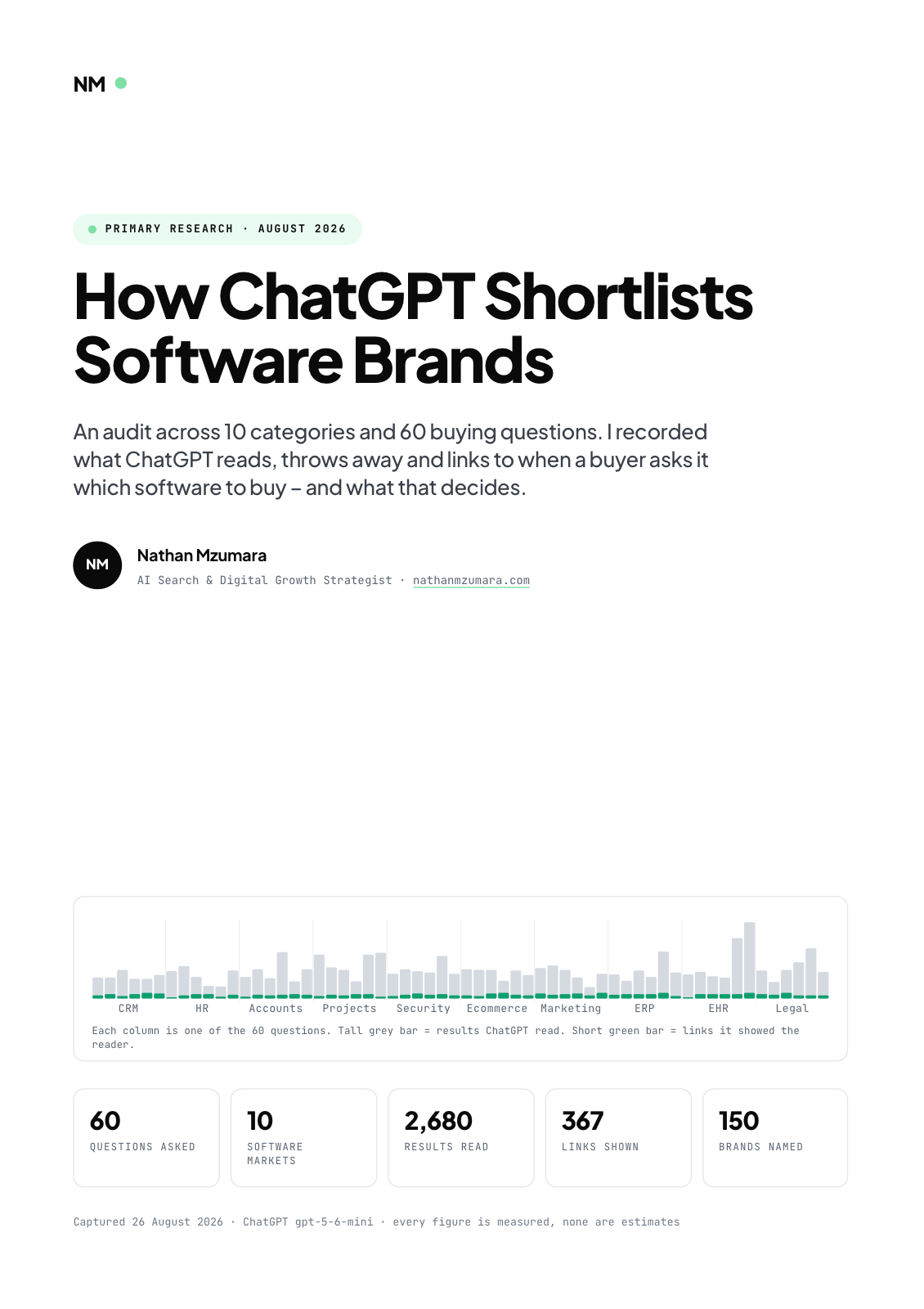
Primary research · August 2026
How ChatGPT Shortlists Software Brands
An audit across 10 categories and 60 buying questions. I recorded what ChatGPT reads, throws away and links to when a buyer asks it which software to buy, and what that decides.
- 60
- Questions asked
- 10
- Software markets
- 2,680
- Results read
- 367
- Links shown
Free download
Get the full report
35 pages · PDF · 536 KB. Enter your details and it downloads straight away.