Enterprise AI
AI security
Also known as: securing AI systems
AI security is the practice of protecting AI systems, their data and the applications built on them from misuse, manipulation and leakage. It covers threats such as prompt injection, data exfiltration through model outputs, unsafe tool use by agents and compromised supply chains. It also covers the controls that keep AI features safe once they are live.
What it is
AI security treats models, prompts, retrieval sources, plugins and agent tools as parts of an attack surface that behaves differently from traditional software. Risks include prompt injection hidden in web pages or documents, sensitive data appearing in model outputs, poisoned training or retrieval data, and over permissioned agents taking actions they should not. It sits alongside conventional application and cloud security rather than replacing it.
Why it matters
Many marketing and customer facing teams now ship AI features such as site assistants, content generation tools and support bots, which expose internal data and systems to untrusted input. A single injection in a crawled page or uploaded file can turn a helpful assistant into a data leak or a source of false statements about your brand. Because these failures are visible to customers, the reputational cost often exceeds the technical one.
How it works
Practitioners scope what each AI system can read and do, apply least privilege to tools and data sources, and separate trusted instructions from untrusted content. They add input and output filtering, log prompts and responses for review, require human approval for sensitive actions, and test systems with red teaming and adversarial prompts before launch. Vendor assessments, secrets management and monitoring for unusual usage patterns complete the picture.
When it applies
It applies from the moment an AI feature can read untrusted content, touch customer data or trigger an action in another system. Review controls before launch, after any change to data sources or tool permissions, and on a regular schedule for systems that stay in production.
Examples
- A team red teams its website assistant and finds that instructions hidden in a crawled PDF can make it reveal internal pricing notes.
- A support bot is restricted to a read only knowledge base and cannot issue refunds without a human approving the action.
- A security review blocks an AI writing tool from connecting to the CRM until data processing terms and access scopes are agreed.
How it is measured
- Number of AI systems with a documented threat model, data scope and permission review
- Results of red team and prompt injection testing, including issues found and time to fix
- Rate of blocked or flagged unsafe prompts and outputs in production logs
- Share of AI vendors with completed security reviews and agreed data handling terms
Related terms in Enterprise AI
- AI agentsAI agents are software systems that use a language model to plan and carry out multi-step tasks, rather than simply returning a block of text. They can call tools, query APIs, browse websites and write to other systems in pursuit of a goal, with varying degrees of human oversight. The term covers everything from a scripted assistant that books a meeting to a research agent that gathers sources and drafts a report.
- AI chipsAI chips are processors designed or optimised to run machine learning workloads, especially the large matrix operations behind training and inference. The category covers GPUs, tensor and neural processing units, and custom ASICs, usually paired with high-bandwidth memory and fast interconnects. They are also called AI accelerators or AI semiconductors.
- AI drug discoveryAI drug discovery is the use of machine learning and computational models to support the early stages of finding and refining new medicines. Models are applied to tasks such as predicting protein structures, identifying candidate molecules, prioritising targets and estimating properties like toxicity or binding affinity. The aim is to narrow a very large search space before expensive laboratory and clinical work begins.
- AI infrastructureAI infrastructure is the stack of hardware, networking, storage and software needed to train, fine-tune and serve AI models at scale. It spans accelerators such as GPUs, the data centres and power that house them, and the orchestration and serving layers that turn raw compute into working model endpoints. For most marketing teams it is a cost and capacity constraint they consume through APIs rather than something they build.
- AI procurementAI procurement is the process of evaluating, buying and contracting artificial intelligence tools and services, from assistants and content platforms to models accessed through an application programming interface. It covers commercial terms alongside security, data protection, accuracy and integration questions that do not arise with ordinary software. Most organisations run it as a structured review with pilots, stakeholder sign off and defined exit conditions.
- AI triageAI triage is the use of machine learning or language models to sort, prioritise and route incoming cases so that the most urgent or most suitable ones reach the right person first. It is used in clinical settings for symptom assessment and in service operations for tickets, leads and enquiries. The system classifies and ranks, while a human usually makes the final decision.
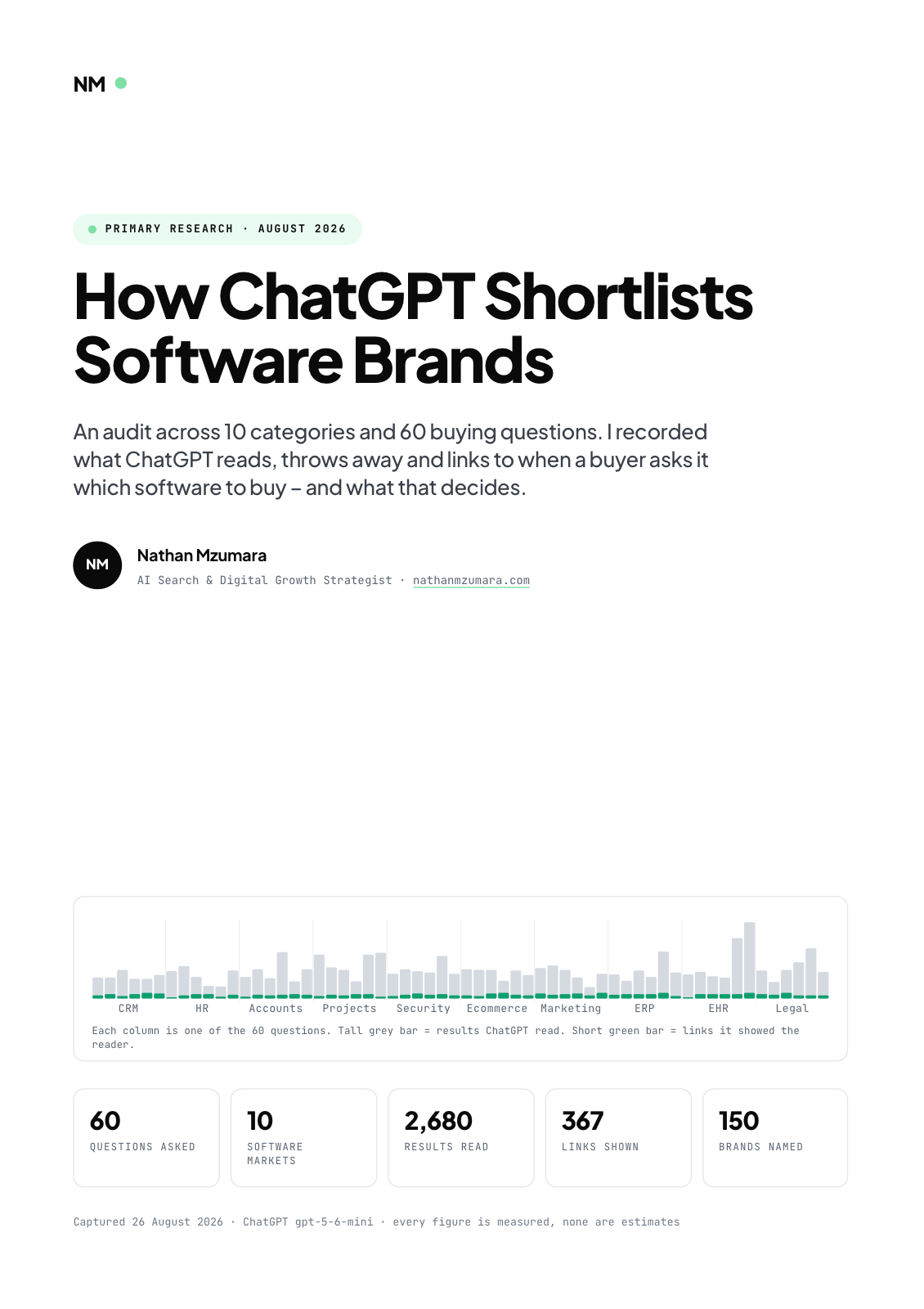
Primary research · August 2026
How ChatGPT Shortlists Software Brands
An audit across 10 categories and 60 buying questions. I recorded what ChatGPT reads, throws away and links to when a buyer asks it which software to buy, and what that decides.
- 60
- Questions asked
- 10
- Software markets
- 2,680
- Results read
- 367
- Links shown
Free download
Get the full report
35 pages · PDF · 536 KB. Enter your details and it downloads straight away.