LLM API Pricing: The Spread Now Matters More Than the Average

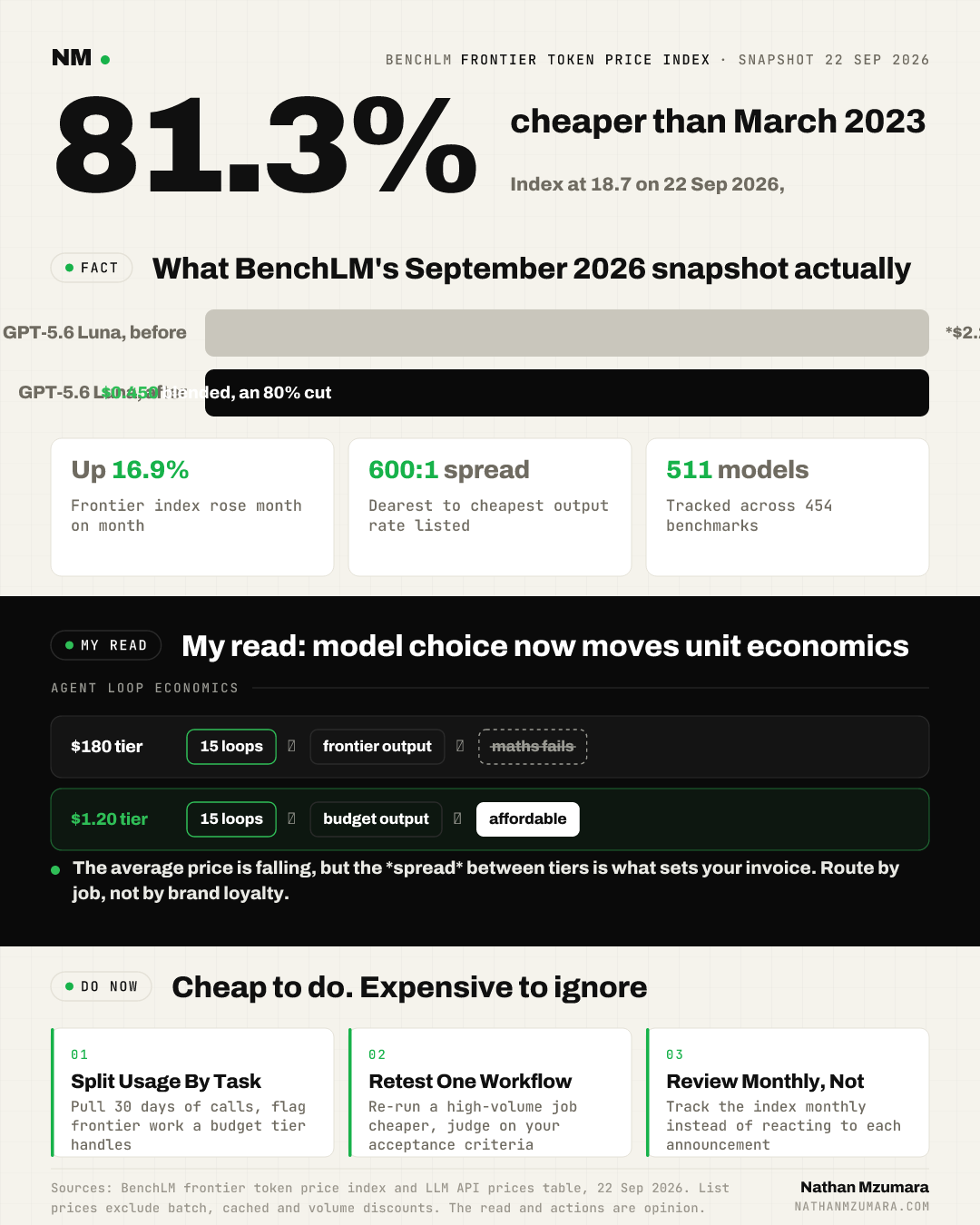
LLM API pricing has fallen 81.3% since March 2023, according to BenchLM's frontier token price index, which stood at 18.7 on 22 September 2026 against a March 2023 base of 100. But the same snapshot shows the index up 16.9% month on month. Cheap is the trend, not the guarantee.
LLM API pricing is what a provider charges to run a model through its interface, quoted per million tokens of input and output. BenchLM blends the two at three parts input to one part output to produce a single comparable rate. It tracks 511 models and 454 benchmarks.
What changed in the September 2026 pricing snapshot?
Five rows moved between the previous snapshot and the one published on 22 September 2026, and they moved in opposite directions.
- GPT-5.6 Luna: cut from $2.25 to $0.450 per million blended tokens, a fall of 80%. OpenAI's budget tier is now listed at $0.20 input and $1.20 output.
- GPT-5.6 Sol: cut from $11.25 to $8.00 blended, down 28.9%, with output moving from $30 to $20 per million in September 2026.
- GPT-5.6 Terra: cut from $5.63 to $4.50 blended, down 20%.
- Claude Opus 5.5: entered the index at $8.00 blended, listed at $4 input and $20 output since September 2026.
- Claude Fable 5.1: entered at $20.00 blended, listed at $10 input and $50 output.
The largest single cut BenchLM has recorded is OpenAI's o3, which went from $40 to $8 output per million tokens in July 2026, a drop of 80%. The cheapest frontier output rate in the set is DeepSeek R1 at $2.19 per million.
Why did the price index rise 16.9% in a month?
The frontier index tracks the median blended price across active frontier models, so it moves when the cohort changes, not only when a provider cuts a rate. Claude Fable 5.1 entering at $20.00 blended pulls the median up even while three OpenAI models got cheaper in the same window.
This is the part most budget models get wrong. Teams plan on a smooth decline and then find their frontier tier repriced upward because the definition of frontier moved. BenchLM's own guidance is to use the monthly series rather than assume every new model will be cheaper.
The real story is the spread between tiers
Look at the list prices rather than the average and the picture changes. The gap between the dearest and cheapest model in BenchLM's table is roughly 600 to 1.
| Model | Provider | Output $/1M | Since |
|---|---|---|---|
| GPT-5.4 Pro | OpenAI | $180 | Apr '26 |
| Claude Fable 5.1 | Anthropic | $50 | Sep '26 |
| Claude Opus 5.5 | Anthropic | $20 | Sep '26 |
| Gemini 3.6 Flash | $7.50 | Jul '26 | |
| DeepSeek R1 | DeepSeek | $2.19 | Jan '25 |
| GPT-5.6 Luna | OpenAI | $1.20 | Jul '26 |
| Gemini 1.5 Flash | $0.30 | May '24 |
Output price per million tokens, from BenchLM's current LLM API prices table, 22 September 2026.
On blended rates the same pattern holds. Claude Fable 5.1 entered at $20.00 while GPT-5.6 Luna fell to $0.450, a gap of more than 44 times within a single snapshot. My read is that model choice is now a bigger lever on unit economics than any negotiated discount you are likely to get.
Why cheap models decide whether AI agents are affordable
An agent does not answer once. It plans, calls a tool, checks the result and tries again, so a single user task can consume many model calls. Run fifteen loops on a $180 output model and the arithmetic stops working. Run them on a $1.20 model and it does.
That is the commercial reason the budget tier keeps getting cheaper while the top tier does not. If you are building on the hosted agent loop OpenAI now offers, the price of your cheapest usable model sets the ceiling on how many loops you can afford per task.
What this means for marketing and growth teams
Route by job, not by brand loyalty. Classification, tagging, extraction and summarisation rarely need a frontier model. Reserve the $20 and $50 output tiers for work where the quality difference is measurable in revenue.
Reasoning models bill their thinking. Models such as o1, o3 and DeepSeek R1 generate internal chain-of-thought tokens before the answer, and those are billed as output. The effective cost per useful token is higher than the sticker rate suggests.
List prices are not your bill. BenchLM notes its table excludes batch, cached and volume discounts. Providers publish separate rates for cached input and background batch processing, so your real cost depends on how you send requests, not only which model you pick.
Price is now a competitive input, not a constraint. Cheaper inference makes always-on content operations, AI visibility monitoring and per-customer personalisation viable for teams that could not fund them 18 months ago.
The counter-view
Falling prices do not automatically cut spend. Most teams I have worked with respond to a 50% price cut by roughly doubling usage, so the invoice stays flat while the workload grows. The 16.9% monthly rise in the frontier index is a reminder that the direction of travel can reverse, and any plan that assumes permanent deflation is a plan with a single point of failure.
What to do about LLM API pricing this week
- Pull your last 30 days of model usage and split it by task type. Identify anything running on a frontier model that a budget model could handle.
- Check your current rates against the live LLM API pricing comparison before you change a production budget. Snapshot rows can include corrected registry values.
- Re-run one high-volume workflow on a cheaper tier and measure output quality against your own acceptance criteria, not a public benchmark.
- Set a monthly review against the frontier token price index rather than reacting to individual launch announcements.
- Tie the saving to a visibility goal. Cheaper inference only pays back if it funds work that moves brand visibility in AI search.
The headline number, 81.3% cheaper than March 2023, is real. The LLM API pricing figure that actually runs your budget is the one sitting between your cheapest usable model and the one you are actually paying for.