OpenAI Launches Ultrafast: Speed Is Now Priced Separately

OpenAI launched Ultrafast on 29 September 2026, a premium speed tier offering up to 8x faster token generation (300 tokens per second) in Codex and up to 6x in the API. It is available today for GPT-6 Astra in Codex, ChatGPT Work and the API, with GPT-6.1 Sol coming soon. Access in Codex and ChatGPT Work requires a new plan, Pro 500.
That last detail is the story. Until now, the two axes you bought on were intelligence and cost per token. Speed arrived bundled with whichever model you chose. OpenAI has just pulled latency out and put a price tag on it.
What exactly did OpenAI announce on 29 September 2026?
Ultrafast is OpenAI's premium speed tier: it generates tokens faster on frontier models rather than changing which models you can reach. OpenAI announced it in a post from the official OpenAI account on 29 September 2026, timestamped 17:57 UTC.
Here is the announcement in full, with nothing rounded:
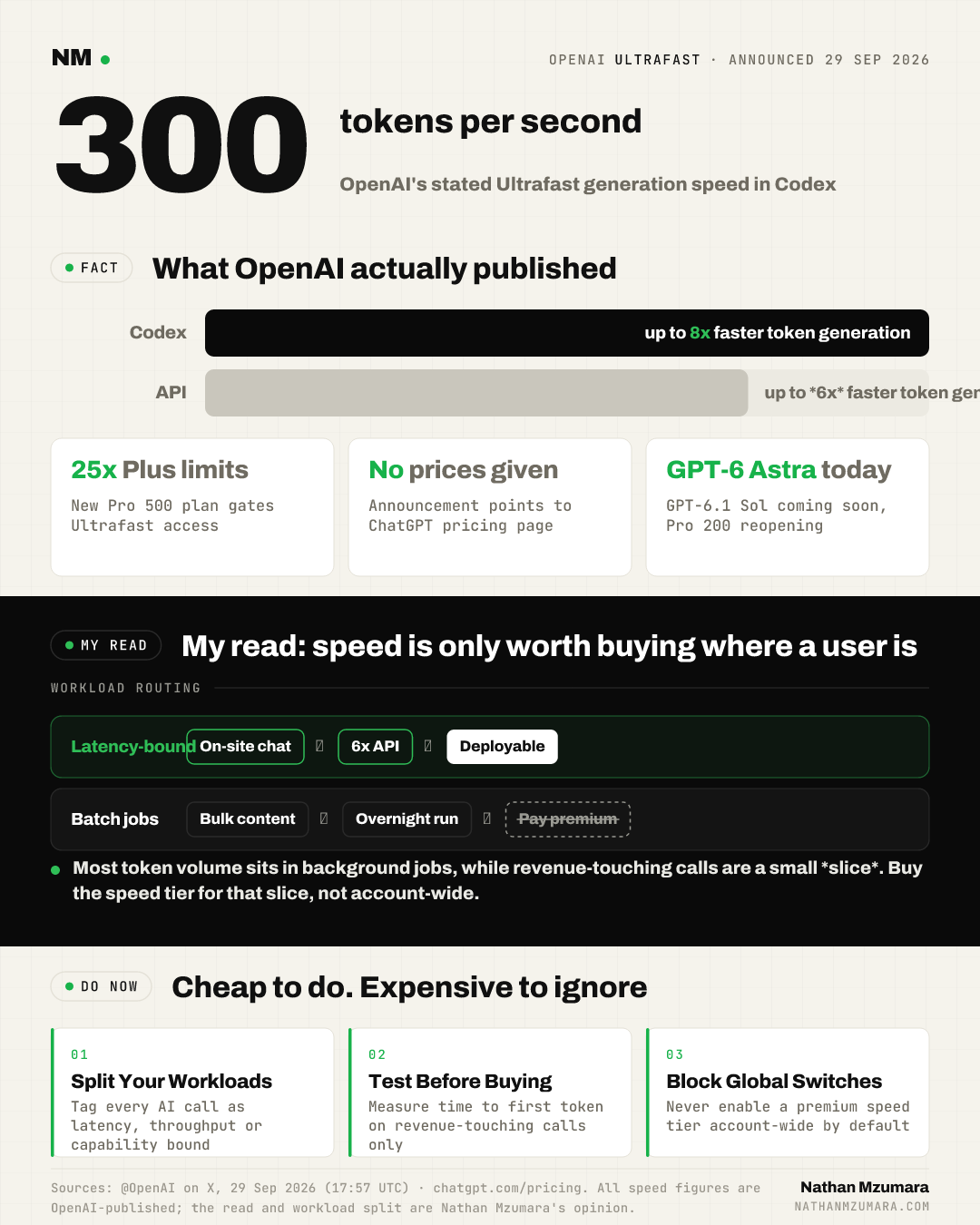
- Ultrafast in Codex: up to 8x faster token generation, which OpenAI states as 300 tokens per second.
- Ultrafast in the API: up to 6x faster token generation.
- Availability: available today for GPT-6 Astra in Codex, ChatGPT Work and the API, with GPT-6.1 Sol coming soon.
- Pro 500: a new plan with OpenAI's highest usage limits (25x Plus) and access to Ultrafast. In Codex and ChatGPT Work, Ultrafast sits behind it.
- Pro 200: subscriptions are reopening, with continued access to frontier models like Astra, including the new GPT-6.1 Sol model, which OpenAI describes as bringing near-Astra capabilities to a model you can use every day.
- Usage limits: OpenAI commits to not reintroducing the 5hr limit, so subscribers can fully use their weekly usage when they want.
- Pricing: no prices are given in the announcement. OpenAI directs pricing details to the ChatGPT pricing page at https://chatgpt.com/pricing.
OpenAI frames the wider commitment plainly: your subscription will continue to help you get more work done with an increasing level of quality.

How does a speed tier change what you are actually buying?
A speed tier does not make a model cleverer. It changes how quickly the model produces its answer, measured in tokens per second and, for anything user-facing, in time to first token.
Codex
In Codex, Ultrafast delivers up to 8x faster token generation at 300 tokens per second. For engineering teams, that compresses the gap between asking for a change and reading it.
The API
In the API, the uplift is up to 6x. This is the number that matters to marketing and growth teams, because the API is where your on-site assistants, personalisation calls and agent workflows live.
Pro 500 and Pro 200
Pro 500 is the access route for Ultrafast inside Codex and ChatGPT Work, and it carries OpenAI's highest usage limits at 25x Plus. Pro 200 is reopening at a lower tier with continued access to frontier models like Astra, plus the new GPT-6.1 Sol.
The 5hr limit
OpenAI's commitment not to reintroduce the 5hr limit means weekly allowances can be spent at whatever pace a user chooses. Combine that with 300 tokens per second and heavy users will hit weekly ceilings far sooner than they used to. One reply to the announcement, from Mallik Cheripally, put it better than any analyst: "ultrafast 8x can finish my weekly usage before i find the stop button".
Why this is the third unbundling, not the first
The same announcement shows the pattern in miniature. OpenAI already sells intelligence in tiers: GPT-6 Astra as the frontier model, GPT-6.1 Sol positioned as near-Astra capability for everyday use. It already sells volume in tiers, now topping out at Pro 500's 25x Plus limits. Speed was the last bundled attribute, and as of 29 September 2026 it is a product.
My read is that this is the same shape as the cost-per-token spread that opened up across vendors over the past two years, which I covered in LLM API pricing: the spread now matters more than the average. Once an attribute gets its own price, averages stop being useful. You have to buy per workload.
What Ultrafast means for marketers, CMOs and growth leaders
In plain English: some of your AI workloads are limited by how clever the model is, and some are limited by how fast it types. Only the second group benefits from paying for speed.
- Latency-bound workloads: on-site chat, live personalisation, conversational ad units, voice and checkout assistants. A user is waiting. A 6x uplift in the API moves several of these from demo to deployable, because the failure mode was never answer quality, it was the pause before the answer arrived.
- Intelligence-bound workloads: strategy synthesis, creative concepting, complex reasoning over messy briefs. Speed does not fix these. Model choice does, which is why Pro 200 reopening with Astra and GPT-6.1 Sol access matters as much as Pro 500 for most teams.
- Batch workloads: bulk content generation, entity extraction, log analysis and answer-engine audits across thousands of URLs. Nobody is watching the cursor. Paying a premium to finish overnight work slightly sooner is spend with no conversion attached.
The trap is the global switch. Turning a premium speed tier on account-wide is the easiest decision to make and the most expensive one to unwind. From my own observation running AI workloads across client stacks, the split is rarely even: the majority of token volume sits in background jobs, while the revenue-touching calls are a small slice. Buy speed for the small slice.
| Workload | Bound by | User waiting? | Buy the speed tier? |
|---|---|---|---|
| On-site chat and checkout assistants | Latency | Yes | Yes, if tested |
| Live personalisation and ad units | Latency | Yes | Yes, if tested |
| Voice interfaces | Latency | Yes | Yes, if tested |
| Bulk content and entity extraction | Throughput and cost | No | No |
| Log analysis and large-scale site audits | Throughput and cost | No | No |
| Strategy and creative synthesis | Model capability | Partly | No, change model instead |
What could go wrong
Three risks stand out. Prices are not stated in OpenAI's announcement, so any business case built this week rests on figures you still have to fetch from the pricing page. Usage burns faster: with no 5hr limit and 300 tokens per second available, weekly allowances on Pro 500 will deplete at a pace nobody has planned for. And the uplift is stated as "up to", which means your measured gain on your prompts, with your tools and your retrieval step, will be lower than the headline.
The counter-view: reasons to leave it alone
There is a decent argument for doing nothing yet. In most marketing stacks, the delay a user feels is not generation speed at all. It is the retrieval call, the CRM lookup, the tool chain and the render. Make generation 6x faster and a two-second pipeline might still feel like a two-second pipeline.
The stronger play for many teams is cheaper capability rather than faster capability, which is the trade I unpacked in GPT-6 Astra halves Parallel's research time and cost. If your problem is unit economics, a speed premium makes it worse.
What to do this week about Ultrafast
- Split your AI calls into two queues: user-facing and background. Do it in code, not in a spreadsheet, so the routing is enforced.
- Measure time to first token and full-response latency on every user-facing call, before you change anything.
- Pick one revenue-touching surface, such as your on-site assistant or checkout helper, and run it on the faster configuration against a held-back control.
- Tie the result to abandonment rate and conversion, not to a latency chart. If latency drops and conversion does not move, you have your answer.
- Check the published prices on OpenAI's pricing page and decide between Pro 500 at 25x Plus limits and a reopened Pro 200 seat with Astra and GPT-6.1 Sol access.
Ultrafast is a useful launch and a clearer signal: OpenAI is unbundling the model into intelligence, cost and now speed. Any CMO still buying "an LLM" rather than a workload-matched configuration will overpay on one axis while underperforming on another. Segment the queues first, measure second, and buy Ultrafast only where a real user is waiting.
This Ultrafast analysis was published 29 September 2026. Last updated 29 September 2026.
Tags
