GPT-6 Astra Halves Parallel's Research Time and Cost

OpenAI published a customer story on 22 September 2026 showing that GPT-6 Astra let Parallel's agents research and synthesise labour-market data in half the time and at half the cost of prior models. The two headline figures OpenAI cites are 50% less time to complete research tasks and a 50% code cost reduction. The product listed is the API.
No rollout timing, markets, plans or pricing are stated in the story. That matters, because the number everyone will quote from this case is a cost number.
What OpenAI published about GPT-6 Astra in September 2026
GPT-6 Astra is the OpenAI model that Parallel Web Systems used, through the API, to run web research agents that search the open web and compile findings into a report. Parallel builds developer infrastructure for AI agents doing knowledge work over the web, covering everything from web grounding for voice agents to research for financial and legal customers.
Before this, Parallel's longest-running research tasks needed a bigger model with extended reasoning to reach a high-quality answer. That approach consumed more time and more resources. The OpenAI customer story on how Parallel cut research time and cost with GPT-6 Astra reports a major improvement on both.
In one test, Parallel asked its agent to research six different labour-market statistics across four states over six months. The agent had to search multiple websites, collect the information, and compile the findings into a single research report. GPT-6 Astra completed that work in half the time of prior models, with roughly 50% code cost reduction, while delivering the same quality of research.
How did GPT-6 Astra cut the cost of a research task in half?
The reported gains come from better search behaviour, not from more reasoning effort. That is the detail growth leaders should read twice.
More targeted search queries
Parallel observed that GPT-6 Astra made more focused searches and took fewer steps to reach a useful result. In the words of Devin Gupta, Member of Technical Staff at Parallel Web Systems: "Astra issued more targeted search queries and focused on the ultimate task better, incorporating its world knowledge compared to previous models."
Fewer research calls and fewer tokens
Gupta also said: "With Astra, we've demonstrated that you can get the same high-quality research much, much faster with fewer research calls and less tokens." Fewer calls and fewer tokens is where the 50% code cost reduction comes from. The task did not get smaller. The route to the answer did.
Sub-agents working at the same time
GPT-6 Astra can delegate specific research tasks to sub-agents, so work happens simultaneously rather than moving through a single sequence of searches. OpenAI says the increased efficiency also makes it more practical for Parallel to divide research among multiple agents. Parallel now has a better path from a complex question to a researched answer, with less time waiting, lower costs, and more room to tackle demanding research tasks at scale.
What this means for marketers, CMOs and growth leaders
Strip out the labour-market data and look at the shape of the task. Six variables, four geographies, six months, many websites, one compiled report. That is a competitor scan. It is also a category sizing exercise, an AI answer audit, a persona refresh and a content gap analysis.
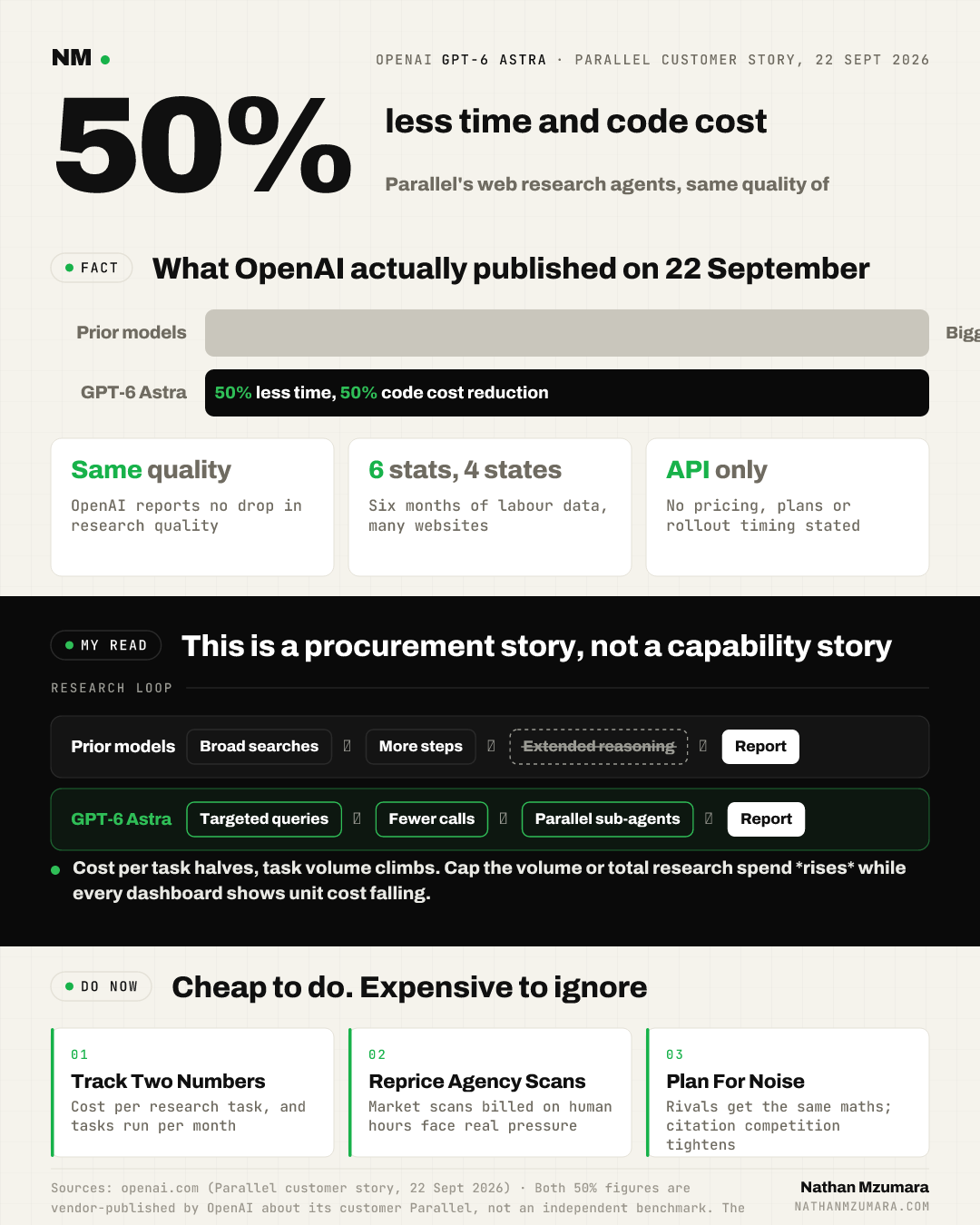
So the OpenAI GPT-6 Astra case is not really a capability story. It is a procurement story. Here is what changes:
- Research frequency: if a deep research loop costs half as much and finishes in half the time, quarterly becomes monthly and monthly becomes daily. Your competitors get the same maths.
- Agency line items: market scans, category research and content briefs were priced on human hours. A 50% code cost reduction on the agentic version puts pressure on that pricing.
- Citation surface: when every brand in a category can run the same research loop daily, published output rises and the competition for citations in AI answers gets harder, not easier.
- Quality floor: OpenAI states the same quality of research at half the cost, not a cheaper approximation. Cost cuts that hold quality are the ones that actually get adopted.
Which research line items survive a 50% cost floor collapse?
The table below is my assessment, not OpenAI's. The only figures from the source are the two 50% metrics.
| Research line item | Task shape | My read on exposure |
|---|---|---|
| Agency market scan | Many sources, one compiled report | High. Closest match to the Parallel test |
| AI visibility monitoring | Repeated queries, tracked over time | High. Frequency was the cost constraint |
| Content gap analysis | Structured comparison across sites | High |
| Persona and qualitative research | Primary interviews, judgement | Low. Not a web synthesis task |
| Strategy and prioritisation | Trade-offs, internal context | Low |
The pattern is simple. Anything whose cost was driven by reading a lot of pages and writing them up is exposed. Anything that depends on what is not on the web holds its value.
The measurement trap: cost per task falls, total spend rises
Cheaper tasks do not produce cheaper budgets. Teams run more tasks. A 50% code cost reduction on a weekly competitor scan becomes a daily competitor scan at 3.5 times the old weekly spend, and every dashboard still shows cost per task falling.
From my observation of Q4 planning cycles, this is how AI line items quietly balloon: the unit metric improves, nobody caps volume, and the total appears in January. The same dynamic sits behind wider model price moves, which I covered in GPT-6 Sol and GPT-6 Luna Halve GPT-5.6 Sol Prices and in LLM API Pricing: The Spread Now Matters More Than the Average.
Track two numbers side by side from now on: cost per research task, and total research tasks run per month. One without the other tells you nothing useful.
The risks and the counter-view
This is a vendor-published customer story, not an independent benchmark. OpenAI published it, Parallel is the customer, and both have an interest in the result. The 50% figures describe Parallel's workloads on the API, and nothing in the story says they transfer to your stack.
There is also a quality question the source does not answer for marketing work. Parallel tested labour-market statistics, which have verifiable sources. Brand perception, SERP interpretation and competitor positioning are messier. Fewer, more targeted searches could mean a narrower evidence base on tasks where breadth is the point.
The counter-view is worth holding. If agentic research gets cheap for everyone, the output stops being a differentiator and the advantage moves to what you do with it. A daily competitor scan nobody acts on is a cost, not an edge. The teams that win will be the ones with a decision process fast enough to use the research, which is a management problem rather than a model problem.
What to do this week with GPT-6 Astra
- List every research line item you pay for, with its annual cost and how often it runs. Mark each one against the task shape in the Parallel test: many sources, one compiled report.
- Take one line item and rebuild it as an agentic loop on the API. Compare the output to the version you already paid for, on quality first and GPT-6 Astra cost second.
- Set a volume cap before you scale anything. Agree the maximum number of research runs per month now, while the cost per task still looks small.
- Re-examine your agency scope at the next renewal. If a deliverable is web synthesis, price it against the new floor.
- Watch your own citation surface. If your category starts publishing daily research, your brand visibility in AI search is the thing that moves first.
My read is that GPT-6 Astra matters to marketing leaders less for what it can do and more for what it now costs. The OpenAI story dated 22 September 2026 gives you one clean, dated, vendor-published datapoint: same research quality, half the time, roughly half the code cost. Treat that as a budget input, decide which research you still want to buy from humans, and put a ceiling on the rest before Q4 planning does it for you.
Tags