AI Model & Product
Codex
Also known as: OpenAI Codex
Codex is an OpenAI product line for turning natural language instructions into working code. The original Codex model was trained on code and natural language and powered early code completion tools, and OpenAI later reused the name for its software engineering agent that can read a repository, write changes and run tasks. Teams use it to automate coding and maintenance work described in plain language.
What it is
Codex began as a family of OpenAI models that translated natural language prompts into code and became known for powering code completion in developer tools. OpenAI later retired the original Codex API models, and the Codex name now refers to its agentic coding tools, available through the command line and within ChatGPT, which work against a codebase rather than just completing single lines. The common thread is instruction to code: you describe an outcome, the system proposes or applies the implementation.
Why it matters
A large share of search and discovery work is blocked by engineering capacity, so tools that let marketers or solo developers ship technical fixes change what is realistically achievable. Structured data, redirect logic, template changes, log parsing and feed transformations are all well suited to instruction-driven coding. It also shifts the skill profile of search teams towards specifying requirements clearly and reviewing generated work rather than writing everything from scratch.
How it works
Practitioners connect a coding agent to a repository or local project, describe the task in plain language, then review the proposed diff before merging. Typical search use cases include generating JSON-LD templates, writing scripts to audit internal links or canonical tags, transforming a product feed into the required schema and building small reporting dashboards from API data. Good practice is to work in branches, require human code review, keep tests in place and never give an agent write access to production without checks.
When it applies
It applies whenever a search, content or growth task needs code and specialist engineering time is scarce or slow to obtain. It suits contained, reviewable changes more than large architectural work on critical systems.
Examples
- A search lead asks Codex to generate Product and FAQPage structured data templates for a CMS, then validates the output in the Rich Results Test.
- An in-house team uses it to write a script that parses server logs and reports which URL patterns Googlebot crawls most often.
- A small ecommerce operator has it build a transformation that maps their inventory export into a compliant Merchant Center feed file.
How it is measured
- Number of technical search fixes shipped per month and median time from request to deployment
- Proportion of agent-generated changes merged without rework, as a quality signal
- Engineering hours saved or reallocated on tracked tickets
- Error and rollback rate for agent-assisted deployments
Related terms in AI Model & Product
- Agents APIAn Agents API is a programming interface for building applications where a model plans, calls tools and completes multi-step tasks rather than returning a single reply. The term is most often used for OpenAI's agent building interfaces, though other vendors offer equivalents. Teams use it to connect models to search, internal data and actions such as booking, updating records or generating reports.
- AI assistantAn AI assistant is a software product that uses a language model to hold a conversation, answer questions and carry out tasks on a user's behalf. It sits on top of one or more underlying models and adds an interface, memory, tools and safety controls. Examples include ChatGPT, Google Gemini, Microsoft Copilot, Claude and voice assistants such as Siri and Alexa.
- AI transcriptionAI transcription is the automatic conversion of spoken audio into written text using speech recognition models. Modern systems often add speaker labels, punctuation, timestamps and language detection, and can feed the output into summarisation or search. It is also called automatic speech recognition or ASR.
- BingBing is Microsooft's web search engine, available at bing.com and integrated into Microsoft Copilot and other Microsoft products. It maintains its own crawler, Bingbot, and its own index, and provides Bing Webmaster Tools for site owners. Its index and APIs have also supplied results to third-party search products and AI assistants.
- ChatGPT VoiceChatGPT Voice is the spoken conversation mode in OpenAI's ChatGPT apps, which lets you talk to the assistant and hear its replies read aloud. Advanced Voice Mode processes speech directly, so exchanges feel closer to a phone call and you can interrupt mid-answer. People use it hands free on mobile, and it is also available on desktop.
- Claude CodeClaude Code is Anthropic's agentic coding tool that works directly with a codebase, reading files, proposing and making edits, and running commands with permission. It runs in the terminal and in supported development environments, driven by natural language instructions rather than manual file by file editing. Marketing and growth teams use it for technical SEO, structured data and data tasks that would otherwise wait for engineering.
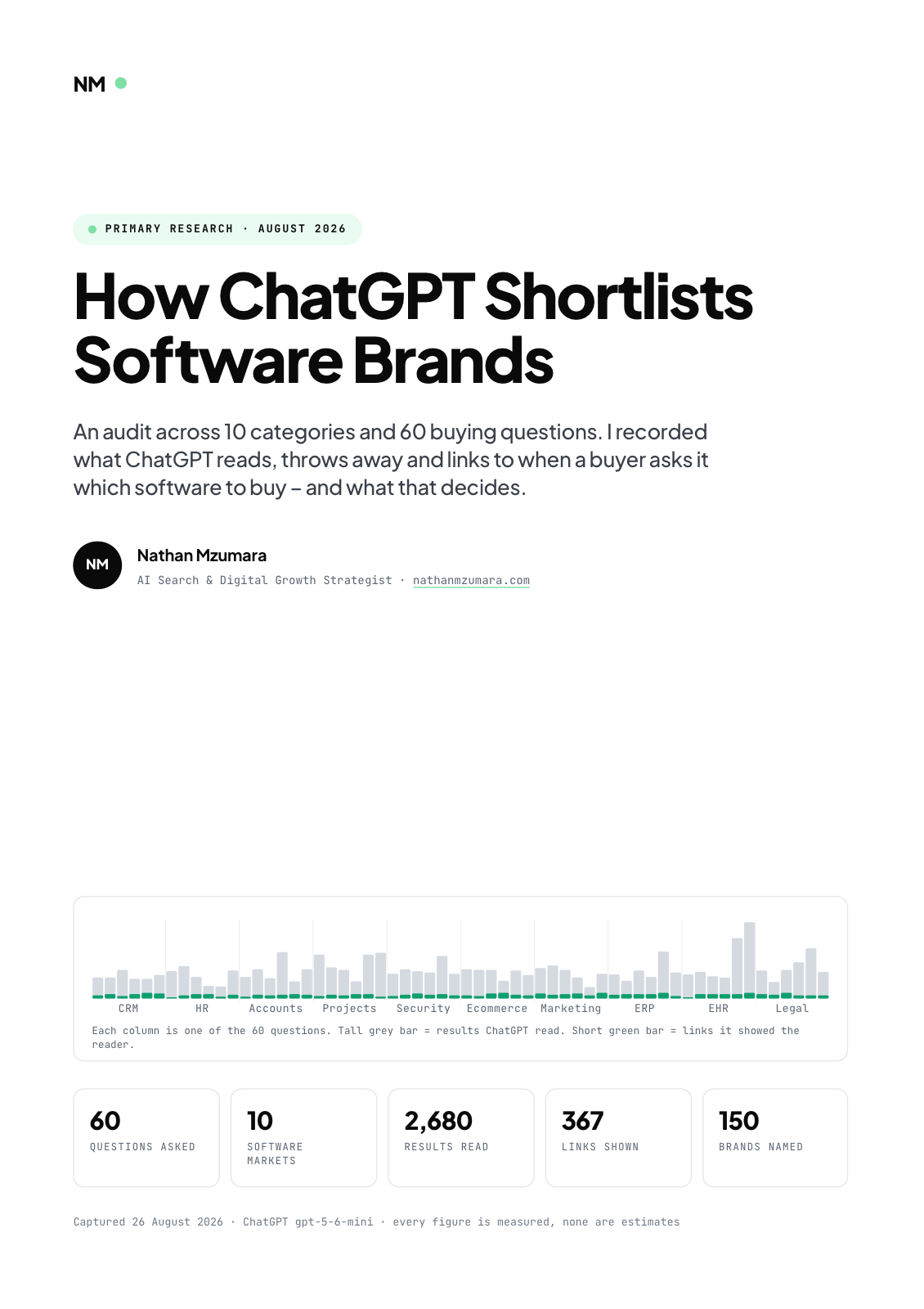
Primary research · August 2026
How ChatGPT Shortlists Software Brands
An audit across 10 categories and 60 buying questions. I recorded what ChatGPT reads, throws away and links to when a buyer asks it which software to buy, and what that decides.
- 60
- Questions asked
- 10
- Software markets
- 2,680
- Results read
- 367
- Links shown
Free download
Get the full report
35 pages · PDF · 536 KB. Enter your details and it downloads straight away.