xAI just shipped Grok Voice 3.0 at the same $0.08 per minute as the previous version

xAI launched Grok Voice 3.0 on 14 October 2026. It ranks first on Artificial Analysis's Speech-to-Speech Index with a score of 86.9, ahead of GPT-Live-1 (Astra, Medium) at 83.2 and Gemini 3.8 Live (Ext. Thinking, High) at 82.6. The price did not move: it ships in the Voice Agent API at $0.08 per minute, the same rate as Grok Voice 2.0.
Grok Voice 3.0 is a speech-to-speech model, which means it listens and replies in audio directly, without converting speech to text and back again. That is why xAI can claim latency under one second. For anyone running a contact centre, a booking flow or an outbound sales motion, the latency number is the one that governs whether a caller stays on the line.
What do the Grok Voice 3.0 benchmarks actually show?
The figures below come from Artificial Analysis's independent speech-to-speech testing, published 13 October 2026 and cited in the xAI announcement.
| Benchmark | Grok Voice 3.0 | Grok Voice 2.0 | GPT-Live-1 (Astra, Medium) | Gemini 3.8 Live |
|---|---|---|---|---|
| AA Speech-to-Speech Index | 86.9 | 81.3 | 83.2 | 82.6 |
| Speech reasoning (Big Bench Audio) | 98.5% | 97.2% | 90.1% | 97.7% |
| Human preference (Speech Agent Arena Elo) | 1070 | 1011 | 1048 | 990 |
| Task success rate | 94.8% | 94.6% | 87.4% | 89.1% |
| Conversational dynamics (Full Duplex Bench) | 97.0% | 95.1% | 94.9% | 91.9% |
Two of those rows deserve attention from growth leaders rather than engineers.
- Full Duplex Bench at 97%: this measures how the model handles pauses, turn-taking and interruptions. Interruption handling is what makes a caller believe they are talking to something competent rather than a phone tree.
- Task success rate at 94.8%: the jump from Grok Voice 2.0 is small, from 94.6%. The real gains this release are in reasoning, preference and conversational feel, not raw completion.
On tau-Voice (τ-Voice), which tests support calls with mixed accents, background noise and interruptions, Grok Voice 3.0 scores 71.6%. GPT-Live-1 (Astra, Medium) scores higher at 74.5%. xAI's claim is that Grok Voice 3.0 reaches comparable quality at 40% lower latency. That is an honest trade, and it is the trade most voice deployments care about.
On EVA-Bench, ServiceNow's open-source enterprise voice agent benchmark, Grok Voice 3.0 records the highest accuracy score at 74%. Nitin Aggarwal, Senior Director of Product Management, Agentic Evals and RAI at ServiceNow, said the model "sets a new Pareto frontier on EVA-Bench" across "200+ realistic enterprise scenarios".
Why the Starlink numbers matter more than the leaderboard
Benchmarks are a proxy. Deployment data is evidence. xAI reports that Starlink call centres use Grok Voice to answer 20,000 customer calls every day across multiple languages.
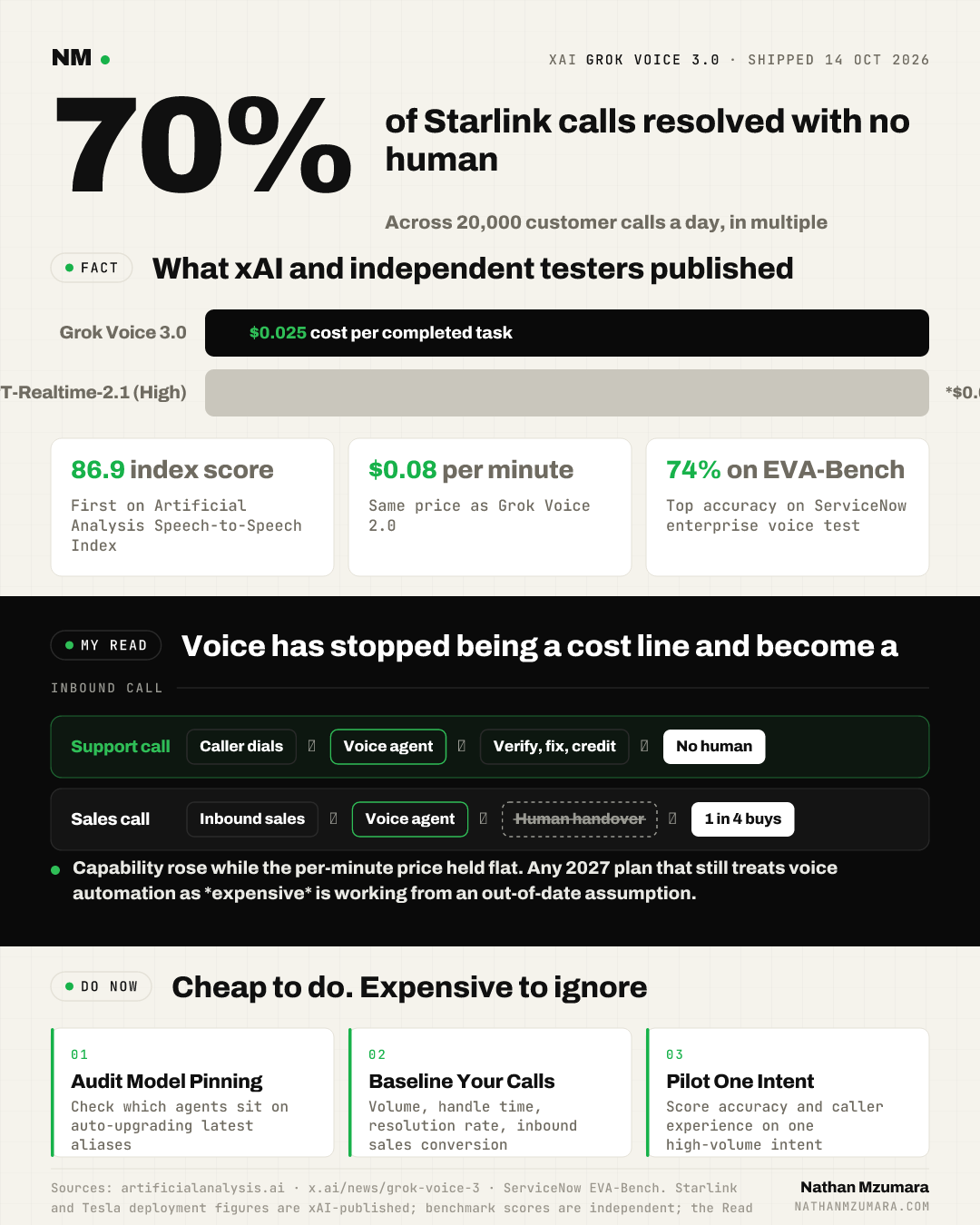
Roughly 70% of those calls are resolved with no human in the loop. One in four sales calls ends in a purchase before the caller hangs up. A single agent built on Grok Voice 3.0 verifies customers, troubleshoots hardware, issues credits and ships replacement equipment.
Read that second sentence again. The voice agent is not deflecting contacts, it is closing revenue. That reframes voice from a cost line owned by service into a conversion surface that marketing and growth should have an opinion about.
In Tesla vehicles, Grok Voice 3.0 handles millions of conversations a day. Drivers use Connectors for small jobs like checking a calendar, and Grok Bot for larger ones like ordering a coffee or booking dinner, hands-free. If your category involves a booking, a reorder or a local purchase, that is a discovery surface you currently have no measurement for.
The price held flat, so the economics changed
Grok Voice 3.0 costs $0.08 per minute, or $4.80 per hour, in the Voice Agent API. Same price as the previous version, better performance.
Artificial Analysis also measures cost per completed task on its Big Bench Audio run. Grok Voice 3.0 comes in at $0.025, against $0.030 for GPT-Live-1 (Astra, Medium) and $0.055 for GPT-Realtime-2.1 (High). On those published figures, a six-minute call runs at $0.48 of model cost.
This is the same pattern we saw when Claude Haiku 5.5 landed at around 75% less to run: capability improves while the unit price stays flat or falls. If your 2027 budget assumes voice automation is expensive, the assumption is already out of date.
What could go wrong
- Silent upgrades: xAI states that agents using
grok-voice-latesthave already been switched over automatically, with no changes needed. Your live customer-facing agent changed behaviour without a release note on your side. That is a governance issue, not a convenience. - Vendor-framed evidence: the Tesla and Starlink figures come from xAI, describing deployments inside companies sharing a founder. The Artificial Analysis and ServiceNow results are independent. Treat the two tiers differently in any board paper.
- Accuracy is not the same as experience: 74% accuracy on EVA-Bench means roughly one in four enterprise scenarios is not handled correctly. You still need an escalation path and a sampling process.
What to do about Grok Voice 3.0 this week
- Find out which model version your existing voice agents are pinned to. If any use a
latestalias, decide deliberately whether that is acceptable for a customer-facing channel. - Pull your own call data: volume, average handle time, resolution rate and conversion rate on inbound sales calls. You cannot judge a 70% resolution claim without your own baseline.
- Run one scripted pilot on a narrow, high-volume intent, and score it on accuracy and caller experience, as EVA-Bench does.
- Add voice to your AI discovery map alongside answer engines and assistants. The same xAI stack sits behind consumer access, as covered in the X subscription bundling Grok, Cursor and X from $8.
The full announcement is on the xAI news page for Grok Voice 3.0, dated 14 October 2026.
Tags
