OpenAI's Economic Research Report: EU Agent Use Passes Half

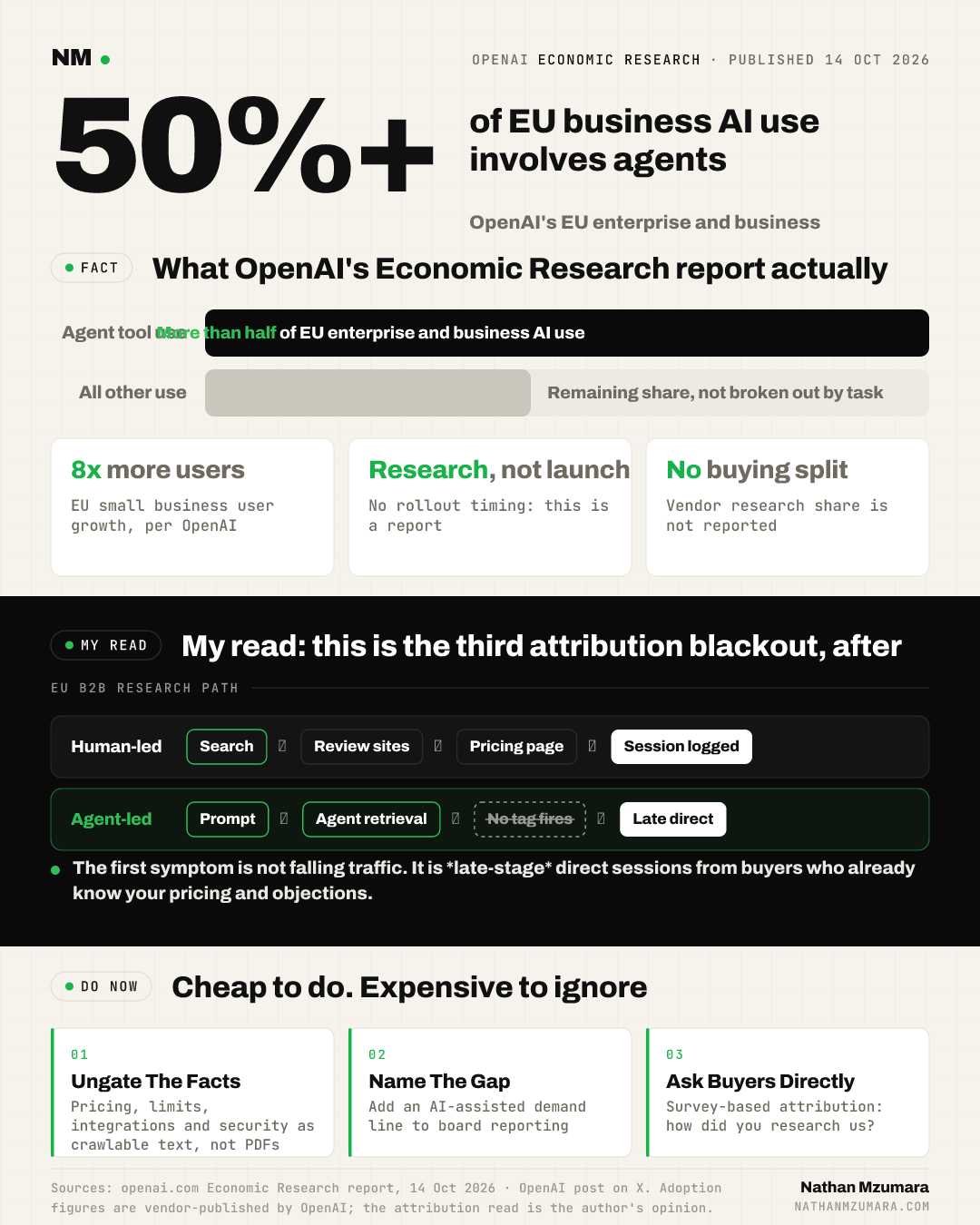
OpenAI published its latest Economic Research report on 14 October 2026. More than half of the AI use among its EU enterprise and business customers now involves AI agent tools, and the number of small business users has grown 8x across the region. OpenAI's own words: European businesses are rapidly expanding their use of AI agents.
What did OpenAI's Economic Research report find?
OpenAI announced the findings in a post on X summarising its latest Economic Research report, published on 14 October 2026. The post had 2,756 likes and 221 retweets. No rollout timing was stated, because this is research rather than a product release.
- Agents are now the majority: More than half of the AI use among OpenAI's EU enterprise and business customers now involves AI agent tools.
- Small business growth of 8x: The number of small business users has grown 8x across the EU region.
- OpenAI's framing: European businesses are rapidly expanding their use of AI agents.
- The stated purpose: The report explores Europe's shift toward agentic AI and the opportunity to turn broader adoption into deeper use.
An AI agent is software that takes a goal from a person and then carries out the multi-step work itself, reading sources and producing an output, without the person visiting each source directly. That last clause is the whole story for marketing teams.
One limit worth stating plainly. OpenAI does not break out how much of that agent use is vendor research, shortlisting or renewal diligence. The report measures how EU businesses use AI, not what they buy with it. The reasonable reading is that buying research is part of the mix, not all of it.
Why does agent-majority AI use break EU pipeline attribution?
Every European measurement model in common use assumes a human arrives on a page. When an agent does the reading, that assumption fails in three separate places.
The session that never happens
An agent can compile a vendor comparison from documentation, pricing pages, review sites and forums without a buyer ever opening a browser tab. No session is created, so no behavioural signal exists. The research happened. Your analytics has no record that it did.
The tag that never fires
Client-side analytics depends on JavaScript executing in a browser. Most agent retrieval does not execute your tags, accept your consent banner or carry a useful referrer. The buyer who eventually converts shows up as direct, or as dark social, long after the decision was effectively made.
The paid media that is never seen
Agents do not view display inventory, do not scroll past sponsored results in the way a person does, and do not sit in a retargeting pool. If a meaningful share of European vendor research now runs through agents, part of your paid discovery budget is buying attention from a buyer who has delegated the looking.
| Stage | Human-led journey | Agent-led journey | What your analytics sees |
|---|---|---|---|
| Problem framing | Search, blog, newsletter | Prompt to an agent | Nothing |
| Vendor longlist | SERP, review sites, peers | Agent retrieval across sources | Nothing, or an unattributed crawl |
| Shortlist and pricing | Pricing page, demo request | Agent reads docs and pricing | Nothing, unless pricing is gated |
| Final check | Multiple visits, competitor tabs | Human opens one tab to confirm | Direct traffic, late stage |
Table: where a European B2B buying journey stops producing measurable signals once an agent runs the research. Structure based on the stages marketing teams already report on.
We have seen this attribution break before
Search marketers lived through the same pattern when Google moved organic queries to "(not provided)" in Google Analytics. The demand did not disappear. The visibility into it did, and teams that waited for the data to come back spent years reporting on a shrinking slice of reality.
Dark social repeated the lesson. Link sharing in messaging apps generated real pipeline that landed in reports as direct traffic. The teams that coped built proxy measures and survey-based attribution rather than arguing with the numbers.
Agentic research is the third instance of the same problem, and the fastest moving. From my observation across European B2B accounts this year, the first symptom is not a traffic fall. It is a rise in late-stage direct sessions from people who already know your pricing tiers and your main objection handling before they ever speak to sales.
What the shift to agentic AI changes for CMOs, growth leaders and founders
In plain English: a growing share of European buying research is now done by software that never loads your site, never fires your tags and never sees your ads. That changes a different thing for each seat at the table.
- For the CMO: Your channel mix report becomes less accurate every quarter, not because the model broke but because the buyer changed. Board reporting needs a named line for AI-assisted demand that nobody can attribute cleanly.
- For the VP of Growth: Efficiency metrics drift. Cost per lead can look stable while the real discovery work moves to a surface you do not buy, do not measure and do not control.
- For the search marketing lead: The job expands from ranking pages to making machine-readable facts available. Pricing, specifications, integrations, limits and security posture need to exist as structured, crawlable text rather than as a PDF behind a form.
- For the founder or CEO: The 8x growth in EU small business users means your smaller customers and prospects are using the same tooling. Agent readiness is not an enterprise-only concern in Europe.
Worth connecting to the demand side too. OpenAI has separately documented how small businesses are putting AI agents to work, which is the same adoption curve seen from the user's side rather than the region's.
What are the risks of acting on this now?
Opening crawler access to agent traffic has a cost. More retrieval means more of your content used in answers you cannot see, and in a European context it raises licensing and consent questions that legal teams will want to review before marketing changes a robots file.
Data governance is the other objection, and it was raised immediately. In one of the most liked replies to OpenAI's post, a user cautioned against putting business data into an OpenAI product and pointed to open source agents instead. That view matters, because it shapes which agents your buyers actually use and which ones you need to be legible to.
The measurement risk is subtler. Build a reporting line for unattributable AI-assisted demand and you create a bucket that can absorb any shortfall. Define the rules before you create the line.
The counter-view: why this could still be a 2027 problem
Here is the strongest argument against funding anything this quarter. The Economic Research report measures AI use inside EU businesses, not vendor research specifically. Most agent use in a company is probably internal: drafting, coding, summarising, reconciling. Buying research may be a small slice.
OpenAI also has an obvious commercial interest in presenting European agent adoption as advanced. The company frames the remaining opportunity as depth rather than breadth, which is the framing you would use when selling expansion seats.
My read is that the direction is right even if the size is overstated, and the asymmetry decides it. A modest agent-readiness programme costs a quarter of one person's time. Being structurally invisible to the research layer for two years costs pipeline you will never see in a report.
What to fund this quarter
- Crawler access policy: Decide, in writing, which AI crawlers may read which parts of your site. Document the reason. Review it with legal once, not every month.
- Structured product and pricing data: Publish pricing tiers, limits, integrations and compliance facts as plain, crawlable text with schema markup. Ungate anything a buyer would need to shortlist you.
- Agent-visible documentation: Rewrite the top twenty answers your sales team gives as self-contained passages. An agent lifts passages, not pages.
- A reporting line for unattributable AI-assisted demand: Add one field to your demo and trial forms asking which tools were used in research. Pair it with a quarterly win-loss question. That is your only real EU read on agent-influenced pipeline.
- A baseline: Record direct and unattributed traffic share by stage now, so you can show movement in six months.
Measurement on paid surfaces is moving in parallel, and the work on third-party attribution inside ChatGPT ads is worth tracking alongside the organic side of this.
What the Economic Research report should change in your next board pack
Replace the implied claim that your channel report explains European demand. Say instead that a growing share of EU vendor research now runs through agents, name the share of pipeline you cannot attribute, and show what you are doing to become readable to the software doing the reading.
Do one thing this week. Pull your EU direct and unattributed traffic by funnel stage for the last four quarters, put it next to the finding in OpenAI's Economic Research report that more than half of EU enterprise and business AI use now involves agents, and take both into your next forecasting meeting. The decision is whether to fund agent readiness now or explain the gap later.
Analysis of OpenAI's Economic Research report by Nathan Mzumara. Published 14 October 2026. Last updated 14 October 2026.
