ChatGPT Ads Adds Visual Format and Third-Party Attribution
OpenAI announced on 5 October 2026 that ChatGPT Ads is getting a new visual ad format, a much wider set of measurement and attribution partnerships, and brand suitability evaluation pilots with DoubleVerify and Integral Ad Science. Testing of the visual format begins later this month in the US with an initial group of advertisers.
The creative format will get the headlines. It is the least important part of the announcement. The measurement and suitability news is what changes the budget conversation, because no CMO moves real money into an environment they cannot verify, attribute or defend in a board meeting.
What OpenAI announced on 5 October 2026
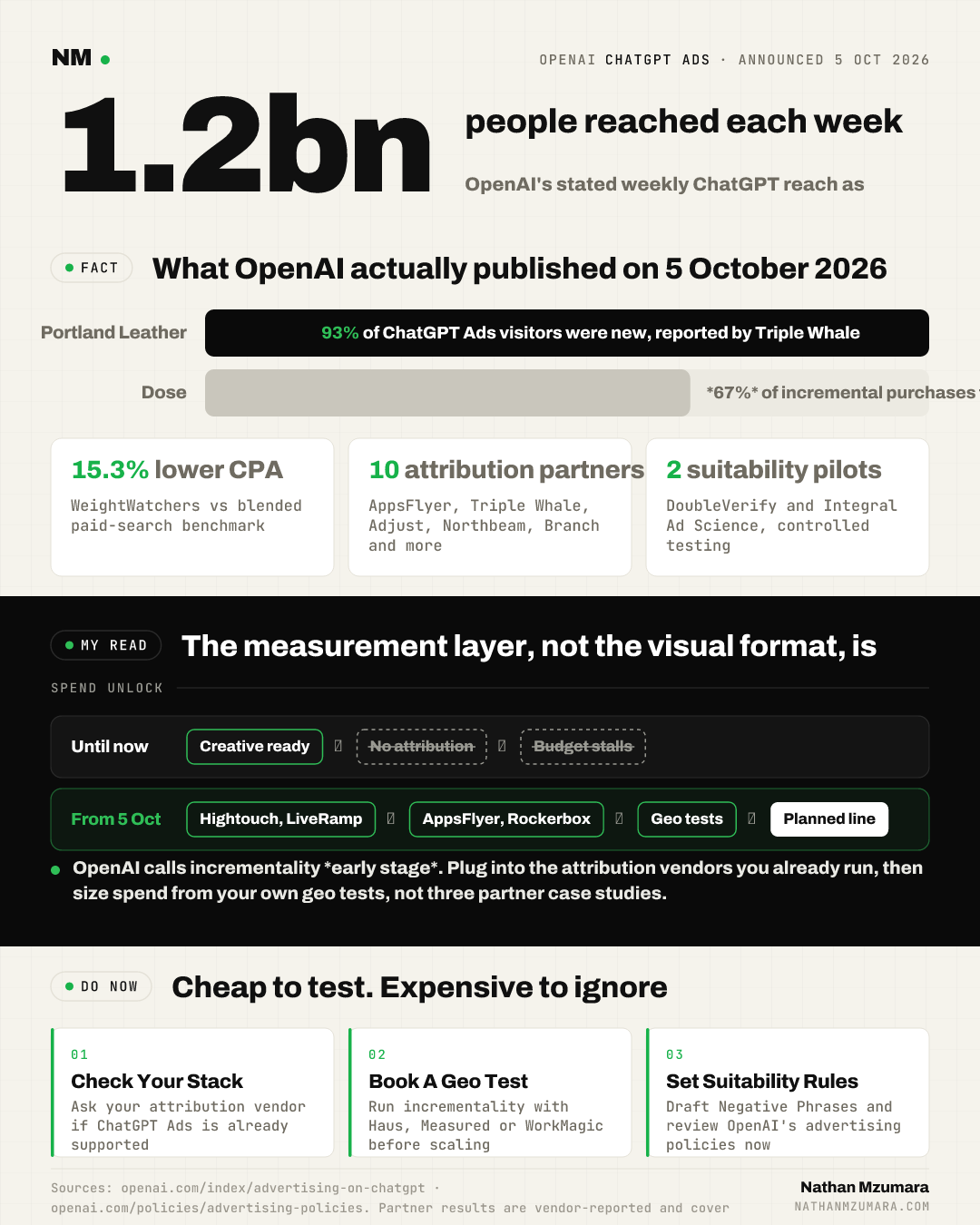
OpenAI published three things at once. A new visual ad format, an expanded measurement partner ecosystem, and new work on brand suitability. OpenAI states that ChatGPT reaches 1.2 billion people each week, describing it as the world's largest AI-native consumer platform.
The company frames advertising as a way to serve a much larger market than subscriptions alone. Businesses can sign up at ads.openai.com. No pricing was stated in the announcement.
The visual ad format is the smallest part of the news
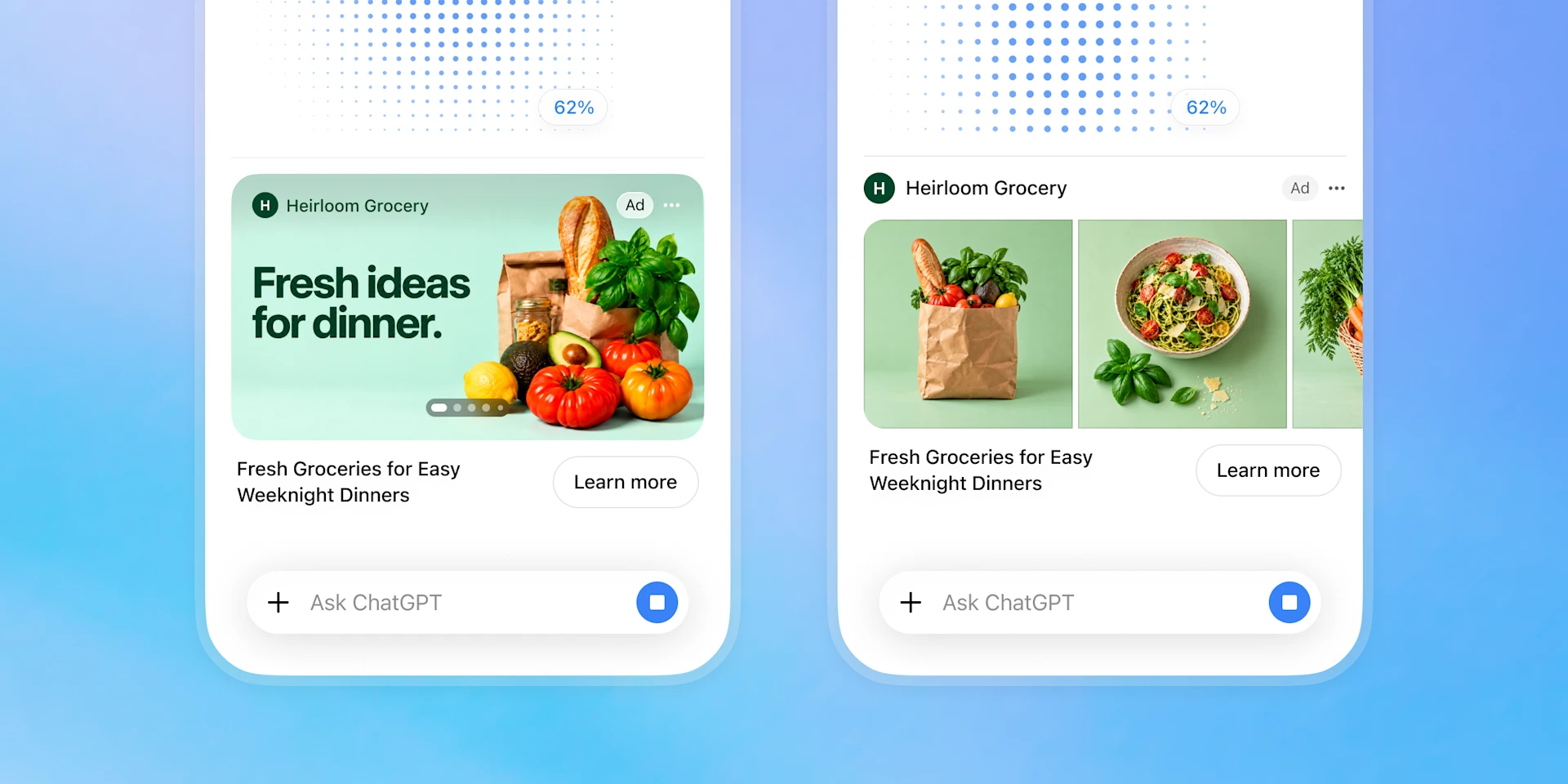
The new format shows images of product inspiration, product usage, or the experiences products make possible. OpenAI says the intent is to help people imagine how products and services could fit into their lives, and to give advertisers new ways to tell their stories visually.
Initially, the format will be tested during image generation in ChatGPT. The ads in ChatGPT that appear in this placement will be clearly labelled and remain separate from the image being created. OpenAI repeats that advertising does not influence the answers ChatGPT provides.
That is a sensible first surface. It is also a test, in one market, with a limited advertiser group. Treating it as a format launch misreads the announcement.
Why the measurement layer is the real story
ChatGPT Ads is OpenAI's advertising product inside ChatGPT, now extending from text placements into visual placements during image generation. Until this week, the blocker on spend was not creative. It was proof.
Data pipes: Hightouch, Tealium and LiveRamp
Integrations with Hightouch, Tealium and LiveRamp let advertisers send conversion data from their existing systems into ChatGPT Ads. That removes the bespoke engineering work that usually stalls a new channel test at the second meeting.
Attribution: AppsFlyer, Triple Whale, DV Rockerbox and others
OpenAI now supports attribution partners across web and app, enabling Conversions API, reporting and click attribution with AppsFlyer, Triple Whale, Adjust, DV Rockerbox, Northbeam, Branch, Singular, Kochava, Airbridge and Tenjin. Full-funnel and advanced measurement partners include Fospha, Measured and INCRMNTAL. That list covers most of the stacks a performance team already runs.
Incrementality: Haus, Measured and WorkMagic
OpenAI is explicit that incrementality work is still in its early stages. The company is partnering with Haus, Measured and WorkMagic on geo-based experiments to explore the causal impact of ChatGPT Ads. Early stage is the operative phrase, and it should shape how much budget you commit.
What the early partner findings actually show
OpenAI published three partner-reported results. They are encouraging and they are small in number. Read them as directional, not as a benchmark you can plan against.
| Brand | Reported by | Result |
|---|---|---|
| WeightWatchers | DV Rockerbox | Attributed cost per acquisition 15.3% lower than its blended paid-search benchmark |
| Dose (wellness) | WorkMagic | Statistically significant lift, with 67% of incremental purchases from net-new customers |
| Portland Leather | Triple Whale | 93% of visitors from ChatGPT Ads were new |
Two of the three findings point at new customer acquisition rather than cheaper conversion of existing demand. That matters more than the CPA number, because it speaks to the cannibalisation question every finance director will ask. Further detail sits on OpenAI's measurement partnerships post.
Does ChatGPT have ads that are safe to run beside?
Brand suitability has been the second blocker on ads in ChatGPT. A conversation is not a page, so the old contextual controls do not map across cleanly.
OpenAI's placement guardrails assess whether a conversation is appropriate for advertising, keeping ads out of emotionally vulnerable, sensitive or otherwise unsuitable contexts. Automated review, human oversight and ongoing monitoring support that. The full rules sit in OpenAI's advertising policies.
Two additions go further. Negative Phrases are now available to qualifying advertisers with narrow placement requirements specific to their own brand policies. Brand suitability evaluation pilots are being developed with DoubleVerify and Integral Ad Science, assessing how OpenAI's standards are applied in a controlled testing environment without access to private user conversations.
Eighteen months versus retail media's several years
Retail media networks took several years to earn the verification and attribution trust that unlocked serious budget. My read is that OpenAI has closed a comparable gap in roughly eighteen months, by buying credibility from the measurement vendors advertisers already trust rather than asking them to trust a walled-garden dashboard.
That is the pattern worth noticing. The playbook behind OpenAI ads on ChatGPT is not to build measurement, it is to plug into it. Same move Amazon made, compressed.
What this means in plain English for marketing leaders
If you run growth, paid media or the whole marketing function, here is what changed on 5 October 2026.
- Budget line: ChatGPT inventory moves out of an innovation pot nobody reports on and into something you model against paid search in the next planning cycle.
- Measurement: your existing attribution vendor probably already supports it, so the integration excuse is gone. Decide on your attribution window and holdout design before you spend.
- Risk and governance: you now need a written suitability policy for conversational placements, including your Negative Phrases list, not just a channel brief.
- Team design: somebody has to own the incrementality test. In my experience this fails when it is handed to the agency buying the media, because they mark their own homework.
- Board reporting: report incremental new customers, not attributed CPA. The Dose and Portland Leather findings suggest that is where the story is.
For search leaders specifically, this sits alongside the broader shift in how discovery is measured. If you have not revisited measurement windows recently, our note on the 90-day Google Analytics conversion window is the companion read.
The risks worth naming before you move budget
Three things could go wrong. The suitability pilots with DoubleVerify and Integral Ad Science are pilots, not shipped verification, so you are still partly trusting a first-party assurance. Incrementality tooling is early stage by OpenAI's own description, which means your first geo test will be a learning exercise as much as a proof.
The third risk is cannibalisation. A 15.3% lower attributed CPA than a blended paid-search benchmark is not the same as incremental revenue. If ChatGPT Ads intercepts demand that would have converted on brand search, you have moved cost, not grown the business.
The counter-view: why waiting is defensible
A reasonable CMO waits two quarters. The visual format is a US test with an initial group of advertisers, no pricing has been published, and the suitability evaluations are unfinished. Nobody was fired for letting someone else debug a beta.
What would have to be true for waiting to be wrong? Auction costs rising as the advertiser pool widens, and early entrants locking in cheaper new-customer acquisition. Are ads coming to ChatGPT at scale? They are already here, and the geographic footprint keeps widening, as our piece on the ChatGPT Ads expansion across Asian markets covered.
Who owns the incrementality test, and what to do with ChatGPT Ads this week
Give ownership to analytics or finance, not to the paid media team and not to the agency. The person who proves the channel works should not be the person whose budget grows if it does.
Three actions this week. Ask your attribution vendor whether they are live on the ChatGPT Ads Conversions API, since ten named partners now are. Draft the suitability policy and the Negative Phrases list with legal and brand. Then scope a geo-based holdout with Haus, Measured or WorkMagic and agree the success metric in advance: incremental net-new customers, not attributed cost per acquisition.
The 5 October 2026 announcement did not prove the channel works. It removed the reasons you could not test it properly. Leaving ChatGPT Ads filed under experiments after this planning cycle is now a decision, not a default.
ChatGPT Ads analysis published 5 October 2026. Last updated 5 October 2026.