Advertising & Paid Media
Brand safety
Also known as: brand suitability
Brand safety is the practice of preventing advertising and brand content from appearing next to material that could damage reputation, such as violent, illegal or misleading content. Brand suitability is the related, narrower idea of matching placements to a specific brand's tolerance and values rather than a universal baseline. Both rely on exclusion lists, content classification and verification reporting.
What it is
It covers where ads run and what surrounds them, across open web inventory, video platforms, social feeds, retail media and increasingly AI generated or AI curated surfaces. Universal floors exclude clearly harmful categories, while suitability settings reflect one advertiser's judgement, for example a family brand avoiding gambling content that another advertiser accepts. Verification vendors and platform controls provide the enforcement and the evidence.
Why it matters
Unsuitable adjacency damages trust and can trigger press coverage or customer complaints that outlast any media saving. It also wastes budget on low quality placements such as made for advertising sites that generate impressions but no meaningful attention. As AI systems summarise and recommend, the same concern extends to the contexts in which a brand is described or cited, not just paid placements.
How it works
Teams define a suitability framework, apply pre bid segments and keyword or topic exclusions, maintain inclusion and exclusion lists, and review placement reports to prune poor inventory. Third party verification measures adjacency and invalid traffic, and incidents feed back into list updates. Many advertisers now favour curated inclusion lists over endless blocking, because inclusion is easier to control at scale.
When it applies
It applies to any paid media activity, sponsorship or influencer partnership, and needs tighter attention during breaking news cycles, elections and sensitive events.
Examples
- A retailer switches from broad keyword blocking to a curated inclusion list of vetted publishers after reviewing a placement report.
- A children's brand sets a stricter suitability tier that excludes crime and conflict news content, while its sister brand allows it.
- An advertiser pauses a social campaign during a major news event, then resumes with tighter adjacency controls in place.
How it is measured
- Brand safety and suitability violation rate as a share of measured impressions
- Percentage of spend on inclusion list or verified inventory
- Invalid traffic and made for advertising spend share
- Number of incidents escalated and average time to remove an offending placement
Insights on Brand safety
Related terms in Advertising & Paid Media
- AI-generated creativeAI-generated creative is ad and marketing creative produced or adapted using generative models, including images, video, voiceover, headlines and body copy. Teams use it to produce more variants, localise faster and test concepts that would be too costly to shoot. It still needs human direction, brand review and legal checks before it runs.
- Asset groupsAn asset group is the creative container inside a Google Performance Max or Demand Gen campaign, holding headlines, descriptions, images, logos, videos and audience signals. Google assembles ads from these assets and serves them across Search, Shopping, YouTube, Display, Discover, Gmail and Maps. Retail campaigns can tie an asset group to a specific set of products through listing groups.
- ChatGPT AdsChatGPT Ads refers to advertising placements inside OpenAI's ChatGPT. OpenAI has publicly signalled that advertising is part of its commercial plans and has been testing and building out ad capabilities, so the format details continue to change. For marketers it represents a possible new paid surface alongside organic visibility in AI assistants.
- ChatGPT Sponsored AgentsChatGPT Sponsored Agents is the name given to a paid placement format in which a brand's agent or assistant can be surfaced inside a ChatGPT conversation to help complete a task, such as booking, quoting or buying. It sits alongside other advertising formats OpenAI has discussed for ChatGPT, where commercial results are marked as sponsored rather than blended invisibly into answers. Availability, naming and mechanics are still moving, so treat any specification as provisional and check current OpenAI documentation before planning spend.
- Conversational advertisingConversational advertising is paid placement inside a dialogue, whether that is an AI assistant, a chatbot, a messaging app or a voice interface. Instead of a static creative next to content, the ad appears as a response, suggestion or handover at the point where the user has expressed intent. The defining features are turn-by-turn context, a disclosure label, and the option for the user to keep talking rather than click away.
- Demand Gen campaignsDemand Gen is a Google Ads campaign type built for visually led prospecting across YouTube, Discover, Gmail and other Google feeds. Advertisers supply image, video and text assets plus audience signals, and Google's systems assemble and place ads to create interest before someone actively searches. It replaced Discovery campaigns and sits between upper funnel video and lower funnel search or shopping activity.
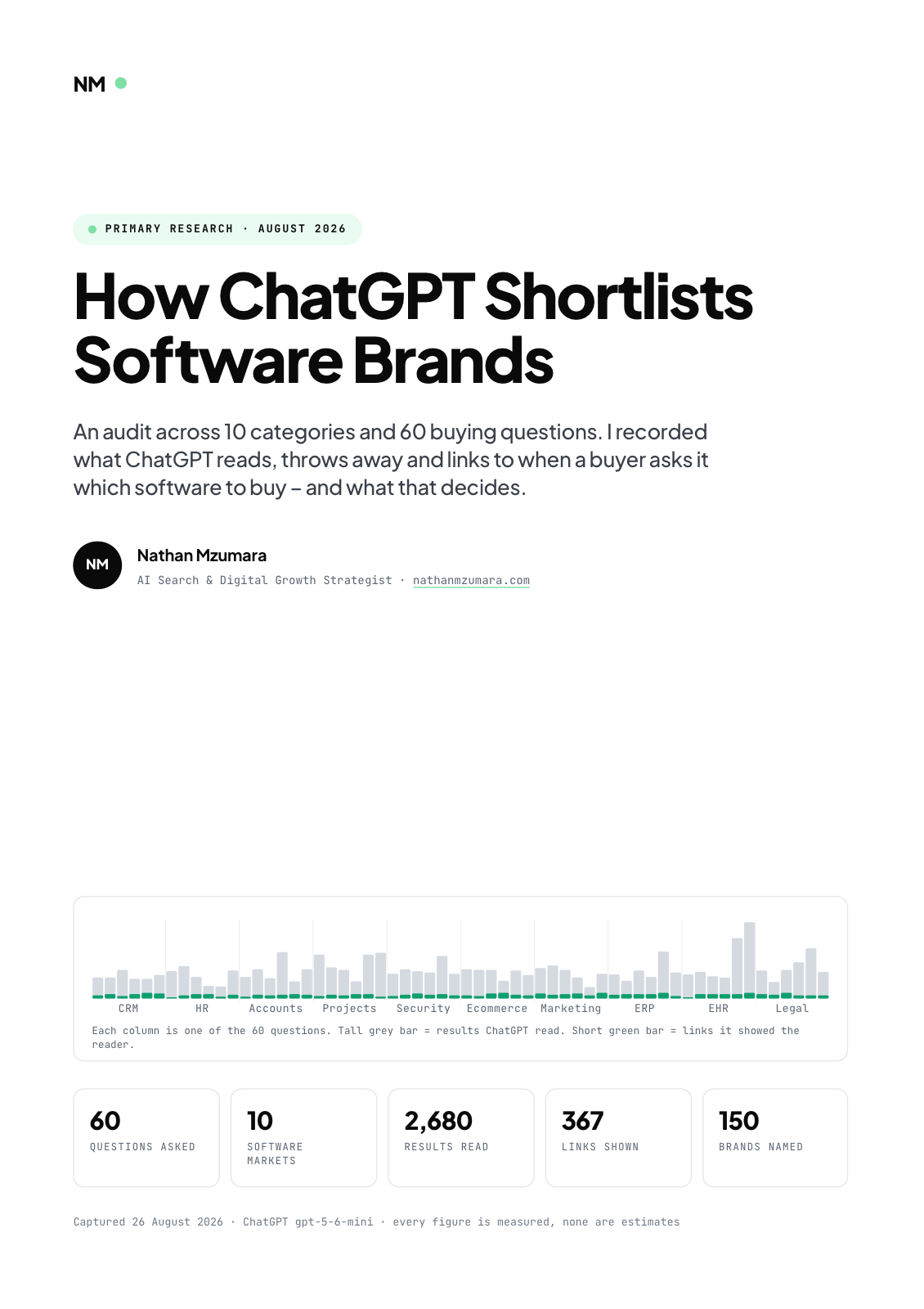
Primary research · August 2026
How ChatGPT Shortlists Software Brands
An audit across 10 categories and 60 buying questions. I recorded what ChatGPT reads, throws away and links to when a buyer asks it which software to buy, and what that decides.
- 60
- Questions asked
- 10
- Software markets
- 2,680
- Results read
- 367
- Links shown
Free download
Get the full report
35 pages · PDF · 536 KB. Enter your details and it downloads straight away.