Anthropic Publishes Claude's Constitution in Full Under CC0

Anthropic has published Claude's constitution in full, the document it says plays a crucial role in its training process and directly shapes Claude's behaviour. Anthropic calls it the final authority on its vision for Claude, with all other guidance and training intended to be consistent with it. It is released under a Creative Commons CC0 1.0 Deed.
That licence matters as much as the content. CC0 means the text can be freely used by anyone for any purpose without asking permission. For the first time, the stated reasoning behind one frontier assistant's outputs is a document you can read, quote, audit and hand to your legal team.
What exactly did Anthropic publish?
Anthropic published the full text of Claude's constitution on its own site, alongside a summary and further discussion in the blog post "Claude's new constitution". The purpose, in Anthropic's words, is to be transparent about its intentions for Claude's values and behaviour, and to give Claude the values, knowledge and wisdom needed to behave safely and beneficially across all circumstances.
Claude's constitution is a detailed description of Anthropic's intentions for Claude's values and behaviour, written to shape how the model acts rather than to set out a checklist of rules. Anthropic says it generally favours cultivating good values and judgment over strict rules and decision procedures, and tries to explain any rules it does want Claude to follow.
Two limits are stated openly. The constitution is written for Anthropic's mainline, general-access Claude models, and some models built for specialised uses do not fully fit it. Anthropic also says Claude's behaviour might not always reflect the constitution's ideals, and that it will be open about divergences, for example in its system cards.
How does Claude's constitution rank safety, ethics and helpfulness?
Anthropic wants all current Claude models to hold four properties, and where they appear to conflict, Claude should generally prioritise them in the order listed. That ordering is the single most commercially useful line in the whole release.
| Priority | Property | What Anthropic says it means |
|---|---|---|
| 1 | Broadly safe | Not undermining appropriate human mechanisms to oversee AI during the current phase of development |
| 2 | Broadly ethical | Being honest, acting according to good values, and avoiding actions that are inappropriate, dangerous or harmful |
| 3 | Compliant with Anthropic's guidelines | Acting in line with more specific guidelines from Anthropic where relevant |
| 4 | Genuinely helpful | Benefiting the operators and users the model interacts with |
Read that bottom-up. Genuine helpfulness sits fourth. If you build on the Anthropic API, the constitution tells you where operator and user requests can be overridden, and by what. That is a planning input, not a philosophy seminar.
What are the main sections of the constitution?
Anthropic lists five main sections. Each one answers a different question about how the model handles the people and instructions in front of it.
- Helpfulness: covers the value of Claude being genuinely and substantively helpful, and how Claude should navigate helpfulness across its different "principals": Anthropic itself, the operators who build on the API, and the end users.
- Anthropic's guidelines: covers supplementary instructions on specific issues such as medical advice, cybersecurity requests, jailbreaking strategies and tool integrations, which Claude is asked to prioritise over more general helpfulness.
- Claude's ethics: sets out the standards of honesty Anthropic wants Claude to hold and its current list of hard constraints, for example that Claude should never provide significant uplift to a bioweapons attack.
- Being broadly safe: covers why Claude should not undermine humans' ability to oversee and correct its values and behaviour during this period of AI development.
- Claude's nature: covers Anthropic's uncertainty about whether Claude might have some kind of consciousness or moral status, and how it hopes Claude approaches questions about its identity.
The document is written with Claude as its primary audience. Anthropic says it is optimised for precision over accessibility, covers topics that may be of less interest to human readers, and discusses Claude in terms normally reserved for humans, such as "virtue" and "wisdom". Expect to do some translation work.
What this means in plain English for marketers and growth leaders
Strip away the philosophy and you are left with a published standard for how one widely used assistant weighs honesty against helpfulness. Brand mentions inside AI answers stop being a pure visibility game and start behaving like a compliance surface.
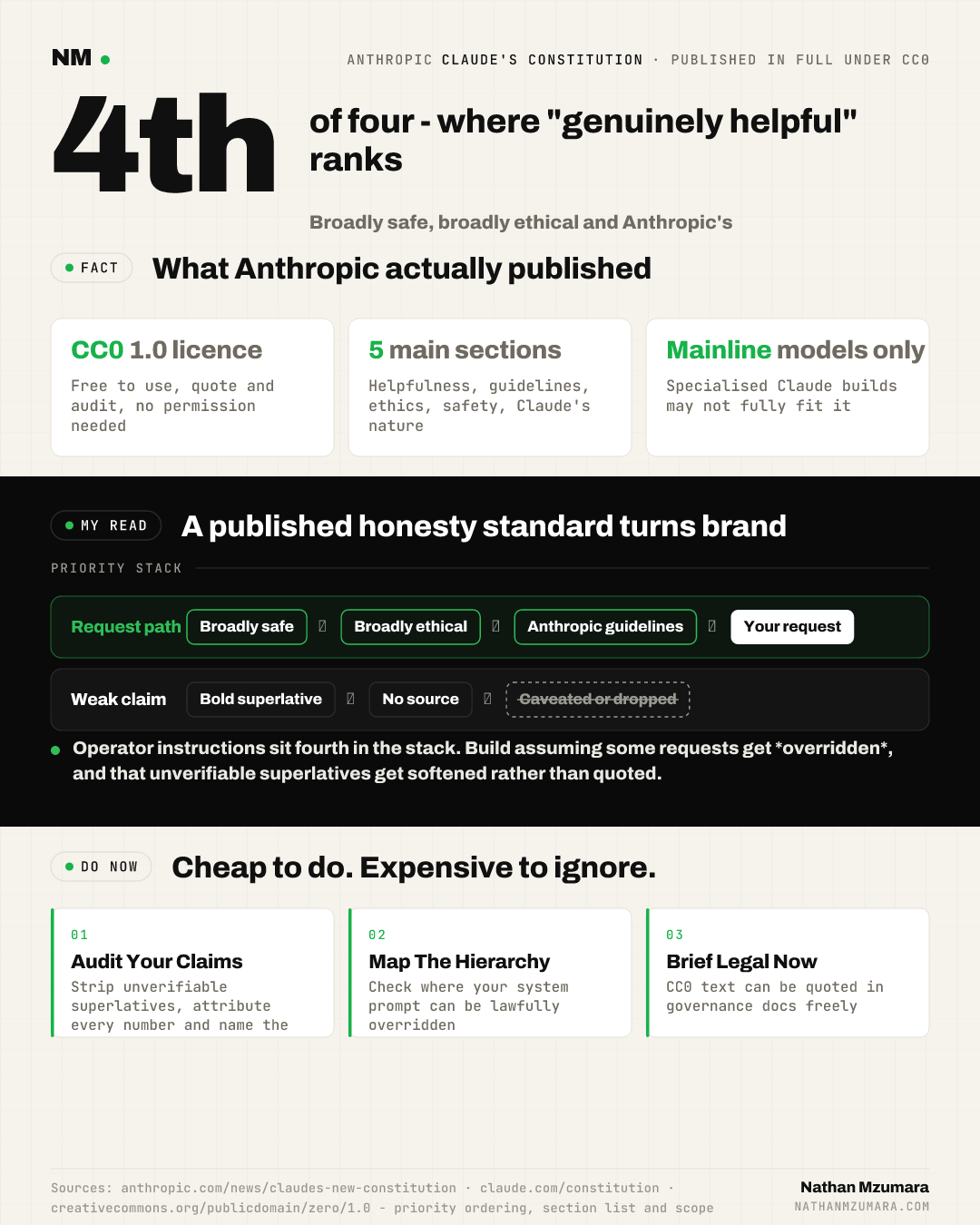
- Claims discipline becomes a ranking input: a model instructed to hold high standards of honesty has a stated reason to caveat, soften or decline an unverifiable superlative. Overstated claims are no longer just weak copy. They are the exact pattern the stated standard pushes against.
- Operator instructions are not sovereign: if you build a Claude-powered assistant, your system prompt sits inside a hierarchy where broad safety, ethics and Anthropic's guidelines rank above helpfulness to you. Design your product assuming some requests get overridden.
- Source quality has a published rationale: the honesty and guidelines sections describe the kind of grounded, specific, checkable material a model is being steered towards. That is a map of the content worth producing and the third-party coverage worth earning.
- Specialised models are out of scope: the constitution covers mainline, general-access Claude models only. Do not assume a specialised deployment behaves the same way.
Here is my own observation from auditing comparison and "best of" pages over the past year. The pages that get quoted cleanly by assistants are the ones that attribute every number, name the period it covers and avoid unqualified superlatives. Pages built on vague claims get paraphrased into something flatter, or dropped. The constitution now gives a public rationale for why that happens with Claude.
The precedent: this is the Search Central moment for AI assistants
Search spent a decade guessing at Google's ranking logic until public documentation turned guesswork into policy work. Teams that read the documentation early built content standards. Teams that did not kept chasing tactics. We saw the same pattern when Google set out its guidance on generative AI content, where the published rules immediately became the brief.
A full behaviour specification under CC0 raises the bar for everyone else. Once one lab publishes its hierarchy of values, rivals face a fair question about why theirs stays private. My read is that published behaviour specifications become a standard disclosure within the next two years.
The risks, and the counter-view
The obvious risk is treating the document as a rulebook. Anthropic says plainly that training models is difficult and Claude's behaviour might not always reflect the constitution's ideals. Optimising content against stated intentions is not the same as optimising against observed behaviour.
There is also a measurement gap. You cannot yet see most of what assistants say about your brand, and AI referral data is already hard to attribute, a problem we covered when ChatGPT stopped passing UTM parameters. A published standard does not fix a blind spot.
The counter-view deserves airtime. The document is written for Claude, optimised for precision over accessibility, and says almost nothing about marketing directly. A reasonable critic would argue marketers are reading commercial instructions into a safety and ethics text. That critique holds if you treat the constitution as a tactical checklist. It fails if you treat it as evidence of the direction all major assistants are moving in.
Who should own Claude's constitution inside your organisation?
This is the decision the release forces. Someone has to own reading, auditing and translating published model behaviour specifications into content, claims and brand-safety standards.
Legal alone is the wrong home, because the output is editorial guidance, not contract review. Marketing alone is the wrong home, because the consequences include product behaviour and regulatory exposure. In my experience the workable answer is a small AI discovery function sitting inside marketing, with a named legal reviewer and a quarterly cadence.
Do three things this week. First, name the owner, by person, not by team. Second, have them read the five sections of Claude's constitution and produce a one-page translation into your claims standards, flagging every superlative in your top twenty commercial pages that you cannot evidence. Third, book the system card review into the calendar, because Anthropic has said it will document where behaviour diverges from the document. Claude's constitution is now a readable standard, and the organisations that assign it an owner this quarter will be writing to it while everyone else is still guessing.
