Google Guidance on Generative AI Content: What the Rules Say

Google does not ban AI-generated content. The Google guidance on generative AI content, set out in Google Search's guidance on using generative AI content on your website and last updated 1 October 2026, says generative AI can be useful for researching a topic and adding structure to original content. The line it draws is different: using these tools to generate many pages without adding value for users may breach the spam policy on scaled content abuse.
That distinction matters more than any model release. It means the risk is not the tool you use. The risk is volume without value.
What is Google's guidance on generative AI content?
Google's guidance on generative AI content is a Search Central documentation page that tells site owners how to publish AI-assisted content without falling foul of Google's spam policies. In plain terms, it says any AI content you publish must meet the standards of the Search Essentials and the spam policy on scaled content abuse.
The page points readers to the Search Quality Rater guidelines, naming two sections directly. Section 4.6.5 covers scaled content abuse. Section 4.6.6 covers main content created with little to no effort, little to no originality and little to no added value.
Google adds an important caveat about those guidelines. They are not a guide to ranking first, and rater ratings do not directly influence ranking. Raters use them to evaluate how Google's various search ranking systems are performing. Read section 4.6.6 as a description of what the systems are being tuned to detect, not as a checklist that hands you a position.
Why Google tells you to fact-check every AI output
The guidance gives a mechanical reason, and it is worth quoting to your team. Google writes that generative models do not retrieve facts, they predict a likely sequence of words based on their training data. Because of this, outputs may contain inaccuracies, also known as hallucinations.
The instruction that follows is unambiguous. Google says it is critical to manually fact-check and review all AI-generated content for accuracy and trustworthiness before publishing. There is no sampling allowance and no exemption for low-stakes pages.
If your content operation has scaled output faster than it has scaled review, that gap is now the thing Google has described in writing. Falling inference costs make the imbalance worse, which is exactly the dynamic behind cheaper models such as Claude Haiku 5.5 landing at around 75% less to run.
The metadata trap most teams miss
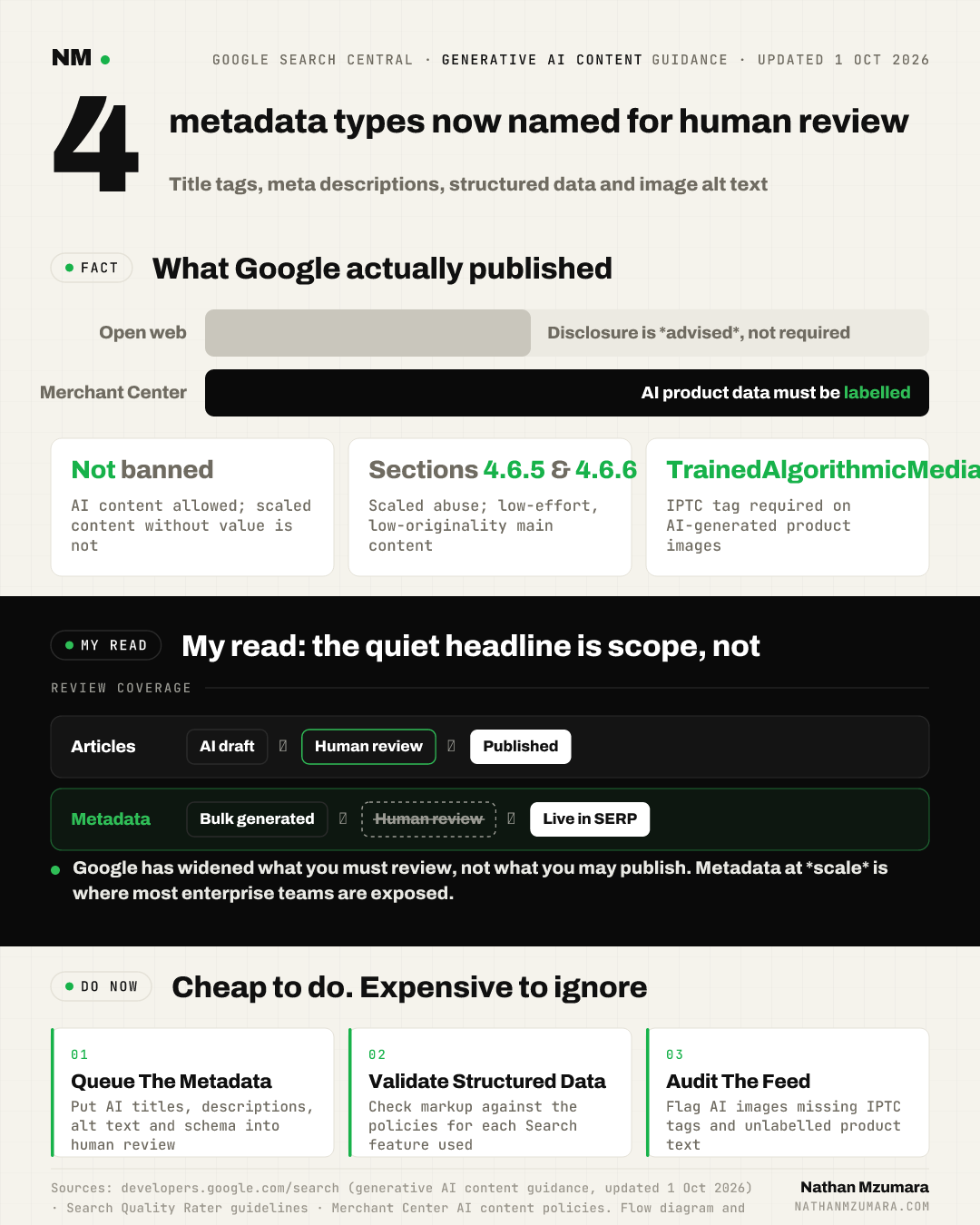
The part of the page that will catch the most organisations is the scope of review. Google states that review also applies to metadata that can appear in Search results. It names four things:
- Title elements: AI-written
<title>tags need the same human accuracy check as body copy. - Meta description elements: generated descriptions can surface in snippets, so inaccuracies show up in the SERP.
- Structured data: Google says to ensure compliance with the general guidelines and the specific policies for individual search features, and to validate the markup to stay eligible for Search features.
- Alternate text for images: alt text generated at scale is in scope alongside everything else.
Most content teams run human review on articles and leave metadata to automation. Google has just named metadata explicitly. Bulk-generated title tags and schema across thousands of URLs are the clearest example of volume without review in a typical enterprise site.
What ecommerce teams must label
Google points ecommerce sites to Google Merchant Center policies for AI-generated content, and these are the hardest requirements on the page.
- AI-generated images: must contain metadata using the IPTC
DigitalSourceTypevalueTrainedAlgorithmicMedia. - AI-generated product data: attributes such as title and description must be specified separately and labelled as AI-generated.
Note the direction of travel. Provenance metadata is becoming machine-readable rather than a line of copy, which is the same shift behind OpenAI's textGrain watermarking in EU ChatGPT text.
Disclosure is advised, not required
On the open web, Google uses softer language. It says sharing information about how a piece of content was created can help give readers more context, and that if you automatically generate content you should consider adding background on how automation was used, in a way that makes sense for your audience. It also suggests adding image metadata.
So the standard is split. Disclosure is a recommendation for web pages and a policy requirement inside Merchant Center.
Acting on Google guidance on generative AI content this week
- Export every AI-generated title tag, meta description, alt text string and structured data block, and put them into the same human review queue as your articles.
- Validate your structured data against Google's policies for the individual search features you rely on.
- Audit your product feed for AI-generated images missing the IPTC
TrainedAlgorithmicMediavalue, and for AI-generated titles and descriptions that are not labelled. - Read sections 4.6.5 and 4.6.6 of the Quality Rater guidelines with your content lead, then ask one question of your highest-volume template: what value does this add that a user could not get elsewhere?
- Decide your disclosure position and publish it, using Google's February 2023 blog post FAQs on AI-generated content as the reference point.
My read is that the quiet headline in Google guidance on generative AI content is scope, not permission. Google has not tightened what AI content is allowed. It has widened the surface area you are accountable for reviewing, and metadata at scale is where most teams are exposed.
