Google Surface
Google Search Central
Also known as: Search Central, Google Webmaster Central, Search Central documentation
Google Search Central is Google's official documentation and communication hub for site owners, SEOs and developers, published at developers.google.com/search. It hosts Google Search Essentials, spam policies, structured data reference documentation, crawling and indexing guidance, plus a blog, YouTube channel and community forum. It was previously known as Google Webmaster Central.
What it is
Search Central is the canonical source for how Google says its crawling, indexing, ranking and rich result systems work, and what it considers acceptable practice. It includes the technical reference for every supported structured data type, guidance on robots.txt, sitemaps, JavaScript rendering and site moves, and the spam policies that govern manual actions. Search Console help documentation and developer guidance for Google's crawlers and user agents sit alongside it.
Why it matters
Most SEO advice in circulation is second hand, and the primary documentation is where you settle disputes about what is actually required or merely rumoured. It is also where Google publishes changes to rich result eligibility, crawler behaviour and policy, which can materially affect what appears in results and in AI-generated answers. Citing the documentation in recommendations makes it far easier to get engineering and legal sign-off.
How it works
Teams use it as the reference when implementing structured data, validating markup against the eligibility requirements for each rich result type, planning migrations, or resolving indexing problems. Many follow the Search Central blog and release notes so that policy and feature changes are picked up early, and use the office hours recordings and forum for edge cases. In practice it works best as a checklist step in technical SEO tickets rather than something read end to end.
When it applies
Use it whenever a technical or policy question needs a definitive answer, before shipping structured data or crawl directives, and during audits, migrations and penalty diagnosis.
Examples
- A developer checks the Product structured data documentation to confirm which properties are required for merchant listing eligibility.
- An SEO lead links to the Search Essentials spam policies in a brief to stop a partner agency buying links.
- A technical team follows the site move documentation to plan redirects and Search Console change of address for a domain migration.
How it is measured
- Percentage of structured data implementations validated against the current documentation before release
- Rich result errors and warnings reported in Search Console after each deployment
- Time between a documented policy or feature change and the corresponding site update
- Number of technical recommendations supported by a primary documentation reference
Insights on Google Search Central
Related terms in Google Surface
- AI ModeGoogle's standalone AI-first search experience inside Search itself, a conversational, multi-step interface for complex queries. Different ranking and citation logic from classical SERP.
- AI OverviewsGoogle's generative answer shown at the top of the SERP for eligible queries. Sourced from the open web, cites multiple pages, and increasingly replaces the traditional snippet for informational intent. Successor to the SGE experiment.
- AndroidAndroid is Google's mobile operating system, used on phones, tablets, televisions and other devices from many manufacturers. For marketers it is a discovery surface as well as a platform, because it ships with Chrome, the Google app, Google Play and Google's assistant features. Being visible on Android means being findable through those entry points, not only through a browser.
- DiscoverGoogle's personalised feed in the Google app and on Android. Algorithmically curated, no query needed, driven by topical interest signals and freshness. Material traffic source for publishers.
- Google Business ProfileGoogle Business Profile is the free Google tool that lets a business manage how it appears in Google Search, Google Maps and local results. It holds core details such as name, address, phone number, opening hours, categories, photos, products, services and reviews. Formerly called Google My Business, it is the main control panel for a business's local presence on Google.
- Google Merchant CenterGoogle Merchant Center is the platform where retailers upload and manage product data for use across Google's shopping surfaces. It holds product feeds, business details, shipping and tax settings, and reports on how products are approved and performing. Merchant Center Next is Google's rebuilt version of the interface, designed to be simpler and more automated.
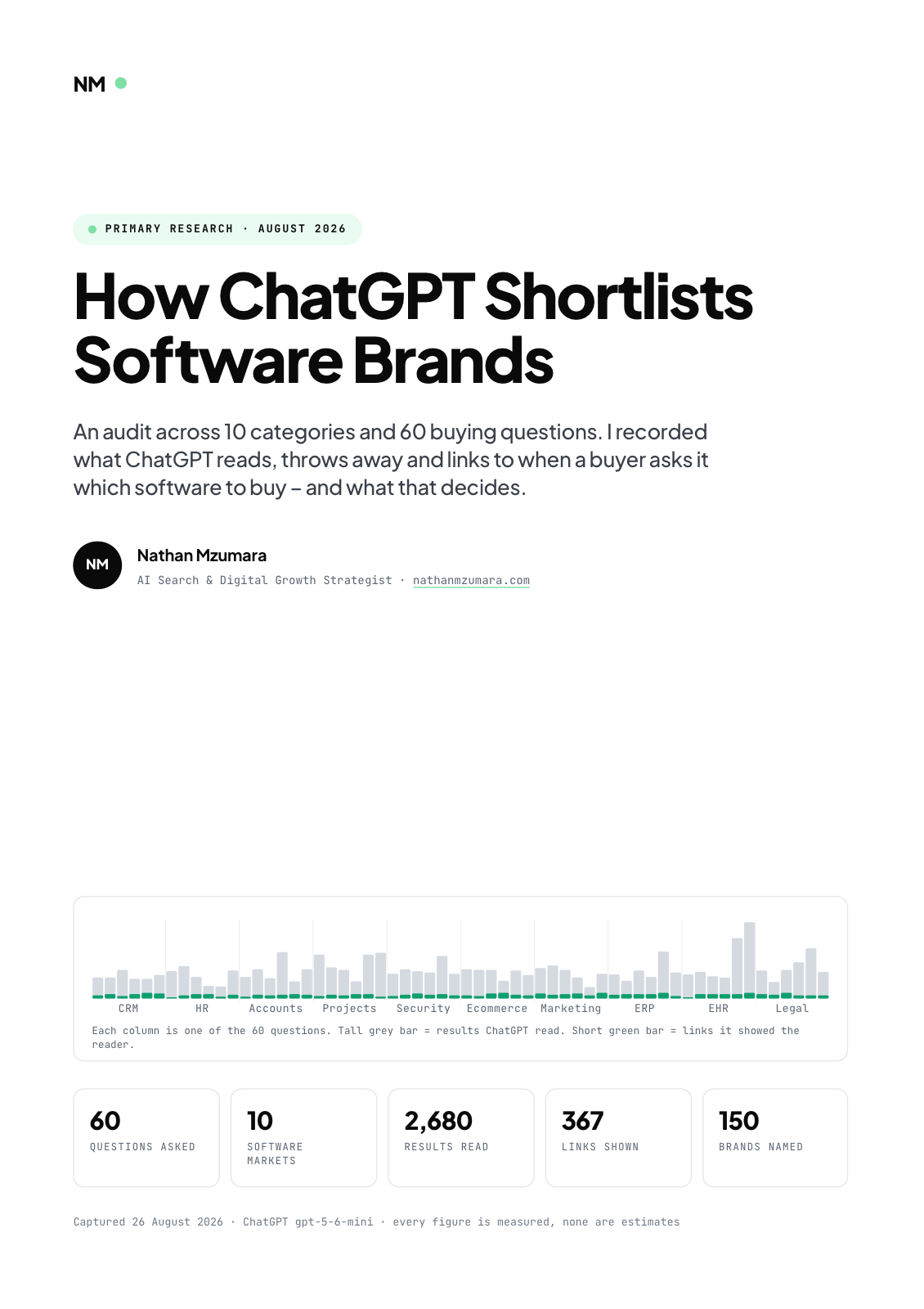
Primary research · August 2026
How ChatGPT Shortlists Software Brands
An audit across 10 categories and 60 buying questions. I recorded what ChatGPT reads, throws away and links to when a buyer asks it which software to buy, and what that decides.
- 60
- Questions asked
- 10
- Software markets
- 2,680
- Results read
- 367
- Links shown
Free download
Get the full report
35 pages · PDF · 536 KB. Enter your details and it downloads straight away.